Bob's Watches Bob's Watches
A GMT (Greenwich Mean Time) watch is a specialized timepiece designed to track two or more time zones at once. These luxury watches have become essential tools for global travelers and watch enthusiasts alike. Unlike a standard watch with three hands, a GMT watch features an additional “GMT hand” that rotates once every 24 hours, pointing to a dedicated 24-hour scale found on the bezel or the dial’s outer edge. This allows travelers, pilots, and business professionals to read their local time and a secondary reference time at a single glance.
Key Takeaways:
- Function: Displays multiple time zones using a 24-hour hand and a rotating bezel.
- Origin: Developed in the 1950s for Pan Am pilots to track UTC/GMT.
- Key Distinction: “True” (Traveler) GMTs allow the local hour hand to jump independently, while “Office” (Caller) GMTs allow independent adjustment of the 24-hour hand.
- Reading: The 12-hour hand shows local time; the 24-hour hand points to a second time zone on the bezel scale.
Originally built as a tool watch for aviation pioneers, the GMT complication has since become one of the most practical and desirable features in watchmaking. This guide breaks down how these watches work, the history behind their invention, and how to choose between the different types of pilot watches available today.
How Does a GMT Watch Work?
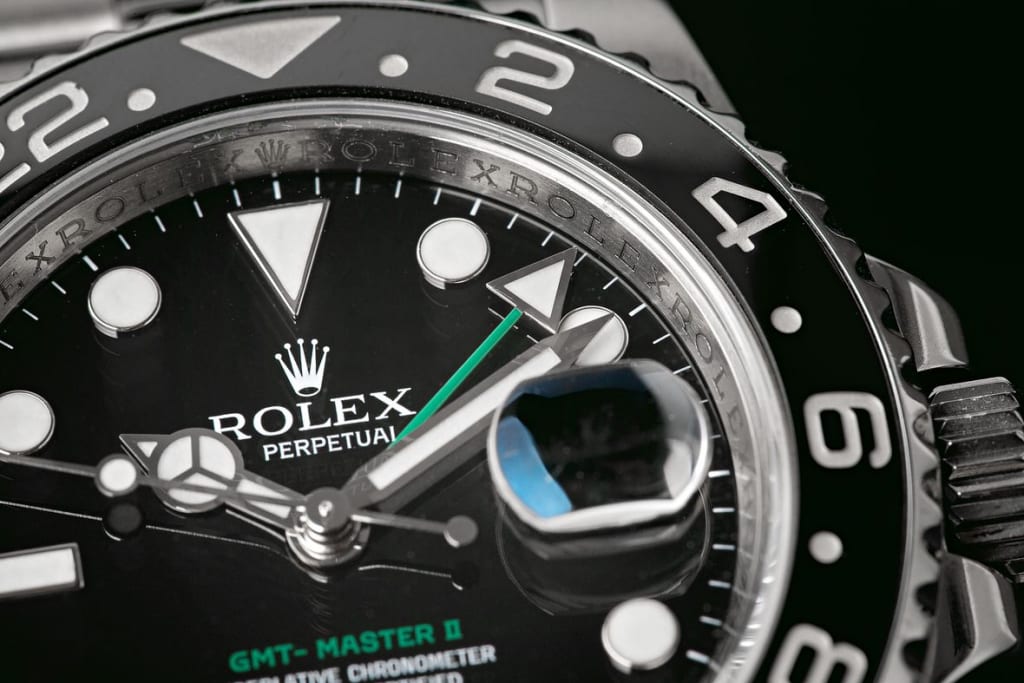
A standard watch tells time with three hands: hours, minutes, and seconds. A GMT watch adds a fourth hand, the GMT hand, which completes one full rotation every 24 hours instead of 12. This single-rotation design is what sets it apart. Because the hand only passes each number once per day, there is no ambiguity about whether a given hour is AM or PM in the second time zone.
The 24-hour bezel, typically numbered from 1 to 24, works alongside the GMT hand. By using the rotating bezel, the wearer can align a reference city or time zone to the GMT hand’s position. On most models, the bezel is color-coded, with darker shading on the nighttime hours (roughly 18 to 6) and lighter shading on the daytime hours, giving an immediate visual read on whether it is day or night in the tracked city.
| Feature | Standard Watch | GMT Watch |
| Number of Hands | 3 (Hour, Minute, Second) | 4 (Adds 24-Hour GMT Hand) |
| Time Format | 12-Hour Scale | Dual 12-Hour & 24-Hour Scales |
| Time Zones | 1 (Local) | 2 to 3 (Local, Home, +1 via Bezel) |
| Primary Use | Daily Timekeeping | Travel & International Business |
“True” GMT vs. “Office” GMT: What’s the Difference?
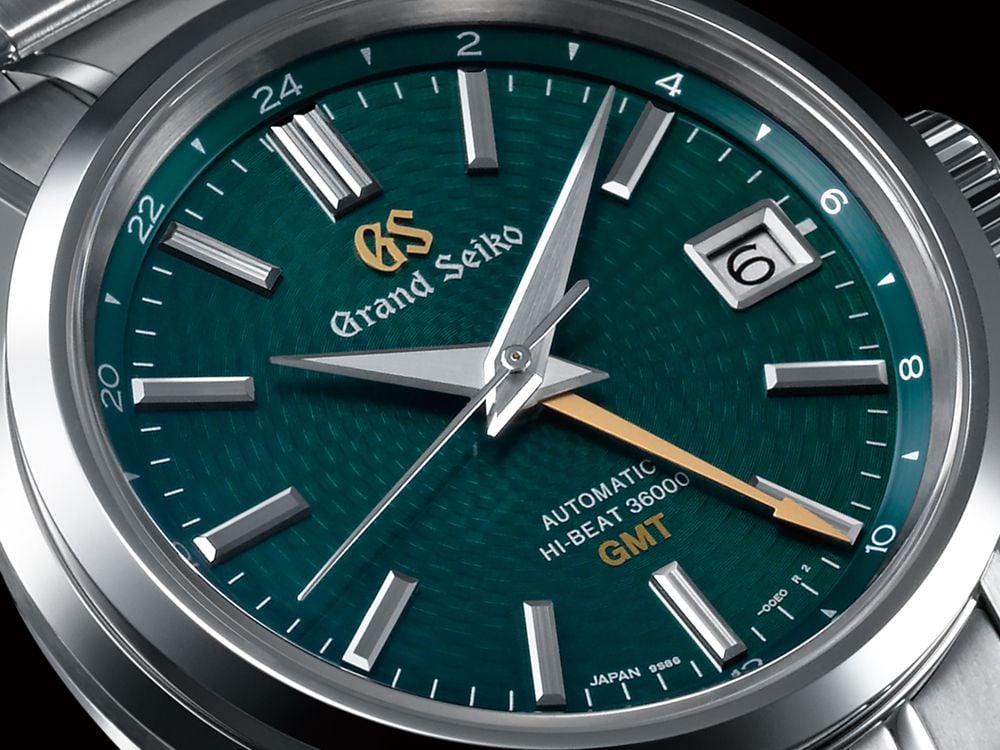
The terms “True GMT” and “Office GMT” are widely used among collectors to describe two different functional approaches to the same complication. Both display a second time zone, but the way each one handles time zone changes is fundamentally different. Understanding the distinction is the most important step in choosing the right GMT for your lifestyle.
The True GMT (Traveler GMT)
A True GMT, sometimes called a Traveler GMT, allows the local 12-hour hand to jump forward or backward in one-hour increments without stopping the seconds hand or disturbing the GMT hand. This is the defining feature that separates it from its counterpart.
How it works:
- The local hour hand moves in one-hour jumps via the crown.
- The GMT hand and minutes hand remain unaffected during adjustment.
- The seconds hand continues running, so the watch never loses time accuracy.
Best for: Frequent flyers and travelers who physically cross time zones and need to reset local time quickly and cleanly at each destination.
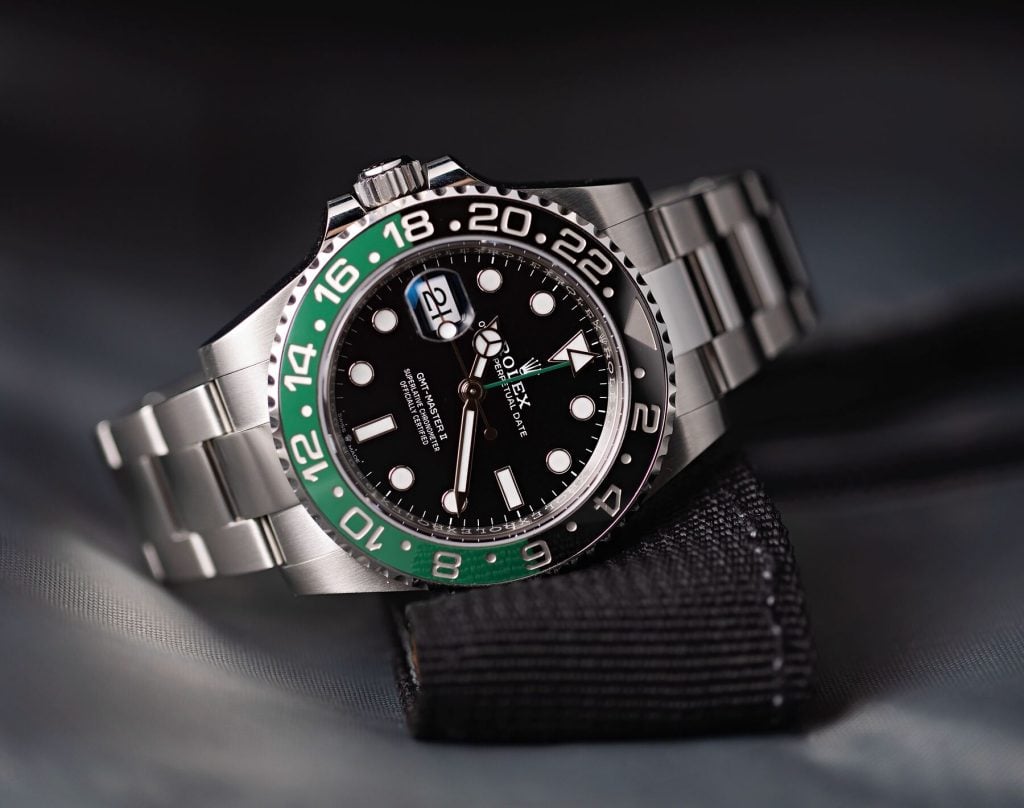
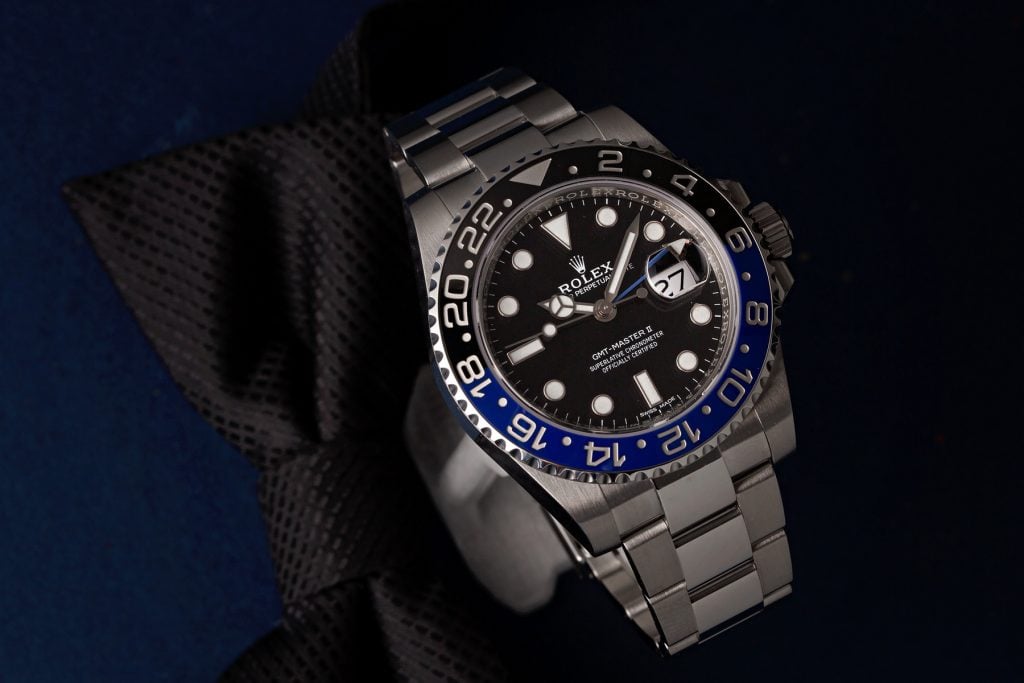
The Rolex GMT-Master II is the benchmark reference for this category. The current generation offers three distinct two-tone ceramic bezel configurations: the red and blue “Pepsi” (ref. 126710BLRO), the black and blue “Batman” (ref. 126710BLNR), and the black and green “Sprite” (ref. 126720VTNR). Each uses the same Caliber 3285 movement with the independently adjustable hour hand, but the bezel color gives collectors a way to personalize the watch without sacrificing function. All three are built on Oyster steel bracelets, and the “Sprite” is notable for being the first left-handed GMT-Master II, with the crown positioned at 9 o’clock.
Notable references: Rolex GMT-Master II (refs. 126710BLRO, 126710BLNR, 126720VTNR), Tudor Black Bay GMT.
The Office GMT (Caller GMT)
An Office GMT, sometimes called a Caller GMT, works differently. Instead of adjusting the local hour hand, the wearer adjusts the 24-hour GMT hand independently while local time stays fixed. The name “Caller” reflects its most common use case: calling clients or family members in a different city without ever leaving home.
How it works:
- The 24-hour hand is set independently to a home or reference time zone.
- The 12-hour hand remains untouched and always shows correct local time.
- Switching between time zone readings is done entirely through the GMT hand.
Best for: Professionals who work across multiple time zones from a fixed location and need a reliable reference point throughout the day.
The Rolex Explorer II (ref. 226570) is one of the most well-known examples in this category, even if it is not always marketed as a GMT first. Originally designed in 1971 for spelunkers and cave explorers who needed to distinguish AM from PM in environments with no natural light, it features a fixed 24-hour graduated bezel paired with a bold, independently adjustable orange GMT hand. The current generation is offered in black or white dial configurations, both on a 42mm Oyster steel case, and remains one of the more understated entry points into Rolex’s GMT lineup. Because the bezel is fixed rather than rotatable, the Explorer II reads a set second time zone without the option to track a third, which suits wearers who want simplicity over flexibility.
Notable references: Rolex Explorer II (ref. 226570), Rolex GMT-Master (pre-1983 references), Patek Philippe Aquanaut Travel Time.
How to Use a GMT Watch and Bezel
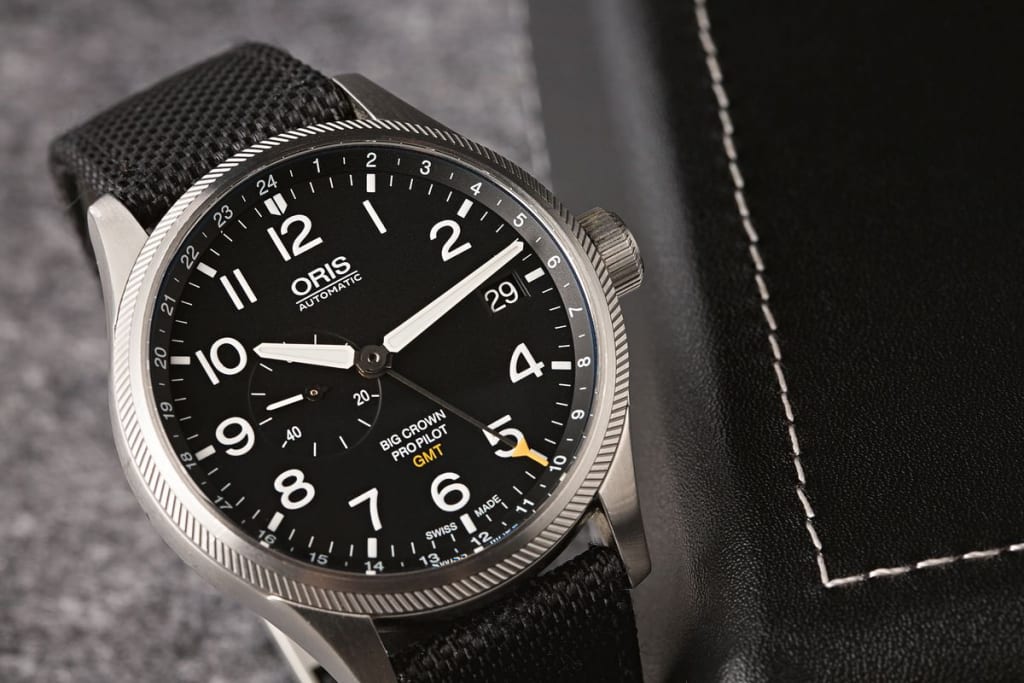
Reading a GMT watch correctly takes a little practice, but the setup process is straightforward once you understand the relationship between the three main components: the 12-hour hand, the 24-hour GMT hand, and the bezel.
Step-by-step setup:
- Set the reference time: Begin by setting the 24-hour GMT hand to your home time zone, or to UTC/GMT if you prefer a universal reference point. Align the bezel so that the 24-hour marker corresponding to your reference hour is lined up with the GMT hand.
- Set local time: Adjust the 12-hour hand to your current local time. On a True GMT, use the dedicated crown position that moves only the hour hand. On an Office GMT, this is set during standard time adjustment.
- Read the second time zone: Once both hands are set, a simple glance at where the GMT hand points on the bezel gives you the hour in your reference time zone. The day/night shading on the bezel tells you immediately whether it is daytime or nighttime there.
- Track a third time zone: Many GMT bezels are bidirectional and can be rotated manually. By rotating the bezel so that a different city’s UTC offset aligns with the GMT hand, you can read a third time zone without any additional adjustment to the watch.
The History and Origin of GMT Watches
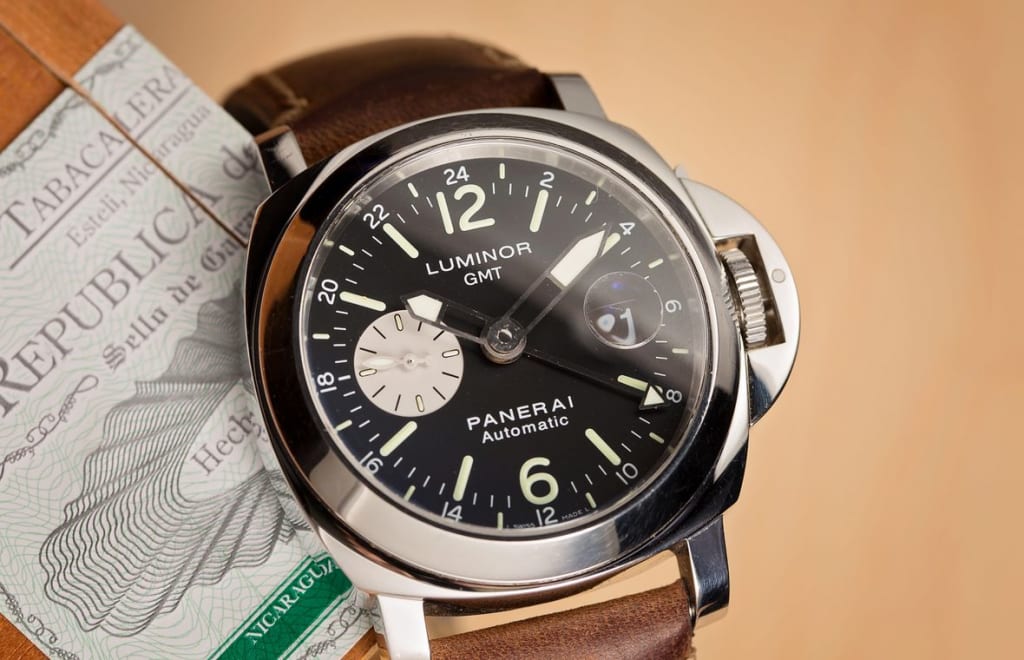
The GMT complication did not emerge from a watchmaker’s imagination alone. It was a direct response to a practical problem: the rapid expansion of long-haul commercial aviation in the early 1950s. As flights began crossing multiple time zones in a single journey, pilots needed a reliable way to track Universal Time (UTC), the global standard used in aviation, while also keeping tabs on their local time. That same demand for legible, tool-focused design laid the groundwork for the broader category of pilots watches, which share the GMT’s roots in aviation utility.
The story most closely associated with the GMT watch centers on the partnership between Pan American World Airways and Rolex in 1954. Pan Am pilots needed a watch that could display two time zones simultaneously. The result was the Rolex GMT-Master, Reference 6542, a watch that set the template for everything that followed.
Key milestones in GMT watch history:
- 1953: Glycine releases the Airman, widely recognized as the first purpose-built 24-hour watch designed for pilots.
- 1954: Rolex introduces the GMT-Master Reference 6542 in collaboration with Pan Am, featuring the now-iconic 24-hour bezel and red-tipped GMT hand.
- 1959: The “Pepsi” bezel, with its red and blue color scheme representing day and night, becomes one of the most recognizable designs in watchmaking history.
- 1983: Rolex launches the GMT-Master II, introducing the True GMT function with an independently adjustable local hour hand, a technical advancement that changed how travelers use the complication.
GMT vs. Worldtimer vs. Dual Time
The GMT is not the only watch complication built around tracking multiple time zones. Two other types appear frequently in collector discussions: the Worldtimer and the Dual Time. Each takes a different approach to the same problem, and understanding how they differ makes it easier to identify which format suits your needs.
A Worldtimer, such as the Omega Aqua Terra Worldtimer, displays all 24 standard time zones at once, typically through a rotating disc or ring around the dial printed with city names. The design is impressive from a technical standpoint, but it prioritizes breadth over simplicity. Reading a specific time zone requires scanning a detailed display, which can be slower in practice than glancing at a GMT hand.
A Dual Time watch uses a simpler approach: two separate hour hands, one for local time and one for a second time zone, both on a 12-hour scale. There is no 24-hour hand, which means AM/PM must be inferred from context or from a separate day/night indicator. GMT watches sit between these two formats, offering more flexibility than a Dual Time and more focused legibility than a Worldtimer, which is a large part of why the complication has remained so popular across decades.
Finding the Perfect GMT Reference for Your Collection
The GMT watch has remained a staple in serious collections not only because of what it can do, but because of what it represents. It is a watch built around the idea of movement, of being connected to multiple parts of the world at the same time. That combination of utility and meaning is rare in any category of luxury goods, and it explains why demand for quality GMT references has held strong for over 70 years.
Choosing the right GMT reference comes down to one honest question: are you a traveler or a caller? If you regularly cross time zones, a True GMT with an independent hour hand will serve you well. The Rolex GMT-Master II covers that need with one of the most proven and recognizable designs in the category, available in steel, two-tone, and precious metal configurations across several bezel color options. If you work with colleagues or clients in different cities without leaving your own, an Office GMT gives you everything you need without additional complexity. The Rolex Explorer II is a strong choice here, offering a clean, tool-watch aesthetic with the practical benefit of an independently adjustable 24-hour hand. Whether you are drawn to the bold bezel colors of the GMT-Master II or the restrained legibility of the Explorer II, the right reference is the one that fits how you actually live, and a well-chosen GMT will serve you well for years to come.
Future Trends in GMT Watches
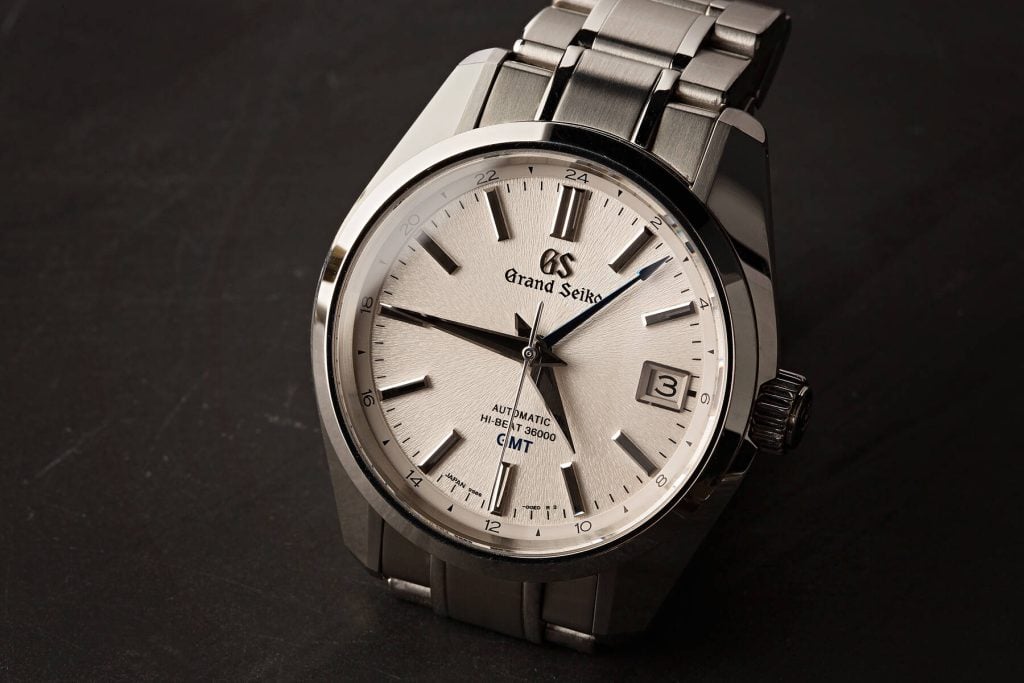
One of the most significant innovations in GMT watch technology is the development of more user-friendly and accurate movements. Manufacturers are focusing on creating mechanisms that allow for easier adjustment of multiple time zones without compromising precision. We’re seeing the emergence of movements that allow independent adjustment of the hour hand in one-hour increments, making it simpler for travelers to adapt to new time zones quickly. Additionally, the integration of high-tech materials like silicon in watch movements is improving magnetic resistance and overall reliability.
Looking ahead, we can expect to see GMT watches that blend traditional mechanical craftsmanship with modern technology. The concept of the “connected” GMT watch is gaining traction, where mechanical movements are complemented by smart features like automatic time zone detection and syncing. However, the core appeal of a beautifully crafted mechanical GMT watch is likely to endure, with brands focusing on refining the user experience and improving durability and accuracy.
Frequently Asked Questions
Final Thoughts
As we’ve explored the world of GMT watches, it’s clear that these timepieces are much more than tools for tracking multiple time zones. They represent a blend of functionality and luxury, embodying the spirit of global travel and international business. From their origins in the golden age of aviation to their current status as coveted luxury items, GMT watches have continually evolved to meet the needs of an increasingly connected world.
The post What is a GMT Watch? The Complete Collector’s Guide (2026) appeared first on Bob's Watches.