Bob's Watches Bob's Watches
The primary difference between the Rolex Submariner and the Explorer is purpose. The Submariner (Ref. 124060) is a 41mm dive watch built around a unidirectional rotating timing bezel and 300 meters of water resistance. The Explorer (Ref. 124270 / 224270) is a streamlined, time-only field watch offered in 36mm or 40mm, featuring a smooth polished bezel and 100 meters of water resistance. Both the Sub and the Rolex Explorer run on the same Caliber 3230 movement with a 70-hour power reserve, so the decision comes down to what you want on the outside of the watch, not what is ticking inside it. This guide breaks down every meaningful difference between these two Rolex icons, from design and sizing to bracelet comfort, market pricing, and long-term value retention.
Key Takeaways
- Size and comfort: The Explorer wears smaller and lighter in either 36mm or 40mm, making it a natural fit under a dress shirt cuff. The Submariner’s 41mm case with its ceramic bezel delivers more wrist presence and a sportier profile.
- Functionality: The Submariner’s rotating bezel lets you track elapsed time underwater or on the surface. The Explorer keeps things simple with hours, minutes, and seconds, nothing more.
- Style range: The Explorer transitions from trail to boardroom without drawing attention. The Submariner is one of the most recognized watches on the planet, and it looks the part.
- Price entry points: The Explorer 36mm starts at roughly $7,900 retail. The Submariner No-Date retails at $10,050. On the pre-owned market, the gap narrows, but the Submariner consistently commands a higher premium.
Few debates in the watch community run as deep as this one. Scroll through any collector forum or online community and you will find passionate arguments on both sides over which model truly deserves the title of the best everyday watch. The truth is, both watches earn that label for different reasons. What follows is a detailed, side-by-side look at every factor that should influence your decision.
Historical Pedigree: Deep Sea Diving vs. Mountaineering

Both the Submariner and the Explorer debuted in 1953, but their origin stories could not be more different. The Submariner was born from Rolex’s partnership with the underwater world. Early prototypes of this Rolex watch were tested by pioneering divers, and the watch quickly became the standard-issue tool for professional dive operations. The Rolex Explorer, on the other hand, came to life on the slopes of Mount Everest. Rolex had been supplying Oyster watches to Himalayan expeditions throughout the 1930s and 1940s, and when Sir Edmund Hillary and Tenzing Norgay reached the summit in 1953, the Explorer name was cemented in history.
Here is a brief look at the key milestones that shaped each model:
- 1953: Rolex introduces the Submariner Ref. 6204, the first wristwatch rated for 100 meters of water resistance, alongside the original Explorer references tied to the Everest conquest.
- 1959: The Explorer receives the Ref. 1016, a reference that would remain in production for nearly 30 years and become one of the most collected vintage Rolex models.
- 1969: The Submariner Ref. 1680 introduces the first date window to the lineup, splitting the collection into Date and No-Date variants.
- 2010: Rolex upsizes the Explorer to 39mm with Ref. 214270, breaking from decades of the traditional 36mm case.
- 2020: The Submariner grows to 41mm with Ref. 124060 (No-Date) and Ref. 126610 (Date), both powered by the new Caliber 3230.
- 2021: Rolex returns the Explorer to its classic 36mm diameter with Ref. 124270.
- 2023: A 40mm Explorer Ref. 224270 joins the collection, giving buyers a choice of two case sizes for the first time in Explorer history.
Design and Aesthetics: The Bezel and Dial Differences
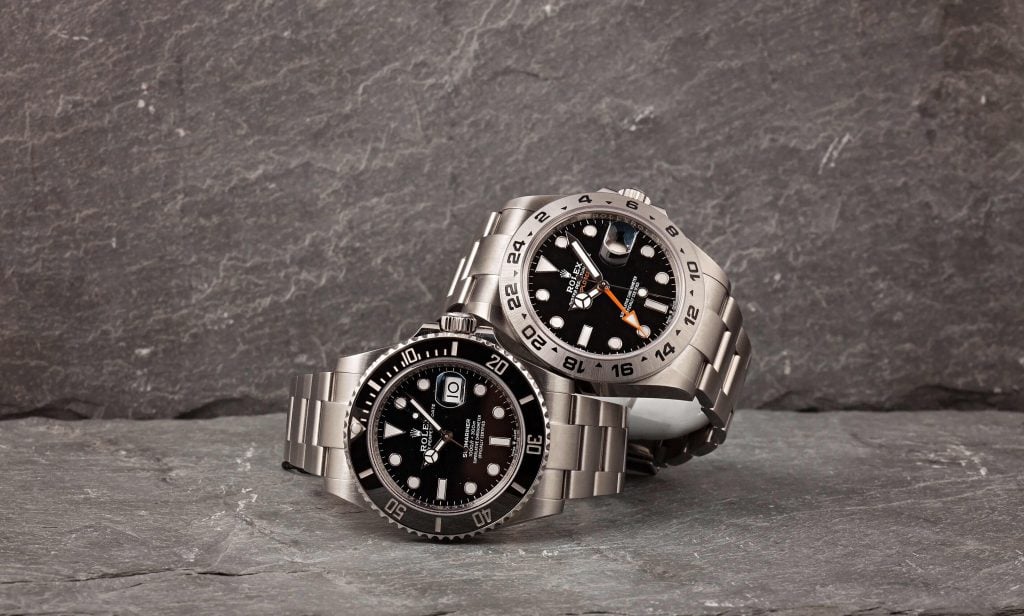
At a glance, the Submariner and the Explorer occupy two completely different design philosophies. One is a purpose-built Rolex tool watch designed to be read at depth, and the other is a minimalist field watch designed to be read in any condition on land. The differences start at the bezel and carry through to every element on the dial.
The Iconic Dive Bezel vs. the Smooth Bezel
The Submariner’s unidirectional rotating bezel is its most defining feature. Made from Rolex’s scratch-resistant Cerachrom ceramic, the 60-minute graduated insert allows a diver to track elapsed time by aligning the zero marker with the minute hand. The knurled edge is designed for grip, even when wearing gloves underwater, and the bezel only rotates counterclockwise as a safety measure. If it gets bumped during a dive, it can only shorten the remaining time, never extend it. The platinum-coated numerals and markings on the black ceramic insert are molded directly into the material, so they will not fade or wear away over time.
The Explorer takes the opposite approach with a smooth, polished domed bezel in Oystersteel. There are no markings, no graduation lines, and no rotating function. It simply frames the dial and catches the light. This is a deliberate design choice that keeps the Explorer looking clean and understated. Where the Submariner’s bezel adds width and visual weight to the watch, the Explorer’s smooth bezel lets the case appear slimmer and more refined. It is one of the biggest reasons the Explorer is often described as a “stealth” Rolex.
Dial Readability and the 3-6-9 Arabic Numerals
The Explorer’s dial is defined by its signature 3-6-9 Arabic numeral dial layout. These oversized numerals at the quarter hours, paired with baton indices and a triangular marker at 12 o’clock, were originally designed for fast, no-nonsense time reading in extreme conditions. The numerals are applied in 18k white gold and filled with Chromalight luminescent material, which emits a long-lasting blue glow. The result is a dial that feels both sporty and classic at the same time.
The Submariner’s dial uses a different vocabulary. Round dot markers sit at most hours, with rectangular batons at 6 and 9, and a triangular pip at 12. The shapes are larger and bolder than typical dress watch indices, designed for instant legibility in low-visibility underwater conditions. Both watches use the same Chromalight lume technology, but the Submariner’s markers tend to appear larger due to the bigger case diameter and the wider dial surface. If you prefer a dial that reads like a classic field instrument, the Explorer is your watch. If you want a dial built to cut through murky water and dim light, the Submariner has the edge.
Case Sizing and Wearability: 36mm vs. 40mm vs. 41mm

Case size is where many collectors make their final decision, and it is one of the most debated topics in online watch communities. The Explorer is currently offered in two sizes: the 36mm Rolex 124270 and the 40mm Ref. 224270. The 36mm model sits close to the wrist with a lug-to-lug measurement of about 44mm and a thickness of 11.5mm. The 40mm version stretches to roughly 48mm lug-to-lug while keeping the same 11.6mm height. Both sizes feel noticeably compact next to the Submariner.
The Rolex 124060 wears at 41mm with a case height around 12.5mm and a lug-to-lug span of approximately 47.5mm. The added bulk comes from the rotating bezel housing and the more substantial crown guards. On the wrist, the Submariner has real presence. It is not a watch that disappears under a shirt cuff, and that is part of its appeal. The Explorer, by contrast, is the definition of “under the radar.” The 36mm version in particular has become a favorite among collectors who want a Rolex that does not announce itself. For wrists between 6 and 7 inches, the 36mm Explorer often feels like the perfect balance. Larger wrists, or those who simply prefer more visual weight, tend to gravitate toward the Submariner or the 40mm Explorer.
Technical Specifications Comparison
Below is a side-by-side comparison of the current production models. The Explorer is available in two case sizes (36mm Ref. 124270 and 40mm Ref. 224270), while the Submariner no-date comes in a single 41mm configuration. All three watches share the same Caliber 3230 movement and 70-hour power reserve, so the differences are entirely external.
| Case Diameter | 41mm | 36mm or 40mm |
| Case Material | Oystersteel (904L) | Oystersteel (904L) |
| Bezel Type | Unidirectional rotating, Cerachrom ceramic | Smooth, polished Oystersteel |
| Water Resistance | 300m / 1,000ft | 100m / 330ft |
| Movement | Caliber 3230 | Caliber 3230 |
| Power Reserve | Approx. 70 hours | Approx. 70 hours |
| Clasp Type | Oysterlock with Glidelock (20mm micro-adjust) | Oysterlock with Easylink (5mm extension) |
| Lug Width | 21mm | 20mm (36mm) / 21mm (40mm) |
| Crown System | Triplock triple seal | Twinlock double seal |
| Retail Price (USD) | $10,050 | $7,900 (36mm) / $8,350 (40mm) |
Submariner No-Date vs. Explorer: The Purist’s Dilemma
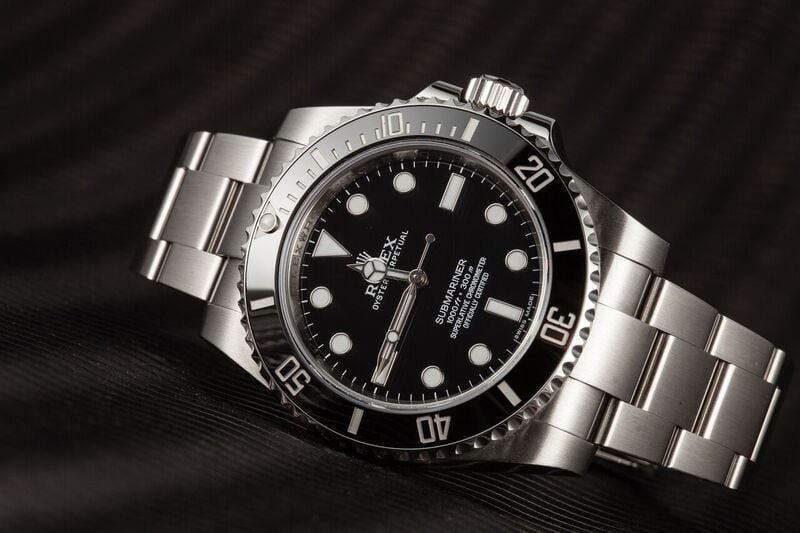

This is the comparison that generates the most heat in collector circles. The Submariner No-Date (Ref. 124060) and the Explorer (Ref. 124270 or Rolex 224270) are both time-only watches with no date window, no GMT hand, and no other complications. They share the exact same Caliber 3230 movement, meaning accuracy, power reserve, and reliability are identical. The choice between them is purely about what sits on top of that movement.
Here is how the two purist options stack up:
- Bezel utility: The Submariner gives you a functional timing bezel that can track anything from a parking meter to a dive stop. The Explorer offers no bezel function at all.
- Bracelet adjustability: The Submariner’s Glidelock clasp provides up to 20mm of on-the-fly adjustment without tools. The Explorer’s Easylink offers a single 5mm extension.
- Visual weight: The Submariner is thicker, heavier, and more visually commanding. The Explorer sits flatter and blends into daily wear.
- Water confidence: 300 meters vs. 100 meters. Both are more than enough for everyday use, but if you plan to actually dive, the Submariner is the clear choice.
- Dial personality: The Explorer’s 3-6-9 layout gives it a field-watch character. The Submariner’s round indices and inverted triangle at 12 give it a diver’s identity.
When you strip both watches down to their core, the decision is simple. Do you want a tool on your wrist, or do you want a watch that quietly does its job without any extras? That question will lead you to the right answer.
Bracelet and Clasp: Glidelock vs. Easylink
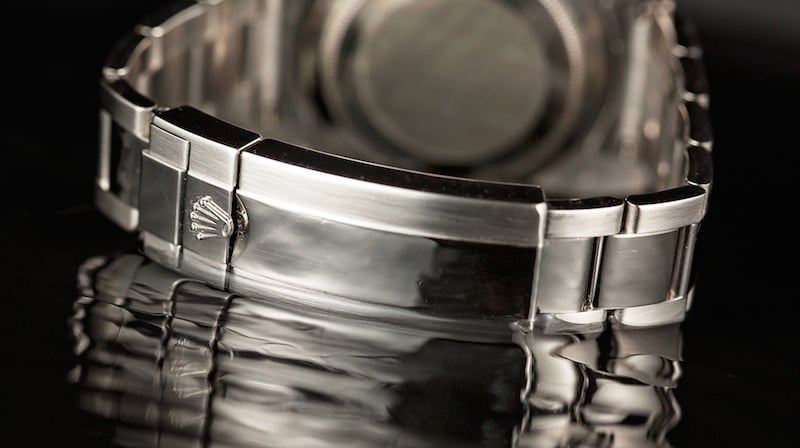
The Submariner’s Glidelock clasp is one of the most practical bracelet systems in watchmaking. A small lever inside the clasp allows the wearer to extend or shorten the bracelet by up to 20mm, in precise 2mm increments, without removing the watch or using any tools. This was originally designed for divers who need to wear the watch over a wetsuit, but it is just as useful in daily life. Wrists swell in the heat and shrink in the cold, and the Glidelock handles those changes effortlessly. For anyone who has ever struggled with a bracelet that feels too tight at noon and too loose in the evening, this system is a genuine upgrade.
The Explorer’s Easylink comfort extension takes a simpler approach. A small folding link hidden inside the clasp adds roughly 5mm of length with a single flip. It is a binary choice: extended or not extended. There is no fine-tuning between those two positions. For most people wearing the Explorer as a Go Anywhere, Do Anything (GADA) watch, this is perfectly adequate. The bracelet can be sized by a jeweler to fit your wrist properly, and the Easylink provides a small buffer for comfort. But if bracelet adjustability is high on your priority list, the Submariner wins this category decisively.
Value Retention and Market Availability

Both the Submariner and the Explorer are strong performers on the pre-owned luxury watch market, but they behave differently in terms of demand, pricing, and liquidity. The Submariner is one of the most traded watches in the world, and it consistently holds value above retail on the secondary market. The Explorer, while stable, tends to trade closer to or slightly below its retail price, making it a more accessible entry point into Rolex’s professional sports watch lineup.
Here are some current market trends based on recent sales data:
- The Submariner No-Date (Ref. 124060) trades at approximately $12,000 to $15,000 on the pre-owned market, representing a premium of roughly 20% above its $10,050 retail price.
- The Rolex Explorer 36 (Ref. 124270) trades around $7,000 to $8,500, often near or slightly below its $7,900 retail price.
- The Explorer 40mm (Ref. 224270) trades around $8,000 to $10,000, close to its retail price of approximately $8,350.
- The Submariner typically sells within 16 days on the secondary market, placing it in the top 4% of all watches for liquidity. The Explorer 36mm sells in about 14 days, also highly liquid.
- Both watches have shown steady price recovery through 2025 and into 2026 following the broader luxury watch market correction of 2022 and 2023.
From a pure investment standpoint, the Submariner has historically delivered stronger premiums and faster resale. But the Explorer’s lower retail price means a smaller outlay and less financial risk, which appeals to first-time Rolex buyers and collectors who prioritize wearing their watches over flipping them.
Final Verdict: Choosing Your Next Rolex Tool Watch
Choose the Submariner if you want unmistakable wrist presence, a functional timing bezel, and the confidence that comes with wearing one of the most recognized dive watches ever made. The Submariner is also the better pick if bracelet adjustability matters to you, if you spend any time near or in the water, or if long-term value retention is a key part of your buying decision. It is a bigger, bolder watch that does not try to hide, and that boldness is exactly why millions of collectors have chosen it over the past seven decades.
Choose the Explorer if you value an understated, versatile watch that transitions from a hiking trail to a boardroom without missing a beat. The Explorer is lighter, thinner, and more comfortable for all-day wear, and its clean design gives it a timeless quality that never feels overdressed or underdressed. Whether you are looking for your first luxury timepiece or adding to a growing collection, browsing the extensive, authenticated inventory at Bob’s Watches ensures you find the perfect fit. Explore our full selection of Rolex models to discover which of these legendary references belongs on your wrist.
The post Rolex Submariner vs. Explorer: Which Is the Ultimate GADA Watch? appeared first on Bob's Watches.