Bob's Watches Bob's Watches
IWC, short for the International Watch Company, was founded in 1868 in Schaffhausen, Switzerland, by an American watchmaker named Florentine Ariosto Jones. His idea was to pair the skilled handwork of Swiss watchmakers with the modern machinery used in American factories, then sell the finished watches back home in the United States. More than 150 years later, that company has grown into one of the most respected names in Swiss watchmaking, known for its pilot’s watches, its engineering, and its clever use of materials like titanium and ceramic. This article walks through the full story, from a struggling startup on the banks of the Rhine to a brand owned today by the luxury group Richemont.
Key Takeaways
- IWC was founded in 1868 by American watchmaker Florentine Ariosto Jones.
- The company is based in Schaffhausen, a town in the part of Switzerland where German is spoken, rather than in the traditional French speaking watch valleys.
- After Jones ran into money trouble, ownership passed to the Rauschenbach family in 1880, then to the Homberger heirs, and finally to Richemont in 2000.
- IWC is best known for its Pilot’s Watches, the Portugieser, and the Ingenieur.
- The brand was an early adopter of titanium and ceramic, and later created its own material called Ceratanium.
- Its motto, “Probus Scafusia,” means good, solid craftsmanship from Schaffhausen.
- In 2024, IWC won the top prize at the Grand Prix d’Horlogerie de Genève for the Portugieser Eternal Calendar.
The pages that follow the history of IWC watches in order, starting with how the company began and who owned it over the years, then moving through its famous watch families, its engineering firsts, and where the brand stands today. Whether you are researching your first IWC or simply enjoy the stories behind great watches, this is the complete picture.
The Founding of IWC: An American’s Swiss Vision (1868)

The story of IWC begins with an unusual plan. At a time when most ambitious young Americans were heading west to seek their fortunes, one watchmaker from Boston traveled the other direction, across the Atlantic to Switzerland, with a clear goal in mind.
That watchmaker was Florentine Ariosto Jones, and the company he started would survive bankruptcy, two world wars, and the near collapse of the Swiss watch industry. The sections below explain who Jones was, why he chose the town of Schaffhausen, and the motto that still guides the brand.
Who Founded IWC? Florentine Ariosto Jones

Florentine Ariosto Jones, born in 1841, was an engineer and watchmaker who had served as a deputy director at one of the leading American watch firms of the day. He believed he could combine two strengths that rarely met in one place. Switzerland had a deep pool of trained watchmakers willing to work for modest wages, while the United States had pioneered the use of machines to make parts quickly and consistently. Jones wanted to build movements in Switzerland using both, then export them to American buyers.
The plan met resistance almost right away. In the French speaking watchmaking regions of western Switzerland, most work was done by hand in people’s homes, and the idea of a single American owned factory was not welcome. Jones needed a different location, one with room to grow and the energy to power machinery. That search led him to the north of the country.
Why Schaffhausen? The Heinrich Moser Connection
Schaffhausen sits in the northeast of Switzerland, close to the famous Rhine Falls. In the middle of the 1800s, the town risked being left behind as industry modernized elsewhere. A local industrialist named Heinrich Moser had already built the town’s first hydroelectric plant on the Rhine, giving Schaffhausen a reliable source of power that few other places could match.
Moser saw promise in Jones’s plan and helped him get started, providing factory space and the water power his machines needed. Together they laid the foundation for what became the only major watch manufacturer in that corner of Switzerland. By 1875, a purpose built factory stood beside the river, ready to house hundreds of workers. The location remains central to the brand’s identity, and IWC still points to the quiet stretch of the Rhine outside its windows as part of who it is.
“Probus Scafusia”: The Motto That Defines IWC
Every great watch brand has a guiding idea, and IWC put its own into words early. The Latin phrase “Probus Scafusia,” established in 1903, translates roughly to good, solid craftsmanship from Schaffhausen. It captures the practical, engineering first spirit that runs through the brand’s watches, where function and durability come before decoration.
That focus on substance shows up in the records too. Since 1885, IWC has kept detailed notes on nearly every watch that has left its workshops, logging the movement, the materials, and the case. For watches that are at least ten years old, owners can still request information about their specific timepiece, a service that speaks to how seriously the brand takes its own paper trail.
Who Has Owned IWC? The Ownership Eras Explained

IWC has changed hands several times, and each owner left a mark on the company. The table below lays out the main eras at a glance, from the founder through to today.
| Era / Owner | Years | Key Figures | What Defined the Era |
| Founder era | 1868 to 1880 | Florentine A. Jones | Company founded, factory built, then financial failure |
| Rauschenbach family | 1880 to 1905 | Johann Rauschenbach and son | Bought for 280,000 francs, business stabilized |
| Homberger and Rauschenbach heirs | 1905 to 1978 | Ernst Jakob Homberger, Hans Ernst Homberger | Family run through both world wars, Pilot’s Watch and Portugieser born |
| VDO Adolf Schindling AG | 1978 to 1991 | Günter Blümlein | Survived the quartz crisis, original company name reclaimed |
| LMH Group | 1991 to 2000 | Günter Blümlein | Grouped with Jaeger LeCoultre and A. Lange & Söhne |
| Richemont | 2000 to present | — | Acquired for 2.8 billion Swiss francs, global growth |
One detail from the family years stands out. After the death of Johannes Rauschenbach-Schenk in 1905, his daughters and their husbands took over the business. One of those husbands was Carl Gustav Jung, the famous psychiatrist, who married into the Rauschenbach family and briefly shared in the ownership of the watch company. Control later passed fully to Ernst Jakob Homberger, who steered IWC through the difficult decades around the two world wars, and then to his son Hans Ernst Homberger, the last private owner before the company joined larger groups.
IWC History Timeline: Key Milestones (1868 to Today)

For readers who want the story in fast, scannable form, the timeline below highlights the moments that shaped IWC. Each entry pairs a year with a single milestone, covering ownership changes, landmark watches, and material firsts.
| Year | Milestone |
| 1868 | Florentine A. Jones founds the International Watch Company in Schaffhausen |
| 1875 | A new factory on the Rhine is completed |
| 1880 | The Rauschenbach family takes over after bankruptcy |
| 1885 | First Pallweber jump hour pocket watches, and detailed records begin |
| 1903 | The “Probus Scafusia” motto is established |
| 1915 | First movements designed specifically for wristwatches |
| 1936 | First Special Pilot’s Watch, the start of the aviation line |
| 1939 | First Portugieser, built with a pocket watch movement |
| 1940 | Big Pilot’s Watch 52 T.S.C. with a central seconds hand |
| 1948 | The Mark 11 sets a new standard for pilot’s watches |
| 1950 | The Pellaton automatic winding system is introduced |
| 1955 | First Ingenieur, with strong protection against magnetism |
| 1967 | First Aquatimer dive watch, water resistant to 20 bar |
| 1969 | The Da Vinci debuts with the Beta 21 quartz movement |
| 1976 | Gérald Genta redesigns the Ingenieur as a luxury sports watch |
| 1980 | First titanium cases and bracelets |
| 1985 | Kurt Klaus’s perpetual calendar appears in the Da Vinci |
| 1990 | A Grande Complication wristwatch combines several functions in one |
| 2000 | Richemont acquires IWC, and the Calibre 5000 arrives |
| 2018 | The 150th anniversary, marked by the Tribute to Pallweber edition |
| 2019 | IWC introduces its own material, Ceratanium |
| 2024 | The Portugieser Eternal Calendar wins the top GPHG award |
The Icons: IWC’s Signature Collections and Their Origins
Much of IWC’s reputation rests on a handful of watch families that have stayed in the catalog for decades. Each one started with a clear purpose, and most can still be traced back to a specific year and idea. The table below gives a quick overview before we look closer at the three that matter most.
| Collection | Introduced | Known For |
| Pilot’s Watches | 1936 | Aviation heritage, clear dials, protection against magnetism |
| Portugieser | 1939 | Large case, precise movement, refined complications |
| Ingenieur | 1955 | Engineering focus, then a 1976 luxury sports redesign |
| Aquatimer | 1967 | Professional dive watches and rotating bezel designs |
| Da Vinci | 1969 | Early quartz, then the perpetual calendar |
| Portofino | 1984 | Understated, classic dress watches |
The Pilot’s Watch: IWC’s Aviation Legacy
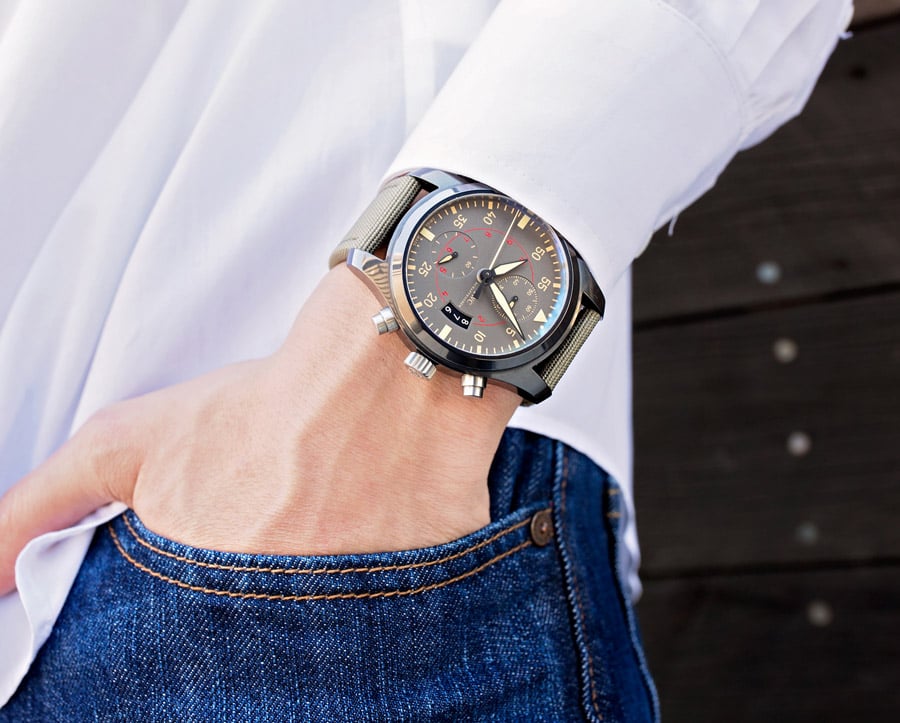
The Pilot’s Watch is the collection most people picture when they think of IWC. It began in 1936 with the first Special Pilot’s Watch, which carried a rotating bezel for tracking takeoff times and an escapement built to resist magnetic fields. Four years later, the Big Pilot’s Watch arrived as a large, highly legible instrument made for military aviators.
The line reached a high point in 1948 with the Mark 11, a watch produced as a precision tool with strong protection against magnetism. It became a benchmark for pilot’s watches and is still studied by collectors today. Across all of these models, the goal stayed the same, which was a watch a pilot could read at a glance and trust under pressure.
The Portugieser: A Pocket Watch on the Wrist
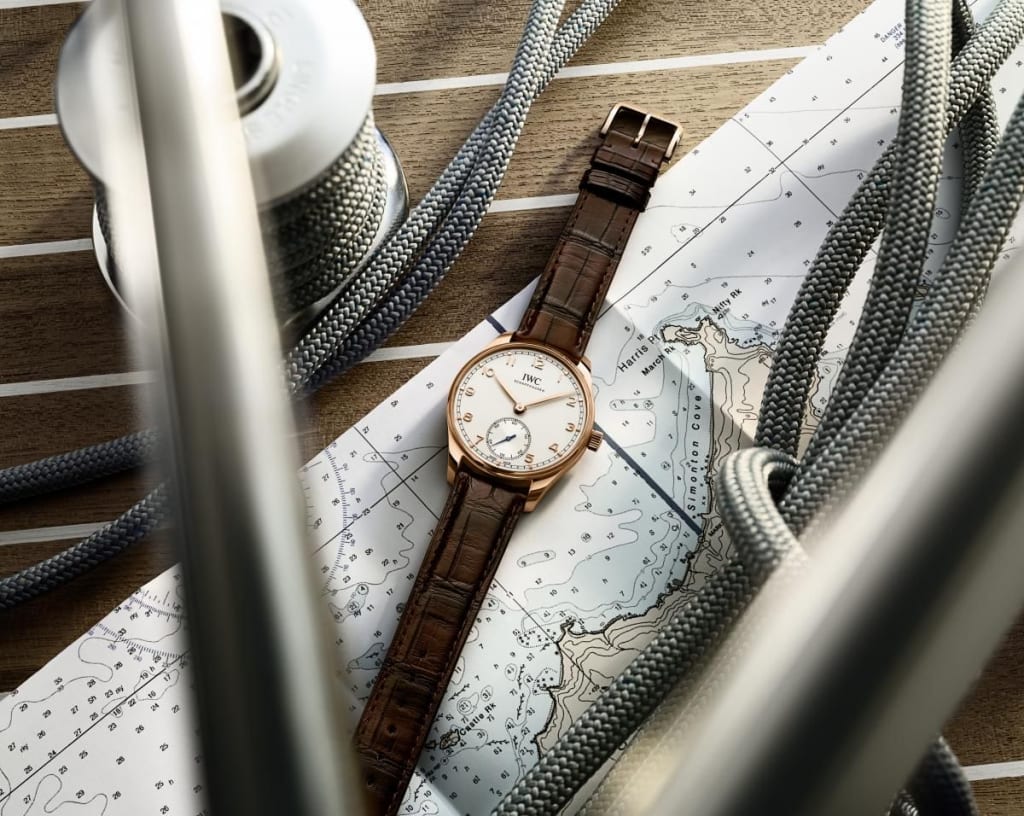
The Portugieser came from a specific request. In the late 1930s, two watch importers from Portugal asked IWC for wristwatches that offered the accuracy of a marine chronometer. To meet that standard, IWC fitted a precise pocket watch movement into a wristwatch case, which made the resulting watch unusually large for its time.
That bold size and clean dial gave the Portugieser a look that has aged well, and the family has since become a home for some of the brand’s finest complications. The modern peak arrived in 2024 with the Portugieser Eternal Calendar, a watch that pushed the collection’s reputation for precision to a new level.
The Ingenieur: Engineering Meets Gérald Genta
The Ingenieur started in 1955 as a watch for people who worked around machinery and magnetic fields, with an inner case designed to shield the movement. For its first two decades it stayed fairly technical and understated, valued more for what it did than for how it looked.
That changed in 1976, when the designer Gérald Genta gave the Ingenieur a completely new shape, with an integrated bracelet and a bezel held by visible screws. The redesign, known by its reference 1832, turned a practical tool into a luxury sports watch and helped define a whole category. Genta’s version still influences how the Ingenieur looks today.
Engineering and Innovation: IWC’s Material and Movement Firsts

If one thread ties IWC’s history together, it is a willingness to solve problems through engineering and new materials. The brand has often been among the first to try a technique that later spread across the industry. The list below covers the firsts and signatures that collectors point to most.
- Pellaton winding system (1950): An efficient automatic winding mechanism, developed under technical director Albert Pellaton, that uses small pawls to wind the watch in both directions. It remains a hallmark of IWC movements.
- Soft iron inner case: A protective inner case, also tied to Pellaton, that shields the movement from magnetic fields, building on the brand’s pilot’s watch know how.
- Titanium (1980): IWC was one of the first watchmakers to use titanium for cases and bracelets, prized for being light and tough.
- Ceramic: An early and ongoing user of ceramic for cases, a material that resists scratches far better than steel.
- Ceratanium (2019): A material developed by IWC that blends the lightness of titanium with the hardness of ceramic, finished in a deep matte black.
- Manufacture movements: Movement families such as the 52000 and 89000 series, made in IWC’s own workshops, including long power reserves and a constant force tourbillon.
- Record precision (2024): The Portugieser Eternal Calendar carries a moon phase display so accurate it will only drift by a single day after roughly 45 million years.
Taken together, these advances explain why IWC is often described as an engineering led brand rather than a purely decorative one. A “manufacture,” in watch terms, is a company that builds its own movements rather than buying them from outside suppliers, and IWC has steadily expanded its ability to do exactly that. The result is a catalog where the way a watch is built matters as much as how it looks.
The People Who Shaped IWC

No brand survives more than 150 years on its own. IWC’s history is really the history of the people who guided it, designed for it, and engineered its movements. The table below introduces five figures whose work still shows up in the watches IWC sells today.
| Person | Role | Contribution |
| Florentine A. Jones | Founder, 1868 | Started the company and set its industrial vision |
| Albert Pellaton | Technical director | Created the Calibre 89, the soft iron case, and the Pellaton winding system |
| Kurt Klaus | Master watchmaker | Designed a user friendly perpetual calendar for the 1985 Da Vinci |
| Gérald Genta | Designer | Reshaped the Ingenieur in 1976 |
| Günter Blümlein | Director and industry leader | Guided IWC through the quartz crisis and formed the LMH Group |
Of these, Günter Blümlein deserves special mention for steering the company during one of its hardest stretches. In the 1970s and 1980s, cheap quartz watches nearly wiped out traditional Swiss watchmaking. Rather than chase that trend, IWC chose to focus on complicated mechanical watches and fine craftsmanship, a decision that helped the brand survive and later thrive. Blümlein’s leadership, along with the technical work of people like Pellaton and Klaus, kept IWC pointed toward quality when the easier path led elsewhere.
IWC in the Modern Era: Richemont, Awards, and Sustainability
IWC’s recent history opens in 2000, when the luxury group Richemont purchased the company. Under Richemont, IWC has expanded its reach around the world while continuing to develop its own movements and refine its core collections. In 2018, the brand opened a modern production center in Schaffhausen that brought many of its manufacturing steps under one roof.
The years since have brought steady recognition, both for the watches and for how the company runs. A few highlights stand out:
- 2018: An environmental review of major Swiss watchmakers ranked IWC first among fifteen brands, the only one to earn its top “Ambitious” rating.
- 2024: The Portugieser Eternal Calendar won the Aiguille d’Or, the highest honor at the Grand Prix d’Horlogerie de Genève, recognizing it as the best watch of the year.
- 2024: The same watch set a world record for the most precise moon phase display ever fitted to a wristwatch.
These honors reflect a brand that still sees its story as unfinished. IWC has described its own history as a story that is still being written, and its recent work suggests the company means it. For collectors, that combination of heritage and forward motion is a big part of the appeal.
What Makes IWC Special, and How It Compares

Buyers researching IWC often want to know how it stacks up against other big Swiss names. The honest answer is that the brands serve different priorities, and “better” depends on what you value most. The comparison below is meant as a quick guide to positioning, not a ranking.
| Brand | Positioning Next to IWC |
| IWC | Engineering led, strong in pilot and dress watches, known for material innovation |
| Omega | Larger scale, deep sport and space heritage, often more accessible pricing |
| Rolex | Higher name recognition and resale value, focused on tool watches |
| Breitling | Aviation and chronograph focus, generally positioned just below IWC in prestige |
Many collectors and watch experts see IWC as a brand that rewards a closer look. It may not carry the instant name recognition of some rivals, but its movements, materials, and design history give it real depth. Whether IWC is the right choice comes down to personal taste, since some buyers care most about resale value while others care about engineering, design, or simply how a watch feels on the wrist. For shoppers weighing a pre-owned IWC, that depth often translates into strong value for the money.
The Enduring Legacy of IWC Schaffhausen

The legacy of IWC Schaffhausen is a story of turning a difficult start into lasting success. What began in 1868 as one American’s risky plan, and nearly ended in bankruptcy within a decade, grew into a manufacture respected for its pilot’s watches, its complications, and its early use of materials that later became industry standards. Through changing owners and a near fatal industry crisis, the brand held on to the practical, engineering first spirit captured in its motto, “Probus Scafusia.”
That legacy is not finished. IWC still describes its history as a story being written, and recent achievements like the Portugieser Eternal Calendar, with its record setting accuracy, show a brand that keeps testing the limits of what a watch can do. For collectors, that mix of heritage and ambition is exactly what makes an IWC worth owning, and it is why the next chapter of the brand’s story is one worth watching.
Frequently Asked Questions
The post IWC History: The Complete Story of IWC Schaffhausen appeared first on Bob's Watches.