Bob's Watches Bob's Watches
Grand Seiko has earned its place at the top of the luxury watch conversation. The brand’s guiding philosophy, often called “The Nature of Time,” shapes every piece in the collection, from the texture of the dial to the precision of the movement inside. If you are looking for a clear-eyed overview of the best models available right now, the names you will hear most are the SBGA211 “Snowflake,” the SBGA413 “Shunbun,” the SLGH005 “White Birch,” and the newer UFA (Ultrafine Accuracy) series. Each one represents a different side of what Grand Seiko does well.
Before diving into the models themselves, here are the key things to know about the brand:
- The “Big Three” movements: 9S (Mechanical), 9R (Spring Drive), and 9F (Quartz)
- Signature design language: the “Grammar of Design” and Zaratsu polishing
- Top iconic pick: SBGA211 “Snowflake”
- The 2026 benchmark: the UFA series powered by the 9RB2 caliber
Grand Seiko started in 1960 as Seiko’s answer to the finest Swiss watches of the era. For decades it operated as a sub-brand, quietly building a reputation for exceptional finishing and movement accuracy. In 2017, it became its own independent brand, and since then it has attracted a much wider audience of serious collectors worldwide. If you’ve already read our Grand Seiko buying guide, the sections below take a closer look at the best models, the technology behind them, and why Grand Seiko deserves your attention in 2026.
The Modern Icons: Must-Own Grand Seiko Models
Grand Seiko’s lineup covers a range of aesthetics and movement types, but a handful of references stand out above the rest. The table below gives you a quick spec comparison, and the sections that follow go deeper on each one.
| Reference | Movement | Case Material | Power Reserve |
| SBGA211 “Snowflake” | 9R65 Spring Drive | High-Intensity Titanium | 72 hours |
| SBGH271 “Rikka” | 9S85 Hi-Beat 36000 | Stainless Steel | 55 hours |
| SBGA413 “Shunbun” | 9R65 Spring Drive | Stainless Steel | 72 hours |
| SLGH005 “White Birch” | 9SA5 Hi-Beat 36000 | Stainless Steel | 80 hours |
| SBGJ201 “Mt. Iwate” | 9S86 Hi-Beat 36000 GMT | Stainless Steel | 55 hours |
| SBGN019 “Sport GMT” | 9F86 Quartz GMT | Stainless Steel | N/A (Quartz) |
SBGA211 “Snowflake” (Spring Drive)

The Snowflake is, for many collectors, the watch that introduced them to Grand Seiko. Its dial is modeled after the deep snowfields around the Shinshu region of Japan in winter, with a texture that catches light differently depending on the angle. The case is made from High-Intensity Titanium, a material that is about twice as hard as conventional titanium, keeping the watch lighter on the wrist while making it more resistant to scratches.
Inside sits the 9R65 Spring Drive caliber, one of Grand Seiko’s most celebrated movements. The Grand Seiko Spring Drive is a hybrid: it uses a mechanical mainspring for power but regulates its timekeeping with a glide wheel and an electromagnetic brake, giving it accuracy closer to a quartz watch, typically within one second per day. We have an in-depth guide called the Grand Seiko Spring Drive explained for more details. The result is that smooth, gliding seconds hand that Spring Drive fans talk about constantly. The Snowflake is not a limited edition, but its secondary market demand remains consistently high.
SBGH271 “Rikka” (Hi-Beat)

The “Rikka” takes its name from the first day of summer in the traditional Japanese calendar, and the dial reflects that theme with warm, layered tones. The case uses Grand Seiko’s angular design language to create sharp contrasts between brushed and polished surfaces, a look that becomes more impressive when you see it in person. At 40mm, it sits comfortably on a wide range of wrist sizes.
The movement is the caliber 9S85, a mechanical Hi-Beat caliber that beats at 36,000 vibrations per hour (vph) rather than the more common 28,800 vph. The higher frequency gives the seconds hand a smoother sweep and improves resistance to positional errors, which helps the watch hold its accuracy through the day. Grand Seiko rates the 9S85 to within plus or minus two seconds per day, and real-world results from owners and enthusiast communities typically bear that out.
SBGA413 “Shunbun” (Cherry Blossom)
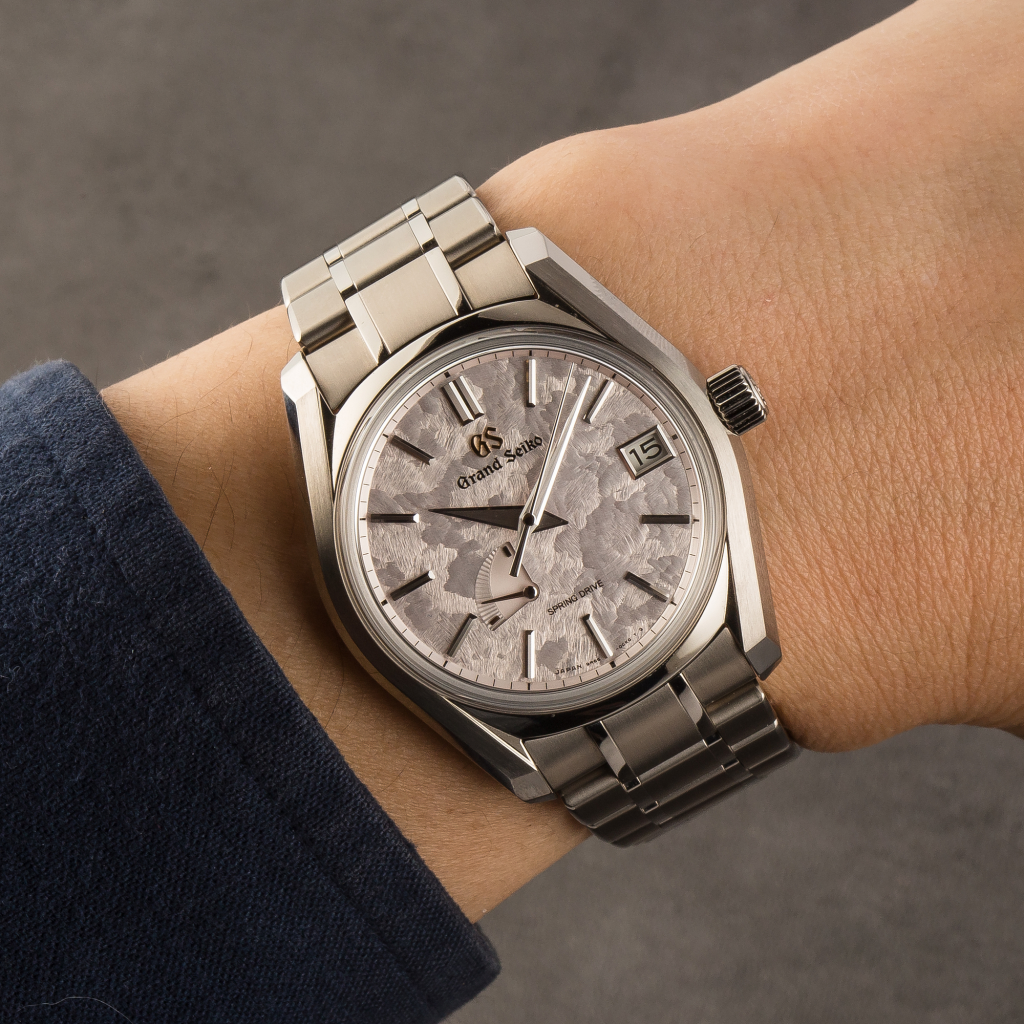
The “Shunbun” is named after the spring equinox, and is part of the Grand Seiko Heritage collection. Its pale pink dial does a convincing job of capturing the soft, fleeting look of cherry blossoms. What sets this reference apart visually is the 62GS case, a design that goes back to a 1967 Grand Seiko reference. The 62GS shape is rounder and more compact than the angular cases Grand Seiko often uses, with no bezel to interrupt the connection between the dial and the crystal. The effect is a watch that feels lighter and more refined.
Underneath the dial is the same 9R65 Spring Drive found in the Snowflake, which means the accuracy story is consistent: around one second per day in typical conditions. The Shunbun has become one of Grand Seiko’s strongest sellers in international markets, and its reputation for dial quality has made it a reference point among collectors who follow Japanese watchmaking closely. It is the kind of watch that photographs well but looks even better in person.
SLGH005 “White Birch” (Evolution 9)

The White Birch was the first watch to showcase Grand Seiko’s Evolution 9 design code and its new 9SA5 movement. The dial is inspired by the white birch forests of the Shinshu highlands, and the contrast between the textured center and the clean edges of the case creates a strong visual identity. The case itself is larger at 40mm and sits a bit flatter on the wrist than earlier Grand Seiko designs, which gives it a contemporary feel without abandoning the brand’s core aesthetic.
The 9SA5 is notable for two reasons. First, it uses a Dual Impulse Escapement, a proprietary design that alternately drives the balance wheel from both sides, reducing energy loss and improving efficiency. Second, it delivers an 80-hour power reserve while maintaining the Hi-Beat 36,000 vph frequency. Grand Seiko rates it to within plus or minus three seconds per day, though its construction suggests the long-term reliability should be excellent. The White Birch helped reposition Grand Seiko as a genuine innovator, not just a finishing specialist.
SBGN019 “Sport GMT” (9F Quartz)

The SBGN019 is the most overtly functional watch in this guide, and the only one here built around Grand Seiko’s 9F quartz technology. Part of the Sport Collection (added to the lineup in 2021), it pairs a 40mm stainless steel case with a black ceramic 24-hour bezel, trading the dress-watch restraint of the Snowflake and Shunbun for something more rugged and travel-ready. The Zaratsu polishing is still here, with the same distortion-free shine on the case flanks, but it is applied to a tool-watch silhouette rather than a formal one.
Inside is the 9F86, a Twin Pulse Quartz GMT caliber. The twin-pulse drive delivers the high torque needed to move wide, heavy hands with precision, and the GMT complication adds an independent 24-hour hand plus a Quickset date, letting you jump the local hour without stopping the seconds. Accuracy is rated to about plus or minus 10 seconds per year, in line with Grand Seiko’s other 9F references and far tighter than any mechanical movement in the lineup. A bright orange GMT hand, echoed on the dial ring, keeps the second time zone readable at a glance, while Lumibrite on the hands and markers handles low light, and the black dial keeps the focus on legibility. It is the watch to reach for if you want Grand Seiko Sport watch in something you can travel with and largely forget about: quartz precision, a GMT function, and minimal servicing. Pre-owned examples currently trade around $3,995.
SBGJ201 “Mt. Iwate” (Hi-Beat GMT)

The SBGJ201 is the traveler’s watch of this group, and it makes its case mechanically rather than with quartz. Part of the Heritage Collection, it is built around the classic 44GS case in 40mm stainless steel, with the sharp planes and Zaratsu-polished surfaces that define Grand Seiko’s most recognizable case shape. The dial is the draw here: a textured white “Mt. Iwate” pattern, named after the mountain visible from the Shizukuishi studio, that gives the surface real depth and a shifting light play that flat dials cannot match. It is a more formal, understated look than the black sport dial of the SBGN019, but with a complication underneath.
That complication comes from the 9S86, a mechanical Hi-Beat caliber running at 36,000 vph with a true GMT function and a 55-hour power reserve. The added 24-hour hand lets you track a second time zone, and because the local hour can be set independently, it adjusts cleanly across zones without disturbing the running of the watch. Visible through the exhibition caseback, the 9S86 carries the same standard of hand-finishing as the rest of the lineup. For a buyer who wants Hi-Beat mechanical craftsmanship, a GMT for travel, and one of Grand Seiko’s most admired textured dials in a single package, the SBGJ201 is a strong argument. Pre-owned examples currently trade around $4,995.
The New Frontier: Ultrafine Accuracy and the 9RB2 Caliber
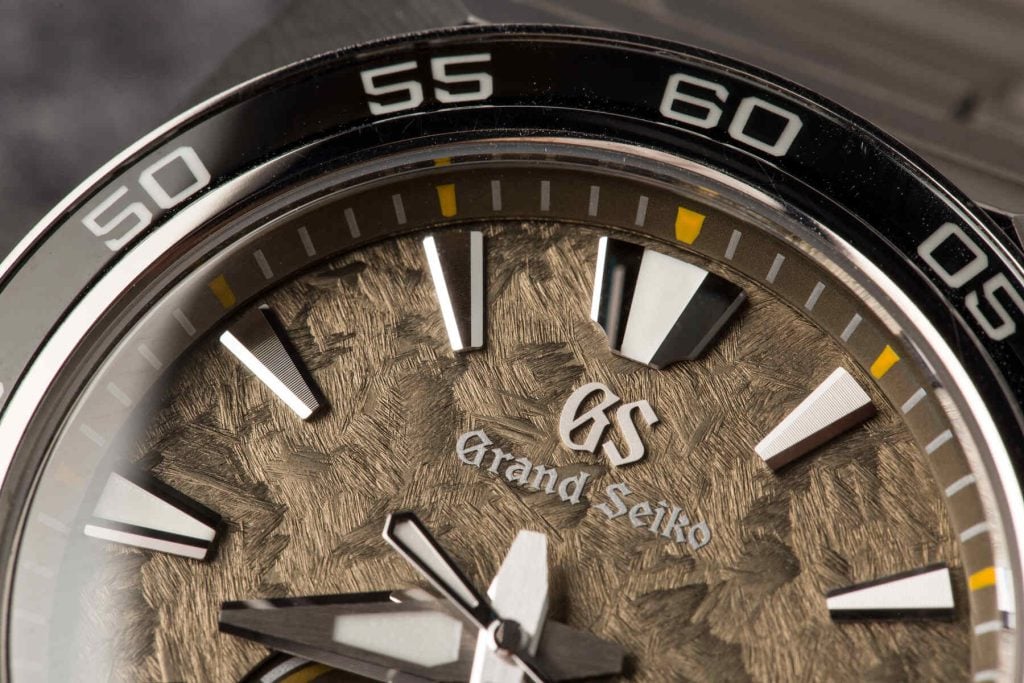
For years, the Spring Drive was Grand Seiko’s most precise mechanical movement, rated to plus or minus one second per day. The UFA (Ultrafine Accuracy) series raises that bar significantly. Introduced in recent seasons, the UFA line is powered by the 9RB2 caliber, and it represents a meaningful step forward in what a mechanical watch can achieve.
The technical specifications of the 9RB2 are worth breaking down:
- Accuracy: plus or minus 20 seconds per year (standard COSC certification allows plus or minus 15 seconds per day, making the 9RB2 roughly 90 times more accurate)
- Case thickness: 11.4mm, slimmer than the Snowflake, which is notable for a Spring Drive movement
- On-the-fly micro-adjustment: a first for Grand Seiko, allowing the rate to be fine-tuned without removing the movement from the case
- Power reserve: 72 hours, consistent with other Spring Drive references in the lineup
The UFA series matters beyond its technical specs because it signals where Grand Seiko is headed. The brand is no longer content to compete on finishing alone. With the 9RB2, it is making a direct case for precision leadership in the broader luxury watch market. For collectors who weigh accuracy heavily in their buying decisions, the UFA is currently the most compelling argument Grand Seiko has made.
Understanding the Big Three Movements
Grand Seiko builds its own movements in-house, and the lineup divides into three families. Each one has a distinct character and is suited to a different kind of buyer. The table below summarizes the key differences.
| Movement Type | Signature Feature | Best For |
| 9S Mechanical | Hi-Beat 36,000 vph frequency; traditional craftsmanship | Collectors who prefer a purely mechanical watch with exceptional finishing |
| 9R Spring Drive | Glide Motion seconds hand; hybrid mechanical and quartz-level accuracy | Buyers who want the smoothest seconds display and the best accuracy in a non-quartz movement |
| 9F Quartz | Instant date change at midnight; plus or minus 10 seconds per year; long-term durability | Those who prioritize precision and reliability above all else, with minimal servicing |
The 9S family covers Grand Seiko’s mechanical Hi-Beat watches. These are the movements most directly connected to traditional watchmaking, with no electronic regulation. The trade-off is that they require more careful regulation to keep accuracy consistent, but for purists, the appeal of a fully mechanical movement is hard to argue against. The 9R Spring Drive sits in between: it uses a mechanical mainspring but introduces a glide wheel regulated by electromagnetism, which brings accuracy close to quartz without any battery. The 9F Quartz line is often overlooked, but it has one of the fastest date-change mechanisms in the industry and requires very little maintenance over its lifespan.
The Collector’s Guide: Dials, Cases, and Zaratsu

Grand Seiko’s reputation is built as much on how its watches look as on how they run. The dial and case finishing are central to what separates a Grand Seiko from almost any other watch at a comparable price point, and understanding the vocabulary helps you appreciate what you are looking at.
The “Nature of Time” design philosophy draws directly from the Japanese landscape. Dials like the Skyflake evoke the fine texture of falling snow, while references inspired by Lake Suwa in Nagano capture the reflective surface of still water. The “Omiwatari” refers to a rare natural phenomenon on Lake Suwa where the ice cracks and forms raised ridges across the surface, and Grand Seiko has rendered this in dial form with a level of detail that is genuinely impressive. These are not cosmetic flourishes. Each dial goes through a specific production process, usually involving hand-applied techniques at the Shizukuishi or Shinshu workshops.
On the case side, the defining technique is Zaratsu polishing, a hand-polishing method that creates mirror-bright surfaces without any distortion or waviness. When you look at the flanks of a Grand Seiko case, you see a clean, unbroken reflection, and the transition between brushed and polished surfaces is razor-sharp. This is the result of skilled craftspeople working each surface individually by hand. It is one of those details that sounds abstract until you hold a Grand Seiko next to other luxury watches and see the difference directly. The two main case styles, the angular 44GS shape and the rounder 62GS shape, use the same finishing process but produce very different visual effects. The 44GS plays with shadow and contrast through flat planes and sharp angles, while the 62GS feels softer and more continuous.
The Best Grand Seiko Dials

Grand Seiko produces more named dial variants than almost any other luxury watch brand, and the range is wide enough that it can feel overwhelming. The dials below are the ones that come up most often in collector discussions, represent the brand’s craft at its highest level, or have had the most influence on how Grand Seiko is perceived globally.
A few of these appear on specific references covered earlier in this guide. Others span multiple case generations or have been reissued in updated form. In each case, what makes the dial worth knowing is not just how it looks in a photograph but what goes into making it.
The Snowflake Dial
The Snowflake dial is the one most people associate with Grand Seiko’s design identity. Inspired by the snow-covered landscape around the Shinshu region in winter, it has a raised, textured surface created using a technique developed specifically for this reference. The texture is not printed or chemically etched. It is built up through a process that gives the dial a three-dimensional quality, and the way it reflects light changes depending on the angle and the lighting conditions. On a bright day it reads almost white. In lower light it takes on a soft, layered depth. It currently appears on the SBGA211 and several limited variants.
The Shunbun (Cherry Blossom) Dial
The Shunbun dial is a pale pink field that captures the look of cherry blossoms at peak bloom, the point just before the petals begin to fall. The color is subtle rather than obvious, and it shifts slightly depending on the light source, moving between warm pink and a cooler, almost ivory tone. Grand Seiko produces this dial at the Shizukuishi Watch Studio, and the process involves multiple stages to achieve that soft, gradated quality. It has become one of the brand’s most recognized designs internationally, in part because it does something technically difficult, which is making pink work in a luxury watch context without looking casual or overtly fashion-forward.
The White Birch Dial
Introduced with the SLGH005, the White Birch dial draws from the forests around the Shinshu highlands in early spring. The center of the dial has a subtle, horizontal texture that suggests the bark of a birch tree, and the overall color sits in a warm off-white range. What makes it stand out among Grand Seiko dials is how it interacts with the Evolution 9 case. The flat, wide bezel and the large crystal frame the dial in a way that gives it more presence than the measurement alone would suggest. It is a quieter dial than the Snowflake but technically just as demanding to produce.
The Omiwatari Dial
Omiwatari refers to a rare natural event on Lake Suwa in Nagano, where dropping temperatures cause the lake’s ice to crack and push upward into ridges that cross the surface. It is a phenomenon closely tied to Shinto tradition in the region, and Grand Seiko has rendered it in dial form across several references. The dial uses raised, irregular ridges across a pale blue or grey field to replicate the look of the ice formation. It is one of the most three-dimensional dials the brand produces and one of the more technically complex to make consistently. Among collectors who follow Grand Seiko closely, it is often cited as the most visually distinctive dial in the current catalog.
The Skyflake Dial
The Skyflake is a variant of the Snowflake concept, but where the original captures ground-level snow, the Skyflake is modeled after snowflakes falling through the air. The texture is finer and the overall tone is lighter, with a brightness that makes the dial read almost luminous in direct light. It appears on a smaller number of references than the Snowflake and tends to appeal to collectors who want a similar aesthetic with a slightly more delicate character. In side-by-side comparisons, the Skyflake reads as more refined and the Snowflake as more dramatic.
The Lake Suwa Dial
Lake Suwa in Nagano has inspired several Grand Seiko dials across different seasons and references. The summer version typically uses a deep, reflective blue that mimics the still surface of the lake on a clear day, while autumn variants shift toward warmer tones to reflect the changing landscape around the shore. The technique used on these dials creates a surface that appears to have depth, almost as though you are looking into the water rather than at a flat plane. The Lake Suwa series is a good entry point for collectors who want something distinctly Grand Seiko but prefer a cleaner, more minimal look compared to the textured snow-inspired references.
Investing in Japanese Luxury: Market Value Trends

Grand Seiko occupies an interesting position in the secondary market. For much of its history, it traded at or below retail because brand recognition outside Japan was limited. That has shifted noticeably over the past five years. A combination of stronger global marketing, the brand’s independence since 2017, and genuine word-of-mouth among collectors has pushed demand, and prices on the secondary market have responded.
A few factors drive value retention in the Grand Seiko market:
- Limited edition releases, particularly those tied to specific seasons or dial textures, tend to carry strong premiums within months of release.
- The White Birch and Shunbun references have both shown consistent secondary market appreciation due to their dial quality and strong collector followings.
- Spring Drive movements, because of their complexity and the time required to manufacture them, tend to hold value better than standard mechanical references.
- Grand Seiko’s price-to-finishing ratio is frequently cited by collectors and industry observers as one of the best in the luxury watch space, which supports long-term value.
- The UFA series, still relatively new, is being watched closely as a potential future collectible due to its technical significance.
Grand Seiko is not Rolex in terms of resale liquidity. The brand does not carry the same instant recognition at a general auction, and some references move more slowly on the secondary market than Swiss counterparts at similar price points. What it does offer is a combination of craftsmanship, movement technology, and aesthetic depth that is becoming harder to ignore as the brand’s global profile grows.
Future Icons: What to Watch in 2026 and Beyond

Grand Seiko is no longer the “hidden gem” of the watch world. Over the past decade, it has moved from a niche conversation among Japan-focused collectors to a genuine contender in the upper tier of the global luxury watch market. The brand now competes for the same buyer who might otherwise be looking at a Patek Philippe entry-level piece or a high-end Omega, and it wins on finishing quality more often than its price point would suggest.
Looking ahead, the 9RB2 and the UFA series are the most significant developments to follow. The on-the-fly micro-adjustment feature alone sets a new standard for what a luxury Spring Drive watch can do, and the 11.4mm case profile opens up design possibilities that were not available with earlier movement architectures. Whether you are drawn to the accuracy of the 9RB2 or the textured dial work of a Snowflake, Grand Seiko’s current lineup offers a level of craftsmanship that is difficult to match at its price. For serious collectors building a long-term collection, it is no longer a secondary choice.
Frequently Asked Questions
The post Best Grand Seiko Watches (2026 Guide) appeared first on Bob's Watches.