Bob's Watches Bob's Watches
The Rolex Pepsi collection is the red and blue bezel version of the GMT-Master and GMT-Master II model, produced in some form since 1955 and discontinued in its final steel reference, the 126710BLRO, in April 2026. Every Pepsi is now a pre-owned purchase. Our sold data puts the steel ceramic Pepsi at a median of $24,595 over the twelve months, up roughly 19 percent across that period.
Key Takeaways
- The Rolex Pepsi refers to the red and blue 24-hour bezel, not to a single watch, and it has appeared on seven main references across seven decades.
- Rolex removed the steel ref. 126710BLRO and the white gold ref. 126719BLRO from its catalog at Watches and Wonders in April 2026, leaving no red bezel in current production.
- The steel Pepsi sold at a median of $24,595 at Bob’s Watches over the twelve months ending July 31, 2026, with most examples trading between $20,995 and $26,595.
- Median sold prices for the steel Pepsi rose about 19 percent between autumn 2025 and summer 2026, with the step change arriving in the weeks around the April announcement.
- Vintage aluminum-bezel references, including the 1675 and the 16710, remain the accessible entry points to the Pepsi lineage.
- The Pepsi outsells every other bezel color in the ceramic 126710 family in our own order data and carries a clear price premium over the blue and black versions.
The sections below cover what the Pepsi is, every reference that has worn the bezel, the history behind the Pepsi, what the 2026 discontinuation did to pre-owned prices, and which generation suits which buyer.
What Is a Rolex Pepsi?

The Rolex Pepsi is a GMT-Master or GMT-Master II fitted with a two-color red and blue 24-hour bezel, nicknamed for the soft drink’s color scheme. Rolex has never used the name itself. Internally the modern versions carry the suffix BLRO, short for the French bleu and rouge.
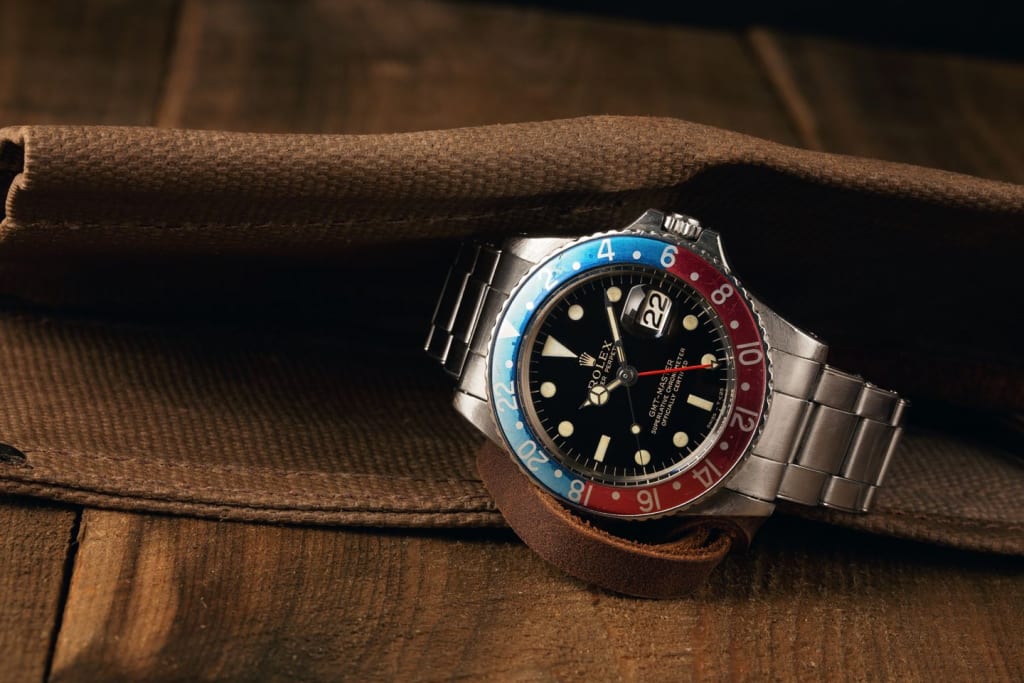
The bezel serves a function rather than a decoration. Red marks daytime hours and blue marks night on the 24-hour scale, so a pilot or traveler reading the fourth hand can tell at a glance whether the second time zone is in daylight. Rolex has produced the colorway in three materials: Bakelite on the original ref. 6542, anodized aluminum from 1959 through 2007, and Cerachrom ceramic since 2014. The blue and red combination has only ever been offered on steel and white gold cases, never on yellow gold, two-tone, or Everose gold models.
Every Rolex Pepsi Reference
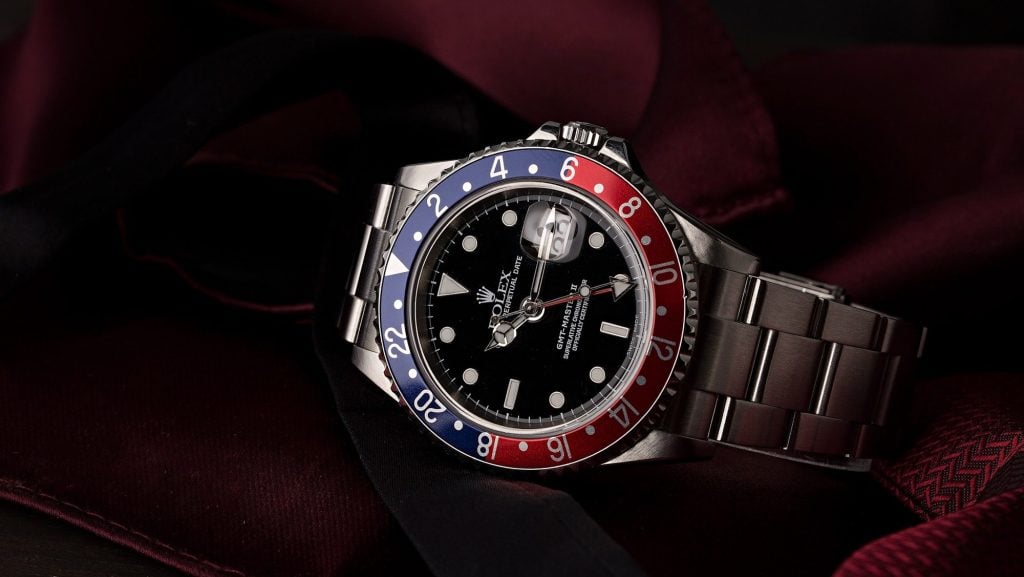
Seven main references have carried the Pepsi bezel, split between the original GMT-Master line and the GMT-Master II that replaced it. The practical difference between the two lines is the Rolex 24 hour hand: on a GMT-Master II, the 12-hour hand can be set independently in one-hour jumps, which allows a third time zone to be tracked using the bezel.
| Reference | Production years | Defining trait |
| GMT-Master 6542 | 1955 to 1959 | Bakelite bezel, no crown guards, 38mm case |
| GMT-Master 1675 | 1959 to 1980 | First aluminum bezel, crown guards, 40mm case |
| GMT-Master 16750 | 1980 to 1988 | Quickset date, 100m water resistance |
| GMT-Master 16700 | 1988 to 1999 | Sapphire crystal, last of the GMT-Master line |
| GMT-Master II 16710 | 1989 to 2007 | Independent hour hand, final aluminum Pepsi |
| GMT-Master II 116719BLRO | 2014 to 2018 | First Cerachrom Pepsi, white gold only |
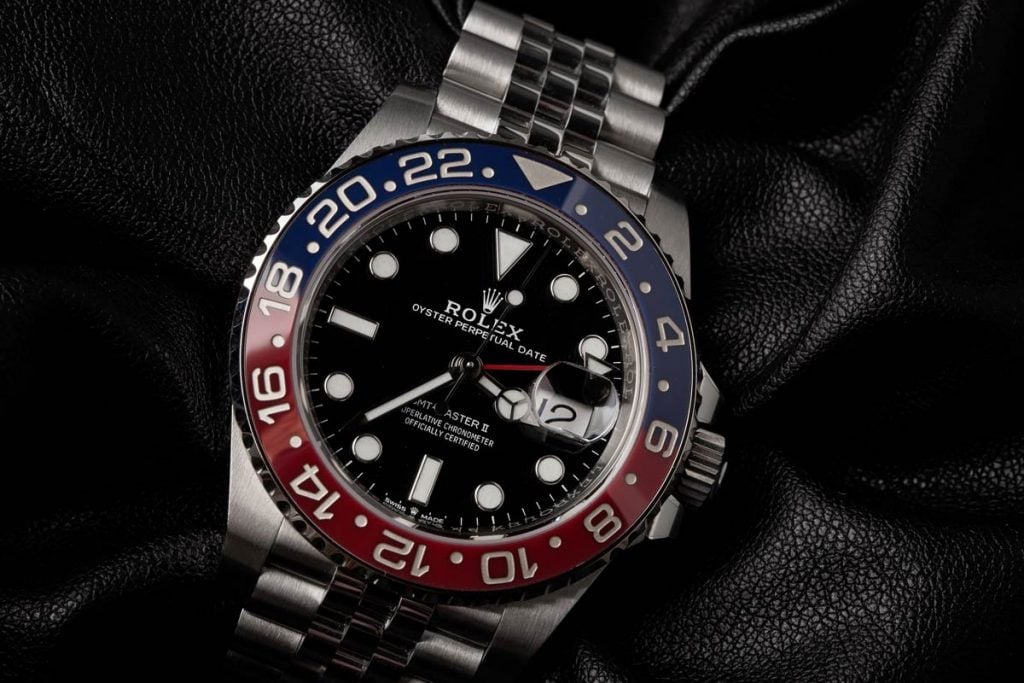
| GMT-Master II 126710BLRO | 2018 to 2026 | First steel Cerachrom Pepsi, Jubilee bracelet |
| GMT-Master II 126719BLRO | 2018 to 2026 | White gold, blue lacquer or meteorite dial |
The vintage aluminum era
The aluminum-bezel references are where fading happens, and fading is a large part of what collectors pay for. Inserts on the 1675 and 16750 commonly shift toward pale blue and pink, and a minority turn a saturated fuchsia that carries a premium over an even, unfaded example. The 1675 ran for more than two decades, which produced gilt-gloss dials into the mid-1960s, matte dials afterward, radium lume replaced by tritium around 1964, and the addition of hacking in 1971. That variation is why 1675 prices spread more widely than any other Pepsi reference.
The 16700 is the last watch in the GMT-Master line and the quiet value in the group, since it shares the sapphire crystal and glossy dial of its GMT-Master II contemporary while lacking the independent hour hand. Browse vintage Rolex Pepsi models to see how condition drives the spread in person.
The ceramic era
Rolex spent years stating that a two-color Cerachrom bezel could not be made, because the red pigment is difficult to stabilize during sintering. The blue and black bezel arrived in 2013 and the blue and red followed in 2014 on the white gold 116719BLRO. The steel 126710BLRO arrived at Baselworld 2018 on a Jubilee bracelet, the first time the five-link bracelet had returned to the professional line in decades, with the Oyster option added in 2021. Both ceramic Pepsi references use the caliber 3285.
Rolex Pepsi History: From Pan Am to Discontinuation
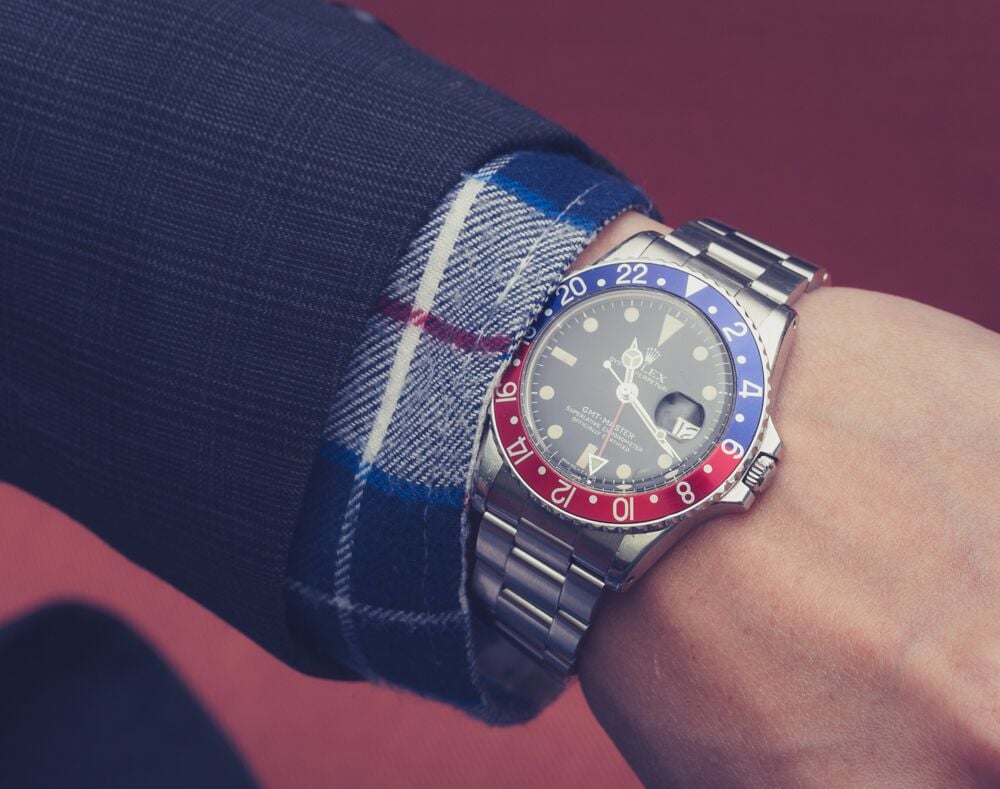
Rolex introduced the GMT-Master ref. 6542 in 1955, developed with Pan American World Airways for pilots flying multi-zone transatlantic routes. The design brief was narrow: show a second time zone without a second watch. Rolex answered it with a fourth hand geared to rotate once every 24 hours and a bidirectional bezel graduated to 24 hours, colored red for day and blue for night.
The Bakelite bezel on the earliest 6542 examples proved brittle and cracked in use, and the radium used to illuminate its numerals drew scrutiny on safety grounds, so Rolex moved to aluminum before the reference finished production. Intact Bakelite examples are among the most collectible vintage Rolex watches for exactly that reason.
The rest of the story is a sequence of refinements rather than reinventions. Crown guards and a 40mm case in 1959. Quickset date and deeper water resistance in 1980. Sapphire crystal in 1988. The independent hour hand and the GMT-Master II name, which allowed a third zone to be read off the bezel. The Pepsi bezel then vanished from steel entirely for eleven years after the 16710 ended in 2007, returned in ceramic on white gold in 2014, and came back to steel in 2018.
Seventy-one years after the 6542, that line ended. On April 14, 2026, at Watches and Wonders in Geneva, the product pages for the 126710BLRO and the 126719BLRO disappeared from Rolex’s website and configurator. No successor was announced and no Coke bezel replaced it. For the first time in the ceramic era, the steel GMT-Master II catalog contains no red.
The 2026 Discontinuation and What It Did to Pre-Owned Prices
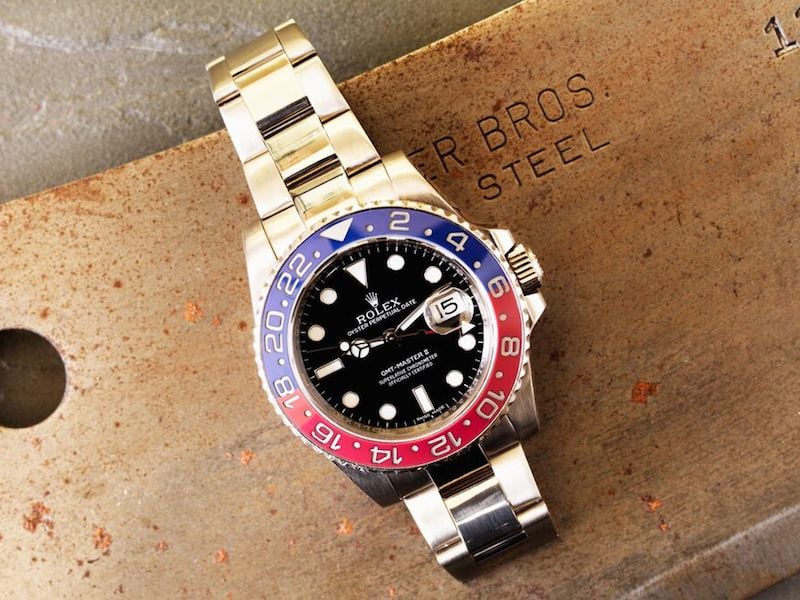
The discontinuation moved pre-owned Pepsi prices upward, and our own sold data shows both the size of the move and its timing. These are transaction prices for watches sold at Bob’s Watches, not asking prices, and they cover the twelve months ending July 31, 2026.
| Reference | Median sold price | Typical range |
| GMT-Master II 126710BLRO | $24,595 | $20,995 to $26,595 |
| GMT-Master II 126719BLRO | $46,855 | $39,995 to $61,945 |
| GMT-Master II 116719BLRO | $32,495 | $30,745 to $38,495 |
| GMT-Master II 16710 | $15,295 | $14,562 to $16,815 |
| GMT-Master 1675 | $17,280 | $11,332 to $23,935 |
| GMT-Master 16750 | $15,570 | $13,970 to $18,070 |
| GMT-Master 16700 | $14,532 | $13,412 to $14,995 |
Ranges show the tenth to ninetieth percentile of sold prices, so they exclude outliers at both ends. Figures are pre-owned market prices, not retail.
The timing is the more interesting part. Between August and October 2025, the median steel Pepsi sold at $21,295. Between May and July 2026, after the Geneva announcement, that median was $25,433, a rise of about 19 percent. Comparing everything before April 2026 with everything after gives a similar picture, $21,854 against $25,470. The market had begun moving before the confirmation, since dealers had been told through the winter that no further deliveries were coming, and the April announcement accelerated a move that was already underway.
“The 2026 discontinuation of the Rolex Pepsi accelerated a pre-owned market surge, with median sold prices for the stainless steel GMT-Master II 126710BLRO. Data from Bob’s Watches shows the market began moving upward over the winter before the official announcement, with modern and vintage Pepsi models commanding high prices.”
Joe Alessindrini, CFO of Bob’s Watches
Direction over the twelve months is not uniform across the family.
| Reference | 12-month direction | Collectibility tier |
| 126710BLRO | Up about 19 percent | Blue chip, supply now fixed |
| 126719BLRO | Broadly flat, small sample | Precious metal flagship |
| 116719BLRO | Broadly flat, small sample | Precious metal, niche demand |
| 16710 | Flat before and after April | Modern classic, deep supply |
| 1675 | Higher, with wide dispersion | Core vintage, condition driven |
| 16700 | Modestly higher | Entry vintage, thin supply |
| 16750 | Sample too small to call | Transitional, scarce |
For context on the retail side, Rolex listed the steel 126710BLRO at approximately $11,800 in the United States before it left the catalog. Retail is now historical rather than current, since Rolex no longer sells the model through authorized dealers. Retail and pre-owned figures should never be read as one number.
Which Rolex Pepsi Should You Buy?
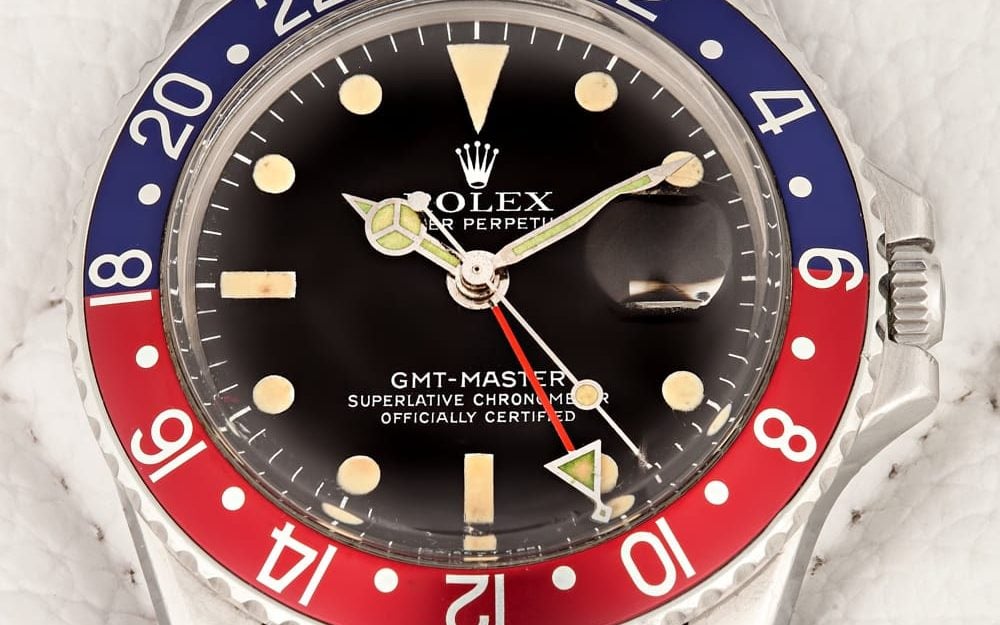
The right Pepsi depends on whether you want the modern ceramic execution, the vintage aluminum one, or a precious metal version, and the gap between them is wide.
- Buy the 126710BLRO if you want the watch to be usable daily without preservation anxiety. The Cerachrom bezel does not fade, the case is 904L Oystersteel, water resistance is 100 meters, and the caliber 3285 runs a 70-hour power reserve. Bracelet choice matters more than buyers expect: Jubilee accounted for about two-thirds of the steel Pepsis we sold over the past twelve months, so Oyster examples surface less often on the pre-owned market.
- Buy the 16710 if you want the Pepsi identity with room in the budget. It offers the independent hour hand, a sapphire crystal, and the last aluminum Pepsi bezel Rolex made, and our median sold price held steady at $15,295 through a period when the ceramic reference climbed.
- Buy the 1675 or 16750 if the bezel patina is the point. Prices spread widely because dial type, lume type, bezel fade, and originality all move the number, which is also what makes these the most rewarding references to shop carefully.
- Buy the 116719BLRO or 126719BLRO if you want white gold. Our sold data puts the 126719BLRO median at $46,855, roughly twice the steel reference, with meteorite dial examples at the top of the range. Our full review of the Rolex 126719BLRO (Pepsi) covers those variants in detail.
On the technical detail worth checking before you buy, the caliber 3285 introduced Rolex’s Chronergy escapement to the GMT line, a redesigned lever and escape wheel in nickel-phosphorus that raised efficiency and made the movement resistant to magnetic fields. It is the movement that took the power reserve from 48 hours on the caliber 3186 to 70 hours on the 126710BLRO, and it is a fast way to confirm which generation of steel Pepsi you are looking at when paperwork is absent.
Full sets matter more on the ceramic reference than on the vintage ones, since a 2018 to 2025 watch should still have its card, tags, and box, and the absence of them raises questions that a 1972 watch does not have to answer.
Pepsi Versus the Rest of the GMT-Master II Family
The Pepsi is the most in-demand bezel in the ceramic 126710 family, and our order data shows it by a clear margin. Over the twelve months ending July 31, 2026, we sold more than twice as many Pepsi 126710BLRO examples as Batman 126710BLNR examples on the Oyster bracelet, and the Pepsi commanded a median premium of roughly 25 percent over the blue and black versions of the same watch.
That premium existed before the discontinuation and widened after it. Buyers who want a ceramic GMT and are priced out of the Pepsi have moved toward the Batman, Batgirl, and Bruce Wayne configurations, which is worth watching if you are choosing between them. For the full comparison, see our breakdown of how the Pepsi and Batman differ in practice, and for the red and black alternative, our Coke versus Pepsi comparison covers a bezel Rolex has not produced in ceramic at all.
“The Rolex ‘Pepsi’ GMT-Master II is more than just a watch; it is a pillar of horological history. Since its discontinuation, we have seen a massive surge in demand on the secondary market. Collectors recognize that the unique red and blue Cerachrom bezel represents a pinnacle of manufacturing complexity that Rolex may not revisit for years. Whether you are looking at a vintage aluminum reference 16710 or the modern ceramic 126710BLRO, the Pepsi remains one of the safest and most rewarding investments in the luxury watch world today.”
Carol Altieri, COO of Bob’s Watches
Is the Rolex Pepsi Still Worth Buying?
The Rolex Pepsi is generally considered one of the more durable value propositions in modern Rolex collecting, though nothing about that is guaranteed. The reasons are specific rather than sentimental: a fixed supply now that production has ended, seventy-one years of continuous cultural recognition, no announced successor, and a bracelet and bezel combination that no current reference reproduces. Prices can move in both directions, and discontinued references often see a brief compression after the initial surge as speculative holders sell. Condition, originality, and a complete set with box and papers influence what any individual example is worth far more than the reference number does.
For buyers, the practical question is no longer whether to wait for an authorized dealer allocation, because that path closed in April 2026. Bob’s Watches has bought and sold every Pepsi reference discussed here, and the prices in this guide come from those transactions rather than from listing data. If you are deciding between generations, our current Pepsi GMT inventory shows what is available across the ceramic and aluminum eras, and the wider Rolex GMT-Master II collection covers the alternatives if the red and blue bezel is out of reach.
Pre-owned prices reflect watches sold by Bob’s Watches between August 1, 2025 and July 31, 2026. Medians and percentile ranges are calculated from transaction prices, not asking prices. Data as of August 11, 2026. This guide is scheduled for quarterly review.
The post Rolex Pepsi (GMT-Master II) Guide: Every Reference, Current Prices, and History appeared first on Bob's Watches.