Bob's Watches Bob's Watches
The main difference between the Rolex Datejust and the Rolex Oyster Perpetual is that the Datejust includes a date window at 3 o’clock with Rolex’s signature Cyclops magnifying lens, while the Oyster Perpetual is a simpler, time-only watch with a clean, symmetrical dial. The Datejust is usually the better choice when buying Rolex watches if you want more design options, dressier configurations, and the practicality of a date function. The Oyster Perpetual is the better choice if you prefer a cleaner dial, a lower price point, and the most minimal expression of Rolex design.
Both watches share the same DNA, an Oyster case, a self-winding “Perpetual” movement, and 100 meters of water resistance, and both are good Rolex investments. This why so many buyers get stuck between them. Bob’s Watches is your trusted authority in all things Rolex, and we buy and sell both of these models every single day. Below is everything you need to make the right call, starting with a quick side-by-side comparison.
Datejust vs Oyster Perpetual: Quick Comparison
| Feature | Rolex Datejust | Rolex Oyster Perpetual |
| Date window | Yes | No |
| Cyclops lens | Yes | No |
| Style | Dressier, more configurable | Cleaner, sportier, simpler |
| Bezel options | Smooth, fluted, or gem-set (varies by model) | Smooth only |
| Bracelet options | Oyster or Jubilee | Oyster |
| Movement (41mm) | Calibre 3235 (date, ~70-hr power reserve) | Calibre 3230 (~70-hr power reserve) |
| Common sizes | 31mm, 36mm, 41mm (28mm Lady-Datejust) | 28mm, 31mm, 34mm, 36mm, 41mm |
| Materials | Steel, two-tone Rolesor, solid gold | Primarily Oystersteel (select Rolesor and gold models new for 2026) |
| Price range | Higher: roughly $1,500 – $2,500 more in comparable steel sizes | Lower: the most accessible entry into the Rolex catalog |
| Best for | A daily luxury watch with more presence and practicality | A first Rolex or a minimalist daily wearer |
Which One Should You Buy?

There’s no single right answer, it depends on what you want the watch to do for you:
- Buy the Datejust if you want a date function, dressier styling options (fluted bezel, Jubilee bracelet, two-tone and gold configurations), diamond or Roman dials, or a watch that can flex from the boardroom to a black-tie event.
- Buy the Oyster Perpetual if you want the most affordable path into a new-generation Rolex, you prefer a perfectly symmetrical time-only dial, or you’re drawn to the playful lacquer dial colors the OP has become famous for since 2020.
- Buy the Datejust if this will be your only watch and you want maximum versatility and long-term configurability.
- Buy the Oyster Perpetual if you already own (or plan to own) a dressier watch and want a clean, sporty daily driver.
If you’re still torn, here’s the shortcut most of our customers land on: if you’ll genuinely use the date, get the Datejust; if you keep gravitating toward clean dials, get the Oyster Perpetual and save the difference toward your next Rolex.
About the Rolex Datejust
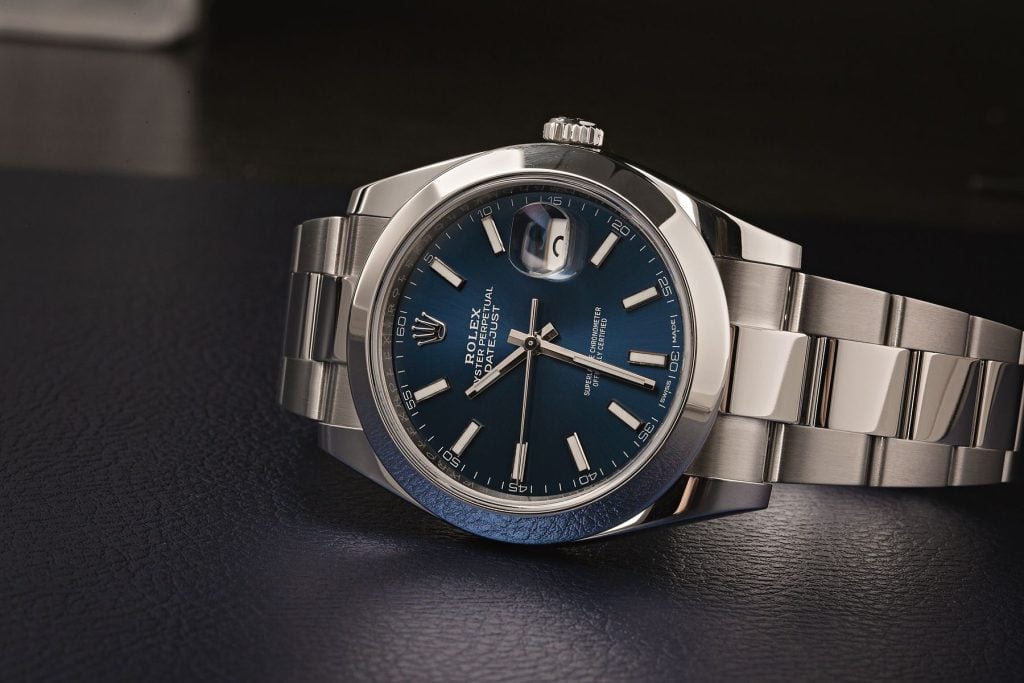
First introduced in 1945, the Rolex Datejust is one of the most recognizable timepieces from the Swiss watchmaker. The model was the first self-winding, waterproof chronometer wristwatch to display the date, shown in a window at 3 o’clock that changes instantaneously at midnight. The date complication may seem like a common thing today, but the Datejust set the standard many decades ago.
The Datejust became the backbone of the Rolex catalog, for generations of buyers, it simply was the Rolex to own. That’s why the watch remains popular among those starting a collection, while also being deep enough to keep seasoned collectors busy for a lifetime.
Rolex has introduced many variations over the years. One of the most important modern updates came in 2009 with the Datejust II, which enlarged the case to 41mm from the traditional 36mm. The Rolex Datejust II has since been discontinued (it remains available pre-owned), and its successor, the Datejust 41, offers the same 41mm diameter with a more refined profile and the modern Calibre 3235 movement. Rolex continues to refresh the collection with new dials nearly every year — most recently the green ombré lacquer dials introduced on the Datejust 41 at Watches & Wonders 2026.
Rolex Datejust Design Cues

There are many variations in the Rolex Datejust lineup, but a few universal style features exist across almost all models:
- Date Complication: At 3 o’clock lies the date window the watch is named after. Its distinctive font and instant midnight changeover created the enduring aesthetic that makes the watch instantly recognizable.
- Cyclops Lens: The sapphire crystal features a Cyclops lens that magnifies the date 2.5x for easy legibility, one of the most copied (and most debated) design elements in watchmaking.
- Bracelet – Jubilee or Oyster: Two bracelet designs are available: the dressier five-link Jubilee, created specifically for the Datejust in 1945, or the sportier three-link Oyster.
- Bezel Options: Smooth, fluted (in white or yellow gold), or gem-set depending on the reference, a level of configurability the Oyster Perpetual doesn’t offer.
- Material: Choose from Oystersteel, yellow Rolesor (steel and yellow gold), white Rolesor, and Everose Rolesor, plus solid gold editions in the smaller sizes.
About the Rolex Oyster Perpetual
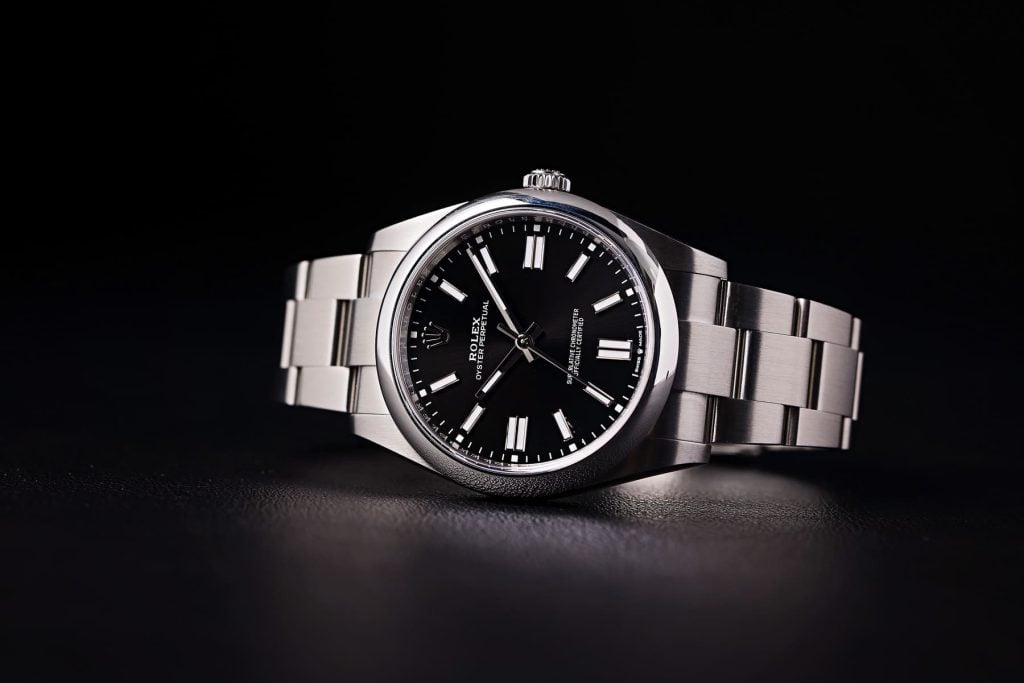
The Rolex Oyster Perpetual is the simplest and most accessible watch in the entire Rolex catalog, but it’s far from basic. It is, in a very real sense, the original Rolex: every modern Rolex is built on the two innovations in its name.
“Oyster” refers to Rolex’s hermetically sealed waterproof case, invented in 1926, and 2026 marks the Oyster case’s 100th anniversary, which Rolex celebrated at Watches & Wonders 2026 with a refreshed Oyster Perpetual lineup, including a yellow Rolesor OP 41 and, for the first time, solid gold 34mm and 28mm models with stone-accented lacquer dials. “Perpetual” refers to the self-winding movement, powered by the motion of your wrist, that Rolex pioneered in 1931.
Today, nearly every watch in the Rolex catalog carries the words “Oyster Perpetual” on its dial, indicating the Oyster case and automatic movement. But the standalone Oyster Perpetual remains its own distinct model: a time-only watch with no complications, distilled to the essentials. Because of this, the Oyster Perpetual is widely regarded as the entry point into Rolex ownership, and since the colorful lacquer dials arrived in 2020 such as the turquoise “Tiffany,” coral red, yellow, green, and lets not forget the Rolex Celebration dial reviewed here. This model has also become one of the most talked-about watches in the catalog.
Rolex Oyster Perpetual Design Cues
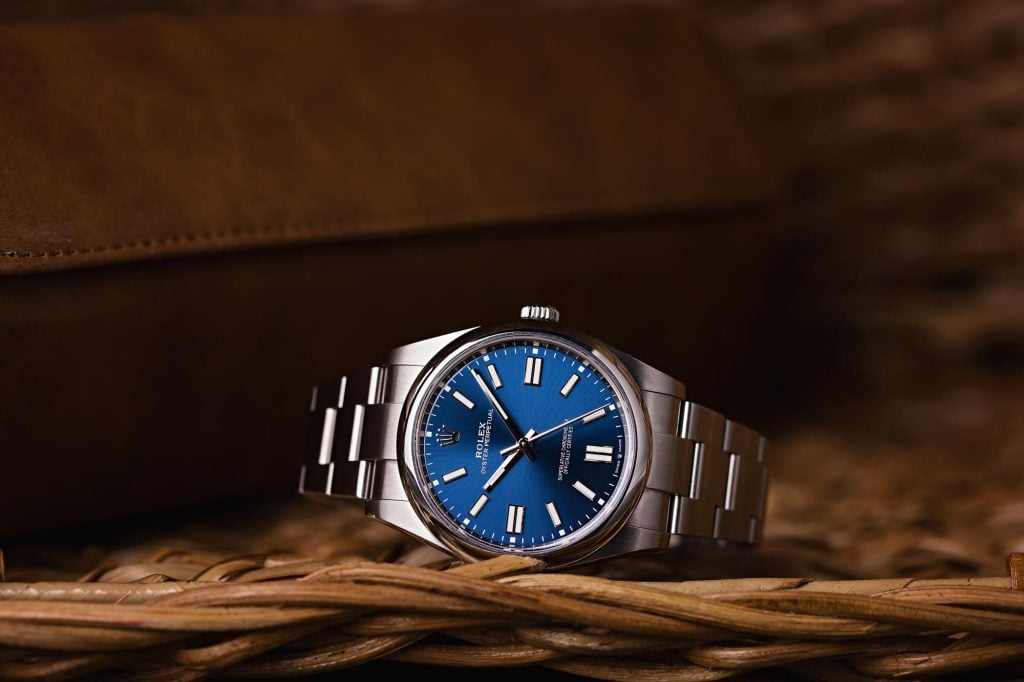
- Time-Only Dial Design: The Oyster Perpetual is a three-hand watch displaying hours, minutes, and seconds. With no date window, it’s perfectly symmetrical dial is one of the main reasons collectors are drawn to it.
- Simple Smooth Bezel: Current-production Oyster Perpetual models wear a smooth, unadorned bezel – no fluting, no gems – for a timeless, sporty elegance.
- Oyster Bracelet Only: Every current Oyster Perpetual comes on the three-link Oyster bracelet; there is no Jubilee option.
- Expressive Dial Colors: From classic silver, bright blue, and bright black to vivid lacquer colors, the dial is where the OP shows its personality.
Biggest Points of Comparison
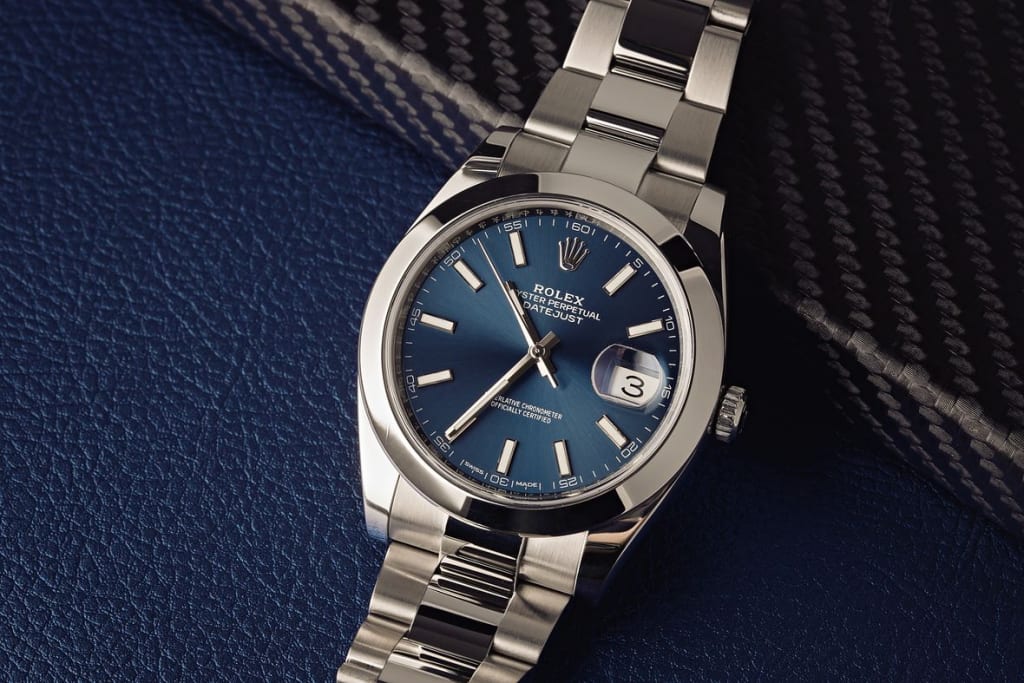
1. Date Complication
The most obvious difference between the two is the date complication on the Datejust. The Oyster Perpetual doesn’t have one because its design philosophy permits only the most essential elements. Many buyers choose the Datejust precisely for this added function, but if you prefer a minimal, symmetrical dial, the Oyster Perpetual is the better choice.
2. Movement
The Datejust 41 is powered by the Calibre 3235, while the current Oyster Perpetual 41 runs the Calibre 3230. These are sibling movements from Rolex’s newest generation: performance is nearly identical, both carry Superlative Chronometer certification (−2/+2 seconds per day), and both offer an extended power reserve of approximately 70 hours. The 3235 simply adds the date display with quickset functionality, so the date can be adjusted independently of the time.
3. Size Options
The Oyster Perpetual is available in more sizes than any other model in the Rolex catalog: 28mm, 31mm, 34mm, 36mm, and 41mm. The Datejust is offered in 31mm, 36mm, and 41mm, with the 28mm Lady-Datejust rounding out the family. If you’re between sizes, particularly if a 34mm suits your wrist, only the Oyster Perpetual has you covered.
4. Price Point
The Oyster Perpetual is the more affordable watch, both at retail and pre-owned. At current retail, the Oyster Perpetual starts around $6,200 for the 28mm and about $7,050 for the 41mm in Oystersteel, while a comparable steel Datejust runs roughly $1,500–$2,500 more depending on size and configuration. If budget is the deciding factor, the Oyster Perpetual is the clear pick; if you want the date and the dressier styling, the premium for the Datejust is modest in the context of Rolex ownership.
Datejust 36 vs Oyster Perpetual 36

The 36mm size is where this comparison gets most heated, because both watches wear almost identically on the wrist. The Datejust 36 (refs. 126200 smooth bezel, 126234 fluted white gold bezel) is the classic, do-everything Rolex, date window, choice of Oyster or Jubilee bracelet, and smooth or fluted bezel options. The Oyster Perpetual 36 (ref. 126000) is the cleaner, more casual take, and the 36mm size has historically been the platform for Rolex’s most playful OP dial experiments.
Our take: If you wear a suit regularly or want one watch to cover every occasion, the Datejust 36, especially the fluted-bezel Rolex 126234 on a Jubilee, is the definitive choice. If your wardrobe leans casual and you love a pop of color or a perfectly balanced dial, the OP 36 delivers 95% of the wearing experience for meaningfully less money.
Datejust 41 vs Oyster Perpetual 41
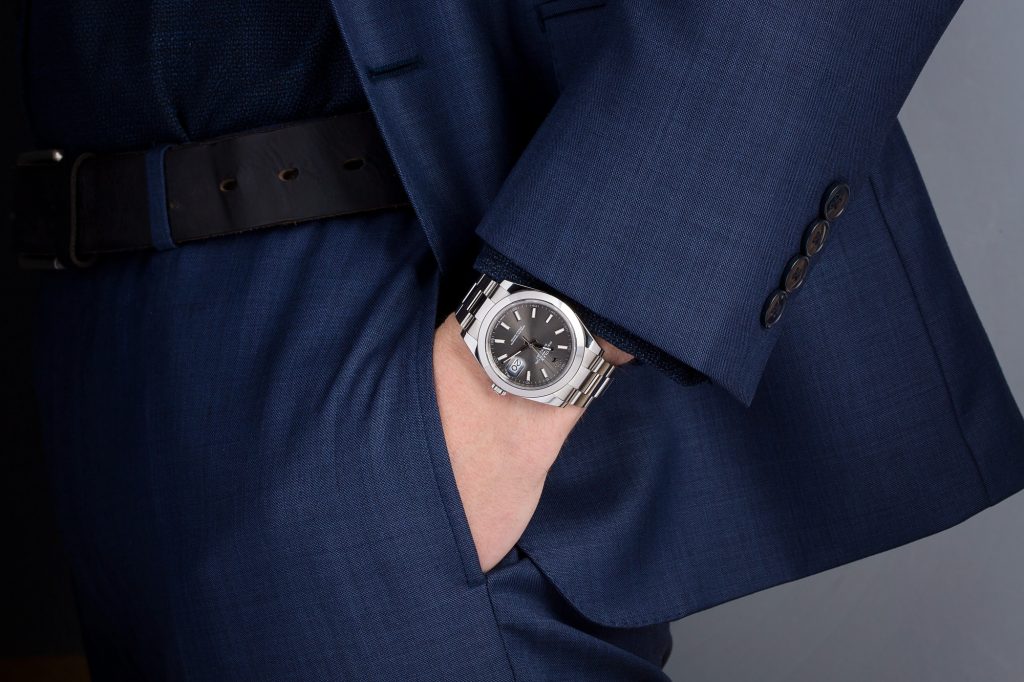
At 41mm, the comparison tightens further, because the smooth-bezel Rolex Datejust 41 (ref. 126300) on an Oyster bracelet looks remarkably similar to the Oyster Perpetual 41 at arm’s length, the date window and Cyclops are the giveaways. Step up to the fluted-bezel Datejust 41 (ref. 126334) on a Jubilee and the two watches diverge completely: one reads as a classic dress-casual icon, the other as a modern minimalist sports watch.
Note that Rolex updated the Rolex Oyster Perpetual 41 to reference 134300, replacing the original 124300, the discontinued 124300 remains highly sought-after on the pre-owned market, particularly in the discontinued turquoise, coral red, and yellow dials.
Our take: Buyers upgrading from an OP 41 who want a date and slightly dressier stance without changing the watch’s character should look at the Rolex 126300. Buyers who want the full traditional Datejust identity, fluted bezel, Jubilee, Cyclops, should go straight to the 126334. And if you want a conversation-starting dial color, nothing in the Datejust lineup matches a colored-dial OP 41.
Price and Resale Comparison
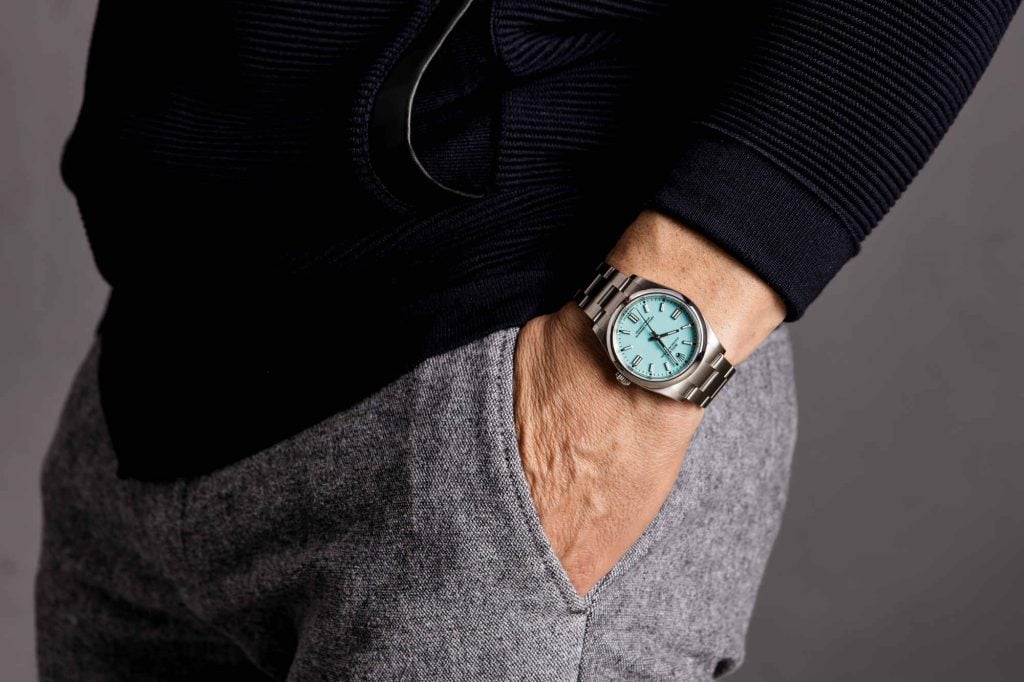
Directionally, here’s how the market looks in mid-2026:
- Datejust 41 (126300): Pre-owned examples typically trade from roughly $10,000 to $14,000 depending on dial, bracelet, and completeness, sitting modestly above retail. It’s one of the most liquid references in the entire Rolex catalog, these watches sell quickly, which matters if you ever plan to trade up.
- Datejust 36: Steel references generally trade below the 41mm equivalents, making the 126200 one of the best-value modern Rolex watches available. Vintage and neo-vintage Datejusts (five-digit references like the 16233) offer an even lower entry point.
- Oyster Perpetual 41 (124300/134300): Standard dial colors (black, silver, blue, green) trade near or modestly above retail. The discontinued 2020 colorway dials, turquoise, coral red, yellow, and the Celebration dial command significant premiums and behave more like sports-model collectibles than entry-level watches.
- Value retention: Both models hold value well by luxury-watch standards. The Datejust tends to be steadier and more predictable; the Oyster Perpetual’s colored dials have shown bigger swings, spectacular highs in 2021–2022 followed by meaningful cooling. If stability matters, Datejust is the safer store of value. If you own a discontinued-dial OP, you’re holding a genuine collectible.
Current Popular References
Rolex Datejust:
- Rolex 126300: Oystersteel, smooth bezel, 41mm; the modern entry point to the Datejust 41
- Rolex 126334: fluted white gold bezel, 41mm; home of the famous “Wimbledon” dial and the new-for-2026 green ombré lacquer dial
- Rolex 126200: Oystersteel, smooth bezel, 36mm; the best-value modern Datejust
- Rolex 126234: fluted white gold bezel, 36mm; the definitive classic configuration
Rolex Oyster Perpetual:
- Rolex 134300: the current-production 41mm flagship of the line
- Rolex 124300: the discontinued 2020–2025 reference in 41mm, home of the coveted turquoise, coral red, yellow, and Celebration dials
- Rolex 126000: 36mm, the sweet-spot size, with the widest range of playful dial colors
- Rolex 124200 and Rolex 277200: mid-size 34mm and 31mm options with no Datejust equivalent at 34mm
Before You Buy

Here are other factors to weigh before purchasing either the Datejust or Oyster Perpetual:
Personal Style. Both models are versatile enough for formal, everyday, or casual wear. However, the Datejust offers far more colorways, sizes, materials, bezels, and bracelet combinations. If you want a watch that expresses your personal style rather than blending in, the Datejust’s configurability is unmatched. If your style is minimalism, the Oyster Perpetual makes that statement better than anything else Rolex builds.
Budget. The Datejust is undoubtedly the more expensive option, and even the Oyster Perpetual of your liking may sit above retail on the secondary market. Rolex never offers sales or discounts, so the pre-owned market is often the smartest place to shop, like-new watches at lower prices, with immediate availability instead of an authorized-dealer waitlist.
Lifestyle. Will you wear the watch daily or occasionally? Both movements offer roughly 70-hour power reserves, so either can sit unworn over a weekend and still be running Monday morning. Daily wearers may also want to consider legibility: if you check the date on your wrist several times a day, that alone settles the debate in the Datejust’s favor.
Frequently Asked Questions
The post Rolex Datejust vs Oyster Perpetual: A Side-by-Side Comparison appeared first on Bob's Watches.