Bob's Watches Bob's Watches
A two-tone Rolex, what the company calls Rolesor, combines Oystersteel with either 18k yellow Everose or white gold in a single watch. Having sold thousands of these, my conclusion is clear: it is the sensible way to get into Rolex gold ownership, since the median selling price at Bob’s Watches was $11,495 as of October 2026.
Key takeaways
- Rolesor is Rolex’s own name for its steel-and-gold watches, and it comes in yellow, Everose, and white versions.
- The median two-tone Rolex sold for $11,495 in our completed sales from January 2025 through October 2026, and 37% of those watches closed under $8,000.
- The Datejust 36 is my best-overall pick. The Submariner “Bluesy” is the sport pick, and it comes with a built-in budget ladder.
- Two-tone is not standing still: our median sold price is up about 8% year over year as of October 2026.
- Condition decides everything on these watches. Gold wears differently than steel, and the traps are specific.
Here’s what I’ve learned from two decades of buying and selling two-tone Rolex watches, along with the advice I would give you from the counter.
What Is a Two-Tone Rolex? Rolesor, Explained

Rolesor is the term Rolex has used for a watch that combines Oystersteel and 18k gold in its case and bracelet, and this term has always been part of the brand’s vocabulary throughout most of the twentieth century. The formula remains the same, with steel used for the case body and the outer links of the bracelet, while gold is used for the bezel, the crown, and the central links. This arrangement ensures that the gold is visible when your eye lands on the watch, and the steel provides durability in the parts that are subject to impact.
People request this kind of watch by many names, such as silver and gold, mixed metal, dual-tone, and two-tone. It’s actually the same thing, and Rolex offers it in three varieties:
- Yellow Rolesor: Oystersteel with 18k yellow gold. The classic, and by a wide margin the version we sell most.
- Everose Rolesor: Oystersteel with Rolex’s own 18k rose gold alloy. Warmer, more current, and it commands a premium on the pre-owned market.
- White Rolesor: Oystersteel with an 18k white gold bezel, usually the fluted bezel on dress models. The stealth option; most people read it as all steel.
There is also Rolesium, a combination of steel and platinum found on the two tone Yacht-Master. Even though it is only a cousin, not a sibling, it would be worth considering if you are looking at watches with a two-tone appearance.
If you want the brand’s own telling, Rolex’s own Rolesor page covers the metallurgy. It won’t tell you what these watches cost in the real world, which is where I come in.
My Rolex Two-Tone Review: Pros and Cons From the Sales Floor

I would say the same thing to a friend. The two-tone model offers the best value among gold Rolex watches and is also the brand’s most controversial design. Since both of these statements are accurate, you should know them before you go in.
What I like after seeing thousands of these at the counter:
- The value is real. A two-tone Datejust carries real 18k gold for a fraction of what the solid-gold version trades for. You’re not buying a gold look. You’re buying gold, rationed intelligently.
- It dresses up and down. The same Bluesy works with a wetsuit and a dinner jacket. Few watches in our cases cover that spread.
- The steel does the hard work. Oystersteel takes the desk dings and bracelet wear; the gold sits mostly on the bezel and center links, where life is gentler.
- The heritage runs deep. Two-tone isn’t a trend Rolex is testing. The Datejust, Submariner and GMT-Master II have carried it for generations.
What I tell buyers to weigh:
- Gold is soft. The polished center links and bezel will pick up scratches faster than the steel around them. That’s physics, not a defect.
- It announces itself. A two-tone Rolex reads as gold from across a room. If you want quiet, buy white Rolesor or steel.
- The market has opinions. Two-tone has historically traded below its steel sport counterparts on the secondary market. I’ll show you why I think that’s the opportunity, not the problem, in the value section below.
The three questions buyers really ask us are whether the gold is solid or plated (in the case of a genuine Rolex, it is solid), whether it will look outdated (the champagne-dial two-tone finish is the most popular of all our two-tone models, so the market has decided on this), and whether it will keep its value (this point will be addressed in the following section).
“The question we hear most is no longer ‘is two-tone back?” It’s ‘which one should I get?’” says Carol Altieri, COO of Bob’s Watches.
Best Two-Tone Rolex Watches: What I Recommend

The figures below are based on the actual sales of Bob’s Watches between January 2025 and October 2026; they show the prices at which the watches were sold, not the prices at which they were listed. These prices are liable to change, so treat them as being similar to a map rather than as exact figures.
| Model | Median sold price | Typical range |
| Datejust 36 | $7,500 | $6,695 to $9,995 |
| Lady-Datejust | $6,995 | $5,995 to $8,995 |
| Yacht-Master 40 | $14,495 | $12,595 to $15,595 |
| Submariner | $15,495 | $13,295 to $18,495 |
| Datejust 41 | $15,995 | $14,995 to $16,600 |
| GMT-Master II | $19,695 | $14,955 to $21,495 |
| Sky-Dweller | $20,345 | $18,995 to $22,620 |
| Daytona | $21,395 | $19,720 to $25,995 |
All figures as of October 2026.
Rolex Datejust 36

That is the standard option, and this is no accident; the two-tone look, universally linked with a Jubilee worn alongside a champagne-dia, is the easiest route into owning a gold Rolex. The Datejust 36 is the most economical way to get started with a gold Rolex, with a median price of $7,500, and it is also the two-tone model we sell in the largest numbers. The guide on our Two-Tone Datejust Ultimate Buying Guide provides a detailed analysis by reference.
Rolex Lady-Datejust and the smaller sizes

Same design language at 26mm to 31mm, with medians starting at $6,995 and vintage examples well under that. The 69173 is the volume classic here. If you’re shopping for a two-tone Lady Datejust for a smaller wrist, this is the strongest number of choices on the pre-owned market.
Rolex Submariner “Bluesy”

The blue-dial, blue-bezel two-tone Submariner is the sport grail of this category, and it conveniently comes in three generations at three price points: the 16613, the 116613, and the current-shape 126613. Think of them as rungs on a ladder from $12,995 to $18,995 by median, and climb to the rung your budget suits, more on that ladder in the value section.
Rolex GMT-Master II “Root Beer”

The Everose 126711 GMT-Master II, with a brown and black bezel, is the two-tone model designed for those who believe they don’t like two-tone, with a median price of $19,895 here. The neo-vintage 16713 achieves the same effect in yellow gold at a median price of $12,645 and is one of the best-value watches in this entire category.
Rolex Datejust 41 and Daytona

The step-up picks. The Datejust 41 gives the classic more wrist presence at a $15,995 median. The two-tone Daytona tops this list at a $21,395 median, and it’s still the cheapest route to a gold-bezel Daytona.
Vintage sleepers

The five-digit and four-digit references are where the deals live: the Datejust 16013 at a $6,695 median, the 16233 at $7,695. Start with our Vintage Watches Buying Guide before you shop for your first vintage watch.
What a Two-Tone Rolex Costs on the Pre-Owned Market
At Bob’s Watches, the median price for a two-tone Rolex was $11,495, with the sale prices of the middle half of all the watches falling between $6,995 and $16,295. This figure is derived from completed transactions we have from January 2025 to October 2026. The following figure is one that surprises people: 37% of the watches sold for less than $8,000.
When you’re shopping, make sure to keep the two price worlds distinct. The current retail price is the amount that Rolex and its official dealers ask for the small number of two-tone models that are still in the catalogue. The pre-owned market includes all the rest and comprises the majority of it; about three-quarters of the two-tone watches that we sell are discontinued models which you can’t buy walk into a boutique and purchase. The figures given in this article refer to prices at which pre-owned watches have been sold.
For budgeting, I group the market into three tiers:
| Tier | Budget | What it buys |
| Entry | Under $8,000 | Datejust 36, Lady-Datejust, vintage Date; 37% of our two-tone sales close here |
| Core | $8,000 to $16,000 | Submariner 16613 and 116613, Yacht-Master 40, Datejust 41, Datejust 31 |
| Grail | $16,000 and up | Submariner 126613, GMT-Master II, Daytona, Sky-Dweller |
All tiers as of October 2026.
Pricing analysis is based on completed Bob’s Watches transactions from January 2025 through October 2026, not current asking prices.
Do Two-Tone Rolexes Hold Their Value?

Let us face the question directly, since the internet tends to claim that two-tone has no value. The full truth is that two-tone has, in the past, traded at a discount compared to the corresponding steel sports models, and it is this discount that makes it the value option. You are receiving genuine 18k gold at prices that the steel models’ hype never permits.
The current trend is upward, not downward. In our completed sales, the median price for a two-tone Rolex has increased by approximately 8% year over year as of October 2026. The two-tone GMT-Master II has risen by about 9% over that period, and the two-tone Daytona by about 10%. While some models retain their value well and others may increase in value, this is by no means a guarantee; no Rolex assures a profit, and anyone who says it does is selling something other than watches. The factors that actually make a difference are the watch’s condition, demand, scarcity, and whether the original box and papers were included.
The Submariner ladder makes the structure of this market visible in one place:
Three generations of the same blue-and-gold idea, separated by roughly $3,000 per rung by median. The 16613 is the value entry, the 116613 adds the ceramic bezel and beefier case, and the 126613 is the current shape with current-shape pricing. The ladder also means your watch has somewhere to go when you upgrade; each generation has its own steady audience.
If you already own a two-tone and you’re curious what it’s worth today, head over to our sell my Rolex watch page to find out.
Yellow Gold or Everose? Oyster or Jubilee?
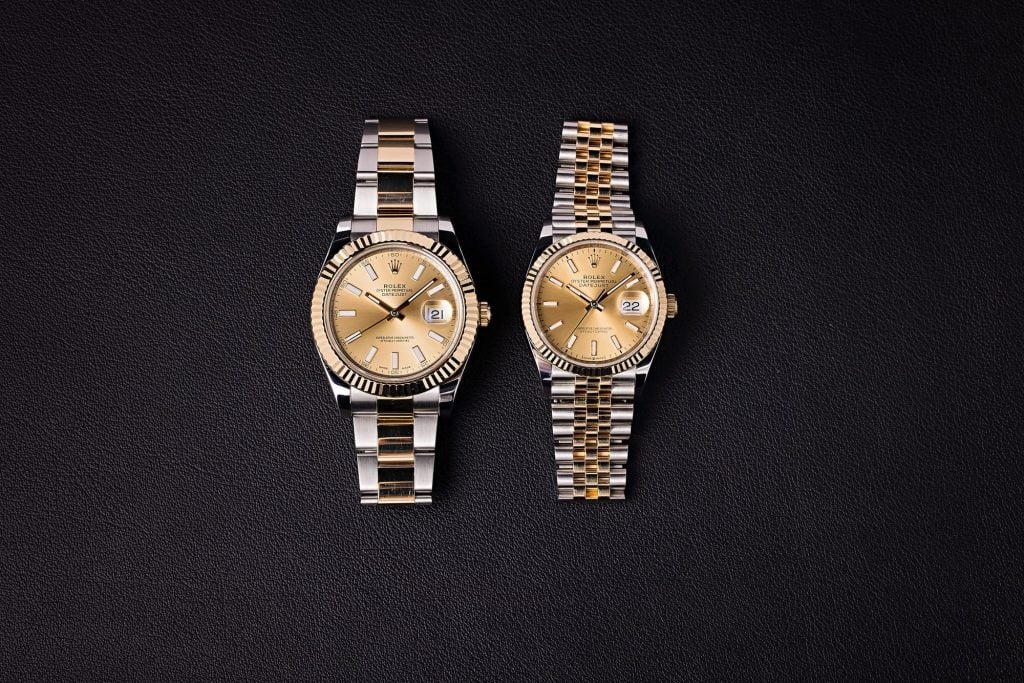
The two forks every two-tone buyer hits, with what our sales data says about each.
Yellow gold is the one people go for, and there’s no doubt about it: about nine out of ten of the two-tone watches we sell are made of steel and yellow gold. It’s also the more economical option, with a median selling price of $10,395, compared with $15,995 for steel and Everose. Before you think that rose gold is worth 50% more, you should know what’s causing that difference: Everose Rolesor is heavily skewed toward current and more recent models, whereas yellow gold spans sixty years of production. The price you’re paying is mainly due to the newness of the watch, not because of its pink color.
My own take: yellow on a champagne dial is the canonical two-tone, and champagne is in fact the most-sold dial color in our two-tone cases. Everose on a dark dial, with the Rolex Root Beer collection as the flagbearer, is the more contemporary move. Neither is wrong. One of them is cheaper.
On bracelets, our sales split almost evenly between Jubilee and Oyster so that the market won’t settle this one for you. The five-link Jubilee drapes and dresses up; the three-link Oyster sits flatter and reads sportier. Try both on. Your wrist will vote within thirty seconds, and it’s the only vote that counts.
How I Vet a Pre-Owned Two-Tone Rolex

Two-tone watches fail inspection in their own particular ways, because gold wears differently than steel. This is the order I look, every time:
- Gold wear-through on the center links and bezel. Gold is soft, and decades of wrist time thin it visibly on the links that take contact.
- Over-polished cases. Soft lugs, blurred bevels, and rounded crown guards mean metal is gone forever. On a two-tone case, the damage shows twice, once in each metal.
- Bracelet stretch on vintage hollow-link bracelets. Hold the older watch vertically; a bracelet that sags as a slinky has lived hard. Solid-link modern bracelets largely retired this problem.
- Frankenwatches, service dials, and aftermarket anything. Mixed-generation parts, replacement dials, and added aftermarket gold or diamonds all cut value, and some are outright deal-breakers.
- Papers, provenance, and reference matching. The serial and reference should agree with the paperwork, and the configuration must match what Rolex actually shipped for that reference.
Every condition claim above should be read alongside our deeper piece on what counts as original versus authentic, the Luxury Watch Buying Guide.
The honest shortcut: buy the seller as much as the watch. A dealer who stands behind authenticity and delivers clear photographs of the watch’s condition has done most of this checklist for you.
Choosing the Best Two-Tone Rolex
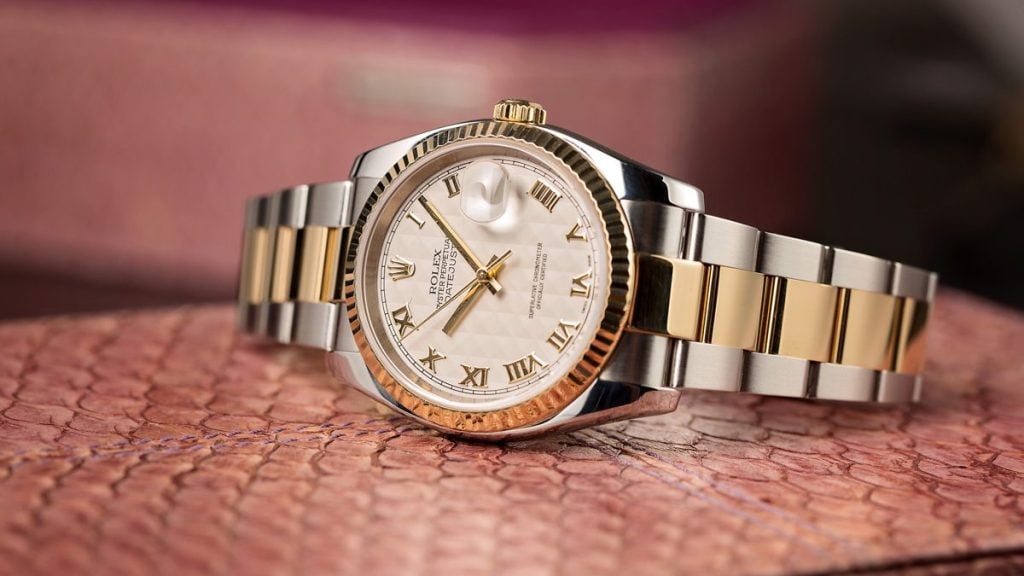
Reduce it to three choices. As for style, go for a Datejust if the watch is mostly worn under the cuff, or choose a Bluesy or GMT if it’s worn everywhere. Regarding budget, if it’s under $8,000, get a Datejust 36 or a vintage reference; in the teens, go for a Submariner or a Datejust 41; and if it’s over $16,000, consider the Daytona or the current-generation sport models. When it comes to dial color, opt for yellow if you prefer the traditional look, or go for Everose if you want the modern golden tone, keeping in mind that yellow is the more economical option.
Wherever you land, two-tone makes the most sense in the pre-owned market, and that’s where Bob’s Watches has lived since 1999. If you’re zooming out to the whole catalog first, start with our Rolex Buying Guide and come back when two-tone wins. It usually does.
Frequently Asked Questions
The post Rolex Two-Tone Review: Top Models & Buying Guide appeared first on Bob's Watches.