Bob's Watches Bob's Watches
The Rolex Kermit is the Submariner Date 16610LV: black dial, green aluminum bezel, produced from 2003 to 2010 for the Submariner’s 50th anniversary. It’s also the least expensive way into Rolex’s family of green-bezel Submariners, and, to my eye, still one of the most interesting. A pre-owned Rolex Kermit in good condition has sold for an average of $16,060 at Bob’s Watches over the last three months.
Key takeaways
- The Kermit 16610LV, produced from 2003 to 2010, is the original green-bezel Submariner; Rolex has kept a green Submariner in the catalog in some form ever since, but the aluminum-bezel original never returned.
- Based on completed Bob’s Watches transactions from over the last three months, these watches have sold for an average of $16,060.
- Early “Flat 4” bezels are the collectible variant of the reference and carry a real premium over standard inserts.
- The most common trap is a standard black-bezel Submariner wearing an aftermarket green insert, so verification matters more here than on most Submariners.
- The Kermit is generally considered a steady value holder among neo-vintage Rolex references, but no watch guarantees a profit.
What Is the Rolex Kermit?

The Kermit is a nickname, not a Rolex name. When Rolex marked the Submariner’s 50th anniversary in 2003, it released the reference 16610LV, a standard Rolex Submariner wearing a bright green bezel over a black dial in stainless steel. Collectors took one look at the green-on-black combination and named it after the famous frog. The LV in the reference stands for Lunette Verte, French for green bezel, and green is the closest thing Rolex has to a house color.
It’s hard to overstate how odd that watch looked in 2003, which Brandon Frazin, Director of Vintage at Bob’s Watches, points out:
“Before the 50th Anniversary Sub, Rolex pretty much only used black and blue bezels in the Submariner line. The green bezel was unexpected and playful. Rolex was taking a risk which is something I like to see. Now green is one of the hottest colors for watches in general.”
Brandon Frazin, Director of Vintage at Bob’s Watches
The 16610LV stayed in the catalog until 2010, then quietly left it. So yes, the Kermit is discontinued, and has been for more than 15 years. Rolex still keeps a green bezel on the current-production Submariner, but the aluminum-bezel original never came back, and that’s a large part of why a black dial, green bezel Rolex from this era gets treated as a collectible rather than just a used Submariner.
Rolex Kermit Specifications
| Spec | Rolex Kermit 16610LV |
| Case | 40mm stainless steel |
| Bezel | Unidirectional, anodized aluminum green insert |
| Dial | Black Maxi dial |
| Movement | Rolex Caliber 3135, automatic |
| Power reserve | About 48 hours |
| Crystal | Sapphire with Cyclops date magnifier |
| Water resistance | 300 meters |
| Bracelet | Stainless steel Oyster |
| Production | 2003 to 2010 |
Two of these rows matter more than the rest. The Maxi dial came first: this watch introduced oversized luminous markers and wider hands to the steel Submariner, a look Rolex later rolled out across the line. On the wrist, it reads as more dial presence without a bigger case. The second is the movement. Caliber 3135 is one of the longest-serving movements Rolex ever built, and any competent watchmaker can service it without drama. A Kermit isn’t a fragile vintage purchase. It’s a tool watch from the last great tool-watch generation.
What the spec sheet won’t tell you is that the aluminum bezel insert is the soul of the thing. It scratches, it can fade in the sun, and it ages in a way the ceramic bezels that followed never will. More on why that’s not entirely bad below.
Kermit Variations: Flat 4 and the Bezel Marks
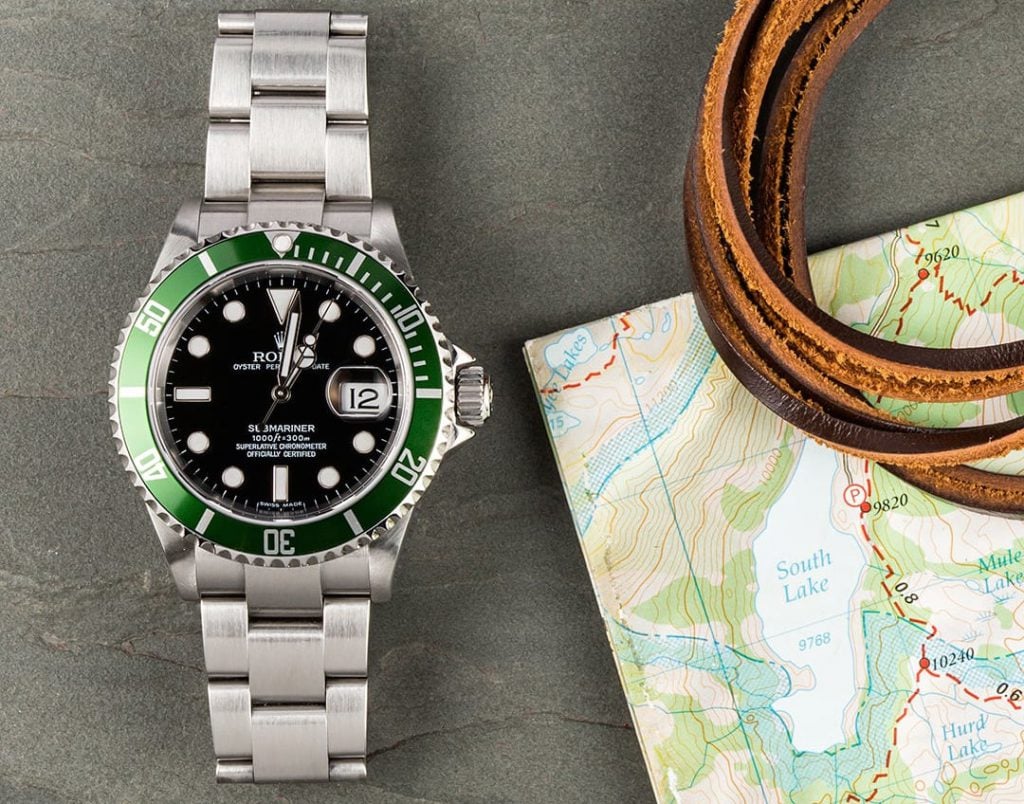
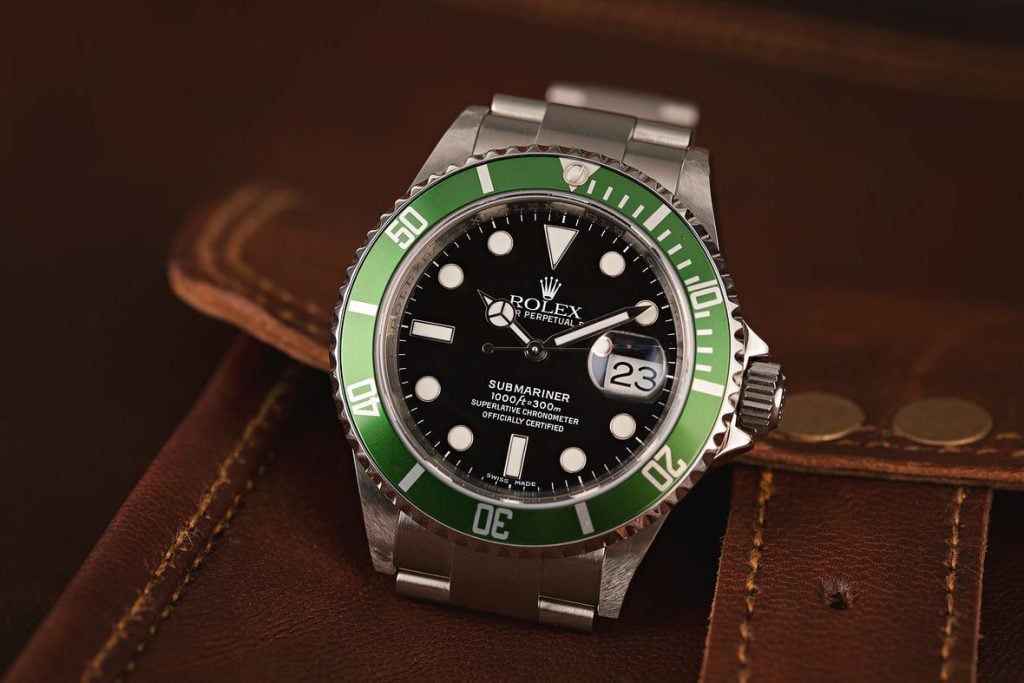
One reference, seven years of production, and a collector market that treats tiny insert differences like separate watches. Carol Altieri, COO at Bob’s Watches, describes the Kermit market as fiercely driven by small manufacturing variations across the 2003 to 2010 run, with the Flat 4 bezels found on early Y- and F-serial production considered the holy grail of the reference.
The Flat 4 is exactly what it sounds like. On the earliest inserts, the 4 in the 40 marker has a flat top instead of coming to a point. That’s the whole difference. It’s also the difference between a standard Kermit and one that trades well above the reference’s usual range, because early production was brief and collectors prize anything scarce with a story. We keep a full breakdown in our Kermit Flat 4 vs. Sharp 4 Bezel Guide.
Personally, I think the Flat 4 premium makes sense when the insert, serial range and overall condition all line up. I wouldn’t pay a premium simply because someone tells me an insert is a Flat 4.
| Variation | What to look for |
| Flat 4 insert | Flat-topped 4 in the 40 marker; the collectible one |
| Pointed 4 insert | Standard pointed 4; the typical Kermit |
| Later insert and dial marks | Small font and lume-plot differences collectors use to date a watch |
A word of caution that comes straight from handling these: inserts move between watches. Bezels are removable, and a Flat 4 insert on a 2008 watch is a parts swap, not a discovery. Serial era and insert have to agree before the premium does.
Rolex Kermit Price: What They Actually Sell For
Most pricing articles quote asking prices, which are a wish list. These are sold prices. From 2023 through September 2026, the average Kermit averages can be found below, and the vast majority of examples landed between about $12,000 and $18,000.
| Year | Average sold price | Range |
| 2023 | $14,612 | $9,395 to $23,490 |
| 2024 | $15,435 | $11,995 to $21,195 |
| 2025 | $14,759 | $12,995 to $17,995 |
| 2026 (through September) | $16,060 | $14,870 to $17,995 |
Pricing analysis is based on completed Bob’s Watches transactions from January 2023 through September 2026, not current asking prices.
Here’s how I read our own numbers. The Kermit hasn’t been a rocket, and that’s the point. Averages have held a tight band in the mid 14,000s to mid 15,000s since 2023 and firmed to $16,060 through September 2026. The ranges tell the sharper story. In 2024 examples sold anywhere from $11,995 to $21,195; in 2026 the spread has narrowed to $14,870 to $17,995, which is what a market looks like when the speculators have left and the buyers who remain actually want the watch.
Where a specific example lands inside that range comes down to the usual suspects: condition, whether the box and papers survived, bezel fade, and whether that 4 is flat or pointed. Flat 4 examples with matching serials sit at or beyond the top of these ranges. If you own one and have been wondering, this is the market telling you what your Rolex is worth has stabilized after the post-boom slide. And if you own a Kermit and the firming trend has you thinking, this is what a good time to sell Rolex watches looks like.
Buying a Pre-Owned Kermit: What We Check

Every Kermit that comes through our door gets inspected before it gets listed, and this reference has a few traps the standard Submariner doesn’t. This is what our team looks at, and what you should look at too, no matter where you end up buying it.
Spotting a Bezel Swap
The cheapest way to fake a Kermit is not to fake a Rolex at all. A standard black-bezel Submariner of the same era costs meaningfully less, and green aftermarket inserts are a few dollars online. Pop one on and an honest used Submariner becomes a dishonest Kermit. This is the single most common problem we see with this reference.
The good news: a swap is catchable, because this watch is more than its insert.
- The reference engraved on the case will not carry the LV designation (it will only inlude the numbers), instead you can find this on the warranty card or papers that the watch came with.
- The dial must be a Maxi dial with the oversized markers; a standard 16610 dial under a green bezel is the tell
- The serial’s production era has to make sense for the configuration, Flat 4 claims included
If a seller can’t show you the case reference or gets vague about the serial era, walk away.
Bezel Fade: Flaw or Feature
Aluminum inserts age. Years of sun and wear can pull the watch’s green toward lighter, sometimes almost olive tones, and every faded bezel fades differently. Ceramic-era collectors call that damage. Neo-vintage collectors call it character, and some will pay extra for an honest, evenly faded insert. Both camps are right, which is why we photograph bezels in natural light and describe fade plainly rather than pretending it isn’t there. What you should avoid is a heavily scratched or dinged insert, since replacing it with a correct period part costs real money, and an incorrect replacement drags the watch’s value down.
Box, Papers, and Watch-Only Examples
A full set, the watch with its original box and papers, sells at the top of the ranges in our pricing table. A watch-only Kermit can be thousands less, and buyers regularly ask us whether the discount is worth it. Our take: on a reference this frequently modified, papers do more than add resale value, they add provenance. A watch-only example from a dealer that authenticates in-house is a reasonable buy at the right price. A watch-only example from a stranger with a story is how people end up owning a bezel swap. Price the risk, not just the watch.
Is the Rolex Kermit a Good Investment?

The honest answer: it’s generally considered one of the steadier neo-vintage Rolex references, and our own sold data backs the steadiness more than the fireworks. Average sold prices moved from $14,612 in 2023 to $15,435 in 2024, then $14,759 in 2025 and $16,060 through September 2026. That’s a market that is corrected and stabilized, not one that promises appreciation.
What supports the reference long term is real: a seven-year production run, the 50th-anniversary story, and the Flat 4 scarcity at the top of the market. What decides any individual watch’s outcome is condition, originality, demand at the moment you sell, and whether the box and papers stayed with it. Certain examples, early Flat 4s with matching serials and full sets, may appreciate meaningfully. A worn watch-only example with a swapped insert almost certainly won’t. No Rolex, this one included, guarantees a profit, and nobody should buy a watch as a substitute for an index fund. Buy it because you want the watch. If the market cooperates, that’s the bonus.
Rolex Kermit Review Verdict: How It Wears in 2026

After handling and selling Kermits over the years, what stands out about the 16610LV is how different it feels from the modern Submariner. It’s still a 40mm Submariner, but on the wrist it feels lighter, slimmer, and a little more relaxed. It sits close to the wrist, slips easily under a cuff, and doesn’t have the broad-shouldered presence of the current case.
The aluminum bezel is a big part of the appeal for me. It scratches, fades, and changes with age, and I actually like that. No two Kermits look exactly the same after 20 years of wear. Some collectors will always prefer the consistency of a ceramic bezel, but to me, the individuality of this watch is one of the reasons to buy it in the first place.
The bracelet has some rattle and the watch doesn’t have the same solid, almost overbuilt feel of a modern Submariner. I don’t see that as a drawback. I see it as part of the charm. It feels like a Rolex from a transitional period, modern enough to wear every day, but old enough to have some personality that has been engineered out of newer models.
Would I choose it over a modern green Submariner? That comes down to what I want from the watch. If I wanted the most technically advanced, worry-free version, I’d take the ceramic model. But if I wanted a Submariner with more character, a more distinctive place in Rolex history, and a bezel that will develop its own personality over time, I’d take the Kermit.
That’s ultimately why I think the 16610LV has held its appeal. It’s not just an older green Submariner. It’s the first one, and it still feels like something a little different.
Frequently Asked Questions
The post Rolex Kermit Review: What Makes This Submariner So Special? appeared first on Bob's Watches.