Bob's Watches Bob's Watches
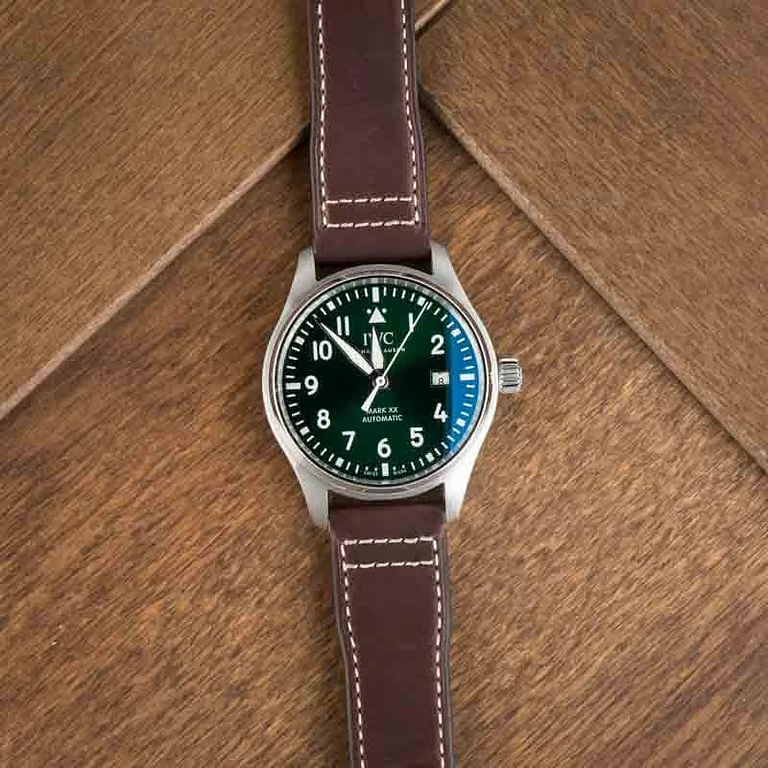
The IWC Mark XX (Ref. IW328201) is a 40mm automatic pilot’s watch that stands among the best everyday luxury tool watches in its price range, backed by the Caliber 32111 with a power reserve of 120 hours, 100 meters of water resistance, and outstanding legibility. In this review and buying guide, we break down the specs, pricing, and references, and compare the IWC Mark XX to the Mark XVIII and the Big Pilot’s Watch so you can decide whether it belongs on your wrist. We also cover the watch’s history, its strengths and weaknesses, and the alternatives worth considering before you buy.
Key Takeaways
- Stainless steel case measuring 40mm across and 10.8mm thick, with 100 meters of water resistance and a soft iron inner case for magnetic protection
- IWC Caliber 32111 automatic movement with a power reserve of 120 hours
- Retail price of about $5,250 on a calfskin strap and about $6,150 on the five row stainless steel bracelet
- Six core references: IW328201 (black dial), IW328203 (blue dial), IW328205 (green dial), plus matching bracelet versions
- Key upgrades over the Mark XVIII include the movement, improved water resistance, and the EasX-CHANGE strap system
- Best suited to buyers who want one versatile luxury watch for daily wear
- Strongest alternatives include the IWC Big Pilot’s Watch 43, the Rolex Explorer, and the Tudor Black Bay 41
The Mark series traces its roots to a military commission from 1948, and few watch families have stayed this consistent for this long. The Mark XX has also stirred debate among collectors, with some praising its refinements and others wishing IWC had returned to a smaller case. Below, we look at both sides, walk through every detail of the watch, and lay out what you should know before spending your money.
What Is the IWC Mark XX?

The IWC Mark XX is the entry point into IWC’s Pilot’s Watch collection and the direct descendant of the Mark 11, the timepiece IWC built for the British Royal Air Force in 1948. Released in 2022, the Mark XX keeps the formula that made its ancestors famous: a clean dial, strong luminescence, magnetic protection, and a case built to take daily wear. It is a time and date watch with no extra complications, which is exactly the point.
| Specification | Detail |
| Reference numbers | IW328201 through IW328206 |
| Case diameter | 40mm |
| Case thickness | 10.8mm |
| Case material | Satin finished stainless steel |
| Weight | About 80 grams on the strap |
| Water resistance | 100 meters |
| Crystal | Sapphire, antireflective on both sides |
| Movement | IWC Caliber 32111, automatic |
| Power reserve | 120 hours (5 days) |
| Frequency | 28,800 vph |
| Jewels | 21 |
| Magnetic protection | Soft iron inner case |
| Strap system | EasX-CHANGE quick release with standard spring bars |
| Retail price | About $5,250 on strap, about $6,150 on bracelet |
The collection includes black, blue, and green dial options, each available on a calfskin strap or a five row stainless steel bracelet. The black dial version remains the classic choice and the closest to the original military design.
IWC Mark Series History: From the Mark 11 to the Mark XX
The story begins in 1948, when the Royal Air Force commissioned IWC watches to build a navigator’s watch. The result was the Mark 11, a simple steel timepiece with a black dial, a triangle at 12 o’clock, generous luminous material, and an inner case of soft iron to shield the movement from magnetic fields in the cockpit. IWC produced it until 1981, and collectors kept chasing it long after production ended. Rising auction demand convinced IWC to revive the line in 1994, and the series has run without interruption since.
| Model | Year | Size | Movement | Defining Change |
| Mark 11 | 1948 | 36mm | Caliber 89 (manual) | The original RAF navigator’s watch |
| Mark XII | 1994 | 36mm | JLC based Caliber 884 | Automatic winding and a date display |
| Mark XV | 1999 | 38mm | ETA based Caliber 37524 | Larger case and a polished bezel |
| Mark XVI | 2006 | 39mm | ETA based Caliber 30110 | Big Pilot style hands and numerals |
| Mark XVII | 2012 | 41mm | ETA based Caliber 30110 | Largest Mark, triple date window |
| Mark XVIII | 2016 | 40mm | ETA based Caliber 30110 | Return to a cleaner, smaller design |
| Mark XX | 2022 | 40mm | IWC Caliber 32111 | Upgraded movement and water resistance |
One detail collectors love to share: there is no Mark XIII, XIV, or XIX. IWC skipped those numbers because 13, 14, and 19 are considered unlucky in various parts of the world. It is a small quirk that says a lot about how carefully the brand manages this family of watches.
IWC Mark XX Review: Hands On With the Design and Specs

Spec sheets only tell part of the story, and the Mark XX earns its reputation in the details. This section covers how the case wears, how the dial performs in real conditions, what the movement delivers day to day, and how the strap system works. Each element follows the same principle that guided the Mark 11: nothing on the watch exists without a purpose.
Case and Wearability
The Mark XX uses a satin finished stainless steel case measuring 40mm across, 10.8mm thick, and roughly 49mm from lug to lug. A polished bezel adds a touch of refinement, a detail first introduced on the Mark XV in 1999, while the screw down crown is large, ribbed, and easy to operate. The solid caseback carries an engraving of a Ju-52 aircraft and screws down tight, contributing to the 100 meter water resistance rating. At about 80 grams on the strap, the watch feels solid without becoming a burden.
On the wrist, the proportions work. The slim profile slides under a shirt cuff, and the case suits wrists from about 6.25 inches up to 7.5 inches and beyond. Some collectors in online communities have pushed for a 36mm or 38mm version that would sit closer to the original Mark 11, and that criticism is fair. Still, 40mm is the mainstream sweet spot for a sports watch today, and the measured thickness keeps the Mark XX from wearing large.
Dial, Hands, and Legibility
The matte black dial follows the template set in 1948. Arabic numerals mark every hour except 3 o’clock, where a date window sits, and a luminous triangle flanked by two dots anchors the 12 o’clock position. The Mark XX brought back two details from earlier generations: the markers at 3, 6, 9, and 12 are longer than the rest, and the date disk is white rather than color matched. The white disk improves contrast and nods to the Mark XII and Mark XV. Rhodium plated hands replaced the black hands of the Mark XVIII, catching light in a way that lifts the whole dial.
Legibility is where this watch earns its keep:
- Sapphire crystal with antireflective coating on both sides
- Super-LumiNova on the hands, the four main markers, and the 12 o’clock triangle
- High contrast white printing on a matte black surface
- A clean minute track around the dial’s outer edge
Purists still debate the hands. The original Mark watches used slim pencil shaped hands, while the current broadsword style arrived in 2006 and borrows from the Big Pilot. IWC has used the older design on special Tribute editions, so buyers who prefer the vintage look have options on the secondary market. The blue dial (IW328203) and green dial (IW328205) versions add color for those who want it, though the black dial remains the definitive Mark.
Movement: IWC Caliber 32111
Inside the Mark XX runs the Caliber 32111, an automatic movement beating at 28,800 vph with 21 jewels and a power reserve of 120 hours. That five day reserve is the headline upgrade over the Mark XVIII, which ran about 42 hours on its ETA based caliber. In practical terms, you can set the Mark XX down on Friday evening and pick it up Wednesday morning still running on time. The movement includes a stop seconds function for precise setting and a quick set date.
Some honesty is in order here. IWC markets the 32111 as a manufacture caliber, but it is built by Valfleurier, the movement specialist within the Richemont Group, and versions of it also appear in watches from Baume & Mercier and Panerai. That does not make it a lesser movement. Experts who have tested the Mark XX report accuracy around one second per day on the wrist, which is excellent performance at this price. Buyers should simply know what they are getting: a proven group caliber rather than a movement exclusive to IWC. The caseback stays closed because of the soft iron cage, so you will not see the movement, though it carries circular graining and Geneva stripes underneath.
Bracelet, Straps, and the EasX-CHANGE System
The Mark XX ships on a black calfskin strap or a five row stainless steel bracelet that costs about $900 more. The bracelet echoes the brick pattern of vintage IWC bracelets and drapes comfortably, though its polished center links pick up small scratches with regular wear. Between the two, the bracelet delivers the more complete package, and it transforms the watch into a true daily wearer. The calfskin strap keeps the classic military character and pairs well with the black dial.
The EasX-CHANGE system deserves credit. Press the release and the strap pops free, no tools required. What sets it apart from most proprietary systems is that it works around standard spring bars, so any 20mm aftermarket strap still fits. Owners are not locked into buying straps from IWC, which is a genuinely useful advantage that many quick release systems fail to offer. Nylon straps, leather options, and rubber all suit the watch, making it one of the most versatile pieces in this segment.
IWC Mark XX vs Mark XVIII: What Actually Changed
At a glance, the Mark XX and the Mark XVIII look nearly identical. Both measure 40mm, share the same numeral typography, and carry the same overall design. The meaningful changes sit under the surface, and they add up to more than the visual similarity suggests.
| Feature | Mark XVIII | Mark XX |
| Movement | Caliber 30110 (ETA 2892 base) | Caliber 32111 |
| Power reserve | 42 hours | 120 hours |
| Water resistance | 60 meters | 100 meters |
| Hands | Black | Rhodium plated |
| Date disk | Matched to dial | White |
| Hour markers at 3, 6, 9, 12 | Same length as others | Longer, per Mark tradition |
| Strap system | Standard spring bars | EasX-CHANGE quick release |
For buyers choosing between the two, the Mark XX is the stronger watch on paper and on the wrist. The movement upgrade alone justifies the gap in most cases. That said, the Mark XVIII trades at attractive prices on the pre-owned market, and it delivers most of the same experience for meaningfully less money. If the five day power reserve and improved water resistance matter to you, buy the Mark XX. If value is your priority, a well kept pre-owned Mark XVIII remains one of the smartest entries into luxury pilot’s watches.
IWC Mark XX vs Big Pilot’s Watch 43
The Big Pilot’s Watch is IWC’s flagship aviation piece, and the two models have grown closer in design over the years. The Big Pilot 43 dropped the power reserve display and the oversized 46mm case of earlier generations, which puts it in more direct competition with the Mark XX than ever before.
| Feature | IWC Mark XX | Big Pilot’s Watch 43 |
| Case diameter | 40mm | 43mm |
| Movement | Caliber 32111 | In house Caliber 82100 |
| Power reserve | 120 hours | 60 hours |
| Date display | Yes | No |
| Caseback | Closed, soft iron cage | Sapphire display |
| Crown | Screw down, ribbed | Signature conical crown |
| Retail price | About $5,250 | About $8,950 |
Buy the Mark XX if you want the more wearable, more versatile watch with the longer power reserve at a significantly lower price. Buy the Big Pilot 43 if you want IWC’s signature statement piece, the in house movement, and the display caseback, and the larger case suits your wrist. For most buyers building a practical collection, the Mark XX is the stronger value, and the roughly $3,700 saved goes a long way toward a second watch.
IWC Mark XX Price, References, and Where to Buy
Pricing on the Mark XX is straightforward, with the strap and bracelet configurations setting the two tiers. The table below covers the six core references. Always confirm current pricing with IWC directly, as retail figures adjust over time.
| Reference | Dial | Strap or Bracelet | Approximate Retail |
| IW328201 | Black | Black calfskin strap | $5,250 |
| IW328202 | Black | Stainless steel bracelet | $6,150 |
| IW328203 | Blue | Blue calfskin strap | $5,250 |
| IW328204 | Blue | Stainless steel bracelet | $6,150 |
| IW328205 | Green | Brown calfskin strap | $5,250 |
| IW328206 | Green | Stainless steel bracelet | $6,150 |
Buying at retail comes with one notable perk: IWC extends the standard warranty to a total of eight years when owners register the watch through the brand’s My IWC program. Boutiques and authorized dealers generally keep the Mark XX in stock, since it is a core collection piece rather than a limited release.
The pre-owned market is where the Mark XX gets interesting. Examples in excellent condition typically trade below retail, and full sets with box and papers command a premium worth paying. When shopping pre-owned, check the condition of the lugs and the EasX-CHANGE fittings, confirm the reference number against the caseback, and ask about service history. The Mark XX holds its value reasonably well for a luxury sports watch outside the Rolex catalog, though buyers should expect normal depreciation from retail rather than treat it as an investment. That honest math is exactly why pre-owned examples represent such strong value.
IWC Mark XX Pros and Cons
Every watch involves tradeoffs, and the Mark XX is no exception. Here is the balanced picture.
Pros
- Power reserve of 120 hours leads its class
- Outstanding legibility in all lighting conditions
- Versatile design that works with a suit or a t-shirt
- 100 meters of water resistance with a screw down crown
- Soft iron cage protects against magnetism
- Quick release straps that still accept standard spring bars
- Direct lineage to one of the most respected military watches ever made
Cons
- Closed caseback hides a decorated movement
- Group caliber marketed with manufacture language
- Offered in 40mm only, with no smaller option
- Polished center links on the bracelet scratch easily
- Price climbed compared to the Mark XVIII at launch
- Date window divides purists who prefer the original layout
Who Should Buy the IWC Mark XX (And Top Alternatives)

The Mark XX makes the most sense for buyers who want one luxury watch that handles everything. It dresses up, it dresses down, it survives a swim, and it runs for five days off the wrist. First time luxury buyers get genuine heritage without the waiting lists attached to some competitors, and seasoned collectors get a refined take on a design with more than 75 years of history behind it.
Buy it if:
- You want a single do it all watch with real military heritage
- Legibility and practicality rank above flash
- You value a long power reserve and easy strap changes
Skip it if:
- You want a case smaller than 40mm
- A display caseback matters to you
- You prefer a movement exclusive to one brand
Worthwhile alternatives include the IWC Pilot’s Automatic Spitfire 39, which offers a smaller case within the same family, and the Rolex Explorer 40, the benchmark for simple luxury sports watches. The Tudor Black Bay Pro and Tudor Ranger deliver tool watch character at lower prices, the Longines Spirit line offers chronometer certification for less, and the Sinn 856 provides serious antimagnetic performance at a fraction of the cost. Each takes a different path to the same goal, but none matches the Mark XX’s specific blend of heritage, refinement, and everyday usability.
The Final Verdict: Is the IWC Mark XX Worth It?
Yes, the IWC Mark XX is worth buying for anyone who wants a luxury pilot’s watch built for daily wear. The upgraded movement, the five day power reserve, the improved water resistance, and the strap system fix nearly every complaint leveled at the Mark XVIII, and the design carries decades of history without feeling dated. Few watches at this price deliver the same combination of capability and pedigree.
The caveat is one of taste rather than quality. Collectors who want the compact spirit of the original Mark 11 may prefer a vintage example or hope IWC eventually offers a smaller case. For everyone else, the Mark XX represents the Mark series at its most complete, and pre-owned examples make the value proposition even stronger. It is a watch you buy to wear, not to store, and that has been the point since 1948.
Frequently Asked Questions
The post IWC Mark XX Review (Buying Guide): Specs, Price, and Is It Worth It? appeared first on Bob's Watches.