Bob's Watches Bob's Watches
The Grand Seiko Spring Drive is a proprietary watch movement developed by Seiko that pairs the high torque of a traditional mechanical watch with the pinpoint precision of an electronic quartz oscillator. It runs entirely on a wound mainspring, with no battery, yet keeps time to within about one second a day, or roughly 15 seconds a month. Its signature trait is a second hand that does not tick or beat. Instead, it glides across the dial in one smooth, continuous sweep that mirrors the steady flow of time itself.
Key Takeaways:
- A true hybrid: Powered by a mainspring like a mechanical watch, but regulated by the Tri-Synchro Regulator, which uses a quartz crystal and an integrated circuit.
- The glide motion: The second hand moves in a smooth, uninterrupted sweep, unlike the tick of a quartz watch or the beat of a mechanical one.
- Strong accuracy: Standard calibers hold about ±1 second per day, while the advanced 9RA series and the 9R01 reach roughly ±10 seconds per month.
- A long road to market: First imagined by Seiko engineer Yoshikazu Akahane in 1977 and released under the Grand Seiko name in 2004.
Few movements spark as much debate among collectors. Is the Spring Drive mechanical, quartz, or something else entirely? Online communities have argued the point for years. This guide breaks down how the Spring Drive works, walks through the calibers and collections that carry it, and explains why this movement holds such a respected place in modern watchmaking.
What Is a Grand Seiko Spring Drive Movement?
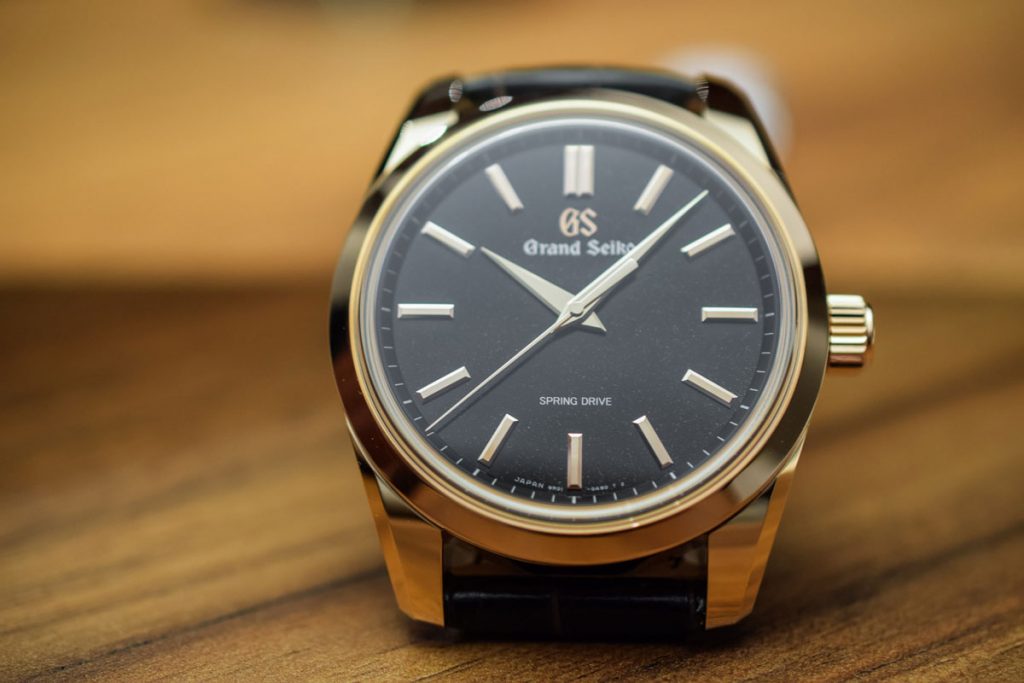
A Grand Seiko Spring Drive movement is the result of a simple but ambitious goal: build a watch with the endurance and soul of a mechanical caliber and the accuracy of quartz, without compromising on either. Traditional mechanical watches are powered by a mainspring and prized for their craft, yet they drift by several seconds a day. Quartz watches keep far better time but rely on a battery and lack the living character that enthusiasts love. Seiko set out to bridge that gap and create what some have described as a “forever watch,” one that draws its power from a mainspring while answering to the steady beat of a quartz crystal.
This is where the hybrid debate begins. To be clear, the Spring Drive Grand Seiko movement has no battery, no power cell, and no electric motor driving the hands. It is powered completely by mechanical energy stored in a wound mainspring, exactly like any traditional watch. The quartz crystal and integrated circuit inside do not power the watch. They only regulate it. That distinction is the key to understanding why the Spring Drive sits in a category of its own, separate from both pure mechanical and pure quartz watches.
How Does the Spring Drive Work? Inside the Tri-Synchro Regulator

At the heart of every Grand Seiko Spring Drive watch is a component Grand Seiko calls the Tri-Synchro Regulator. The name refers to the three types of energy it manages: mechanical, electrical, and electromagnetic. In a standard mechanical watch, a balance wheel and escapement control how quickly the mainspring releases its energy. The Spring Drive removes that assembly entirely and replaces it with a single spinning part known as the glide wheel. Here is how the energy moves through the movement from start to finish:
- Mechanical power. The mainspring unwinds just as it would in any mechanical watch, releasing stored energy and producing the high torque needed to drive large, heavy hands.
- Transmission. The gear train carries that energy to the glide wheel, which takes the place of the traditional balance wheel and escapement.
- Electrical power. As the glide wheel spins, it passes a coil and generates a tiny electric current. That current powers an integrated circuit and a quartz oscillator, which vibrates at exactly 32,768 times per second.
- Electromagnetic braking. The integrated circuit compares the glide wheel’s speed against the steady reference signal from the quartz crystal. If the wheel runs too fast, the circuit applies a contactless electromagnetic brake to slow it down, holding it to exactly eight rotations per second.
Because the brake never physically touches the wheel, there is no friction and no wear at the point of regulation. The table below shows how the Spring Drive compares with a traditional mechanical watch.
| Feature | Traditional Mechanical Watch | Grand Seiko Spring Drive |
| Power source | Mainspring | Mainspring |
| Regulation system | Balance wheel and escapement | Tri-Synchro Regulator (IC and quartz) |
| Battery or cell | None | None |
| Second hand motion | Beating or ticking in small steps | One smooth, continuous glide |
| Friction at regulation | High (pallet and escape wheel contact) | None (contactless magnetic braking) |
| Typical accuracy | About -4 to +6 seconds per day | About ±1 second per day |
Why the Spring Drive Second Hand Glides
The smooth sweep of the second hand is the most recognizable trait of any Grand Seiko Spring Drive watch, and it comes straight from the way the movement is regulated. In a mechanical watch, the escapement locks and releases the gear train many times each second. That start and stop motion is what creates the familiar ticking step of the second hand. The Spring Drive has no escapement to interrupt the flow, so the gear train never pauses.
Because the glide wheel turns continuously under the control of the electromagnetic brake, the second hand it drives moves in one unbroken motion across the dial. There are no individual steps and no audible tick. Grand Seiko treats this as more than a technical side effect. The brand designs its watches around the idea of capturing the natural, continuous flow of time, and the gliding second hand is the clearest expression of that philosophy on the wrist.
The Evolution of the Spring Drive Movement

Grand Seiko has refined the Spring Drive across several generations of calibers since its commercial debut. Each new movement has pushed power reserve, accuracy, or design further, while keeping the core Tri-Synchro Regulator intact. The calibers below trace that progress from the everyday workhorse to the studio masterpiece.
Caliber 9R65: The Modern Standard
Introduced in 2004, Caliber 9R65 brought Spring Drive into the Grand Seiko lineup and remains the foundation of the collection. It offers a power reserve of 72 hours and accuracy of about ±1 second per day, which works out to roughly ±15 seconds per month. Reliable and refined, it powers many of the brand’s most popular automatic models. Its later siblings expanded the family with added functions, including a GMT in the 9R66 and a chronograph in the 9R86.
Caliber 9R01: The Masterpiece Movement
Caliber 9R01 represents the high end of Spring Drive watchmaking. Built by hand at Grand Seiko’s Micro Artist Studio, it uses a series of three barrels arranged in sequence to deliver a power reserve of eight days, or 192 hours, and keeps time to within ±10 seconds per month. Its layout and finishing draw inspiration from the landscape around Lake Suwa, and it sits inside some of the brand’s rarest precious metal pieces.
Caliber 9RA5 and 9RA2: The Latest Generation
Launched in 2020 and 2021, the 9RA5 and 9RA2 are the most advanced Spring Drive movements to date. They run slimmer than the 9R6 series, extend the power reserve to five days, or 120 hours, and move the power reserve indicator to the caseback for a cleaner dial. A carefully selected quartz oscillator and an integrated temperature sensor push accuracy to ±10 seconds per month, or about half a second a day.
Grand Seiko Collections Featuring the Spring Drive Movement

Grand Seiko organizes its Spring Drive watches into distinct collections, each with its own design language and purpose. Whether you want a quiet dress watch or a rugged tool watch, there is a Spring Drive built for it. The families below cover most of what you will find across the current range.
Heritage Spring Drive
The Grand Seiko Heritage line holds the classic, everyday models that most people picture when they think of Grand Seiko. This collection is home to the famous “Snowflake,” reference SBGA211, whose textured white dial and gliding second hand have made it one of the brand’s signature watches.
Evolution 9 Spring Drive
Grand Seiko Evolution 9 is the brand’s modern design direction. These watches feature wider lugs, a lower center of gravity, and the latest calibers for a sharper, more contemporary look. The “White Birch,” reference SLGA009, with a dial pattern inspired by the bark of a white birch tree, is one of the most celebrated pieces in the series.
Elegance Spring Drive
The Grand Seiko Elegance collection leans dressy, with slim profiles and clean dials. Several models use manually wound Spring Drive calibers, which allow a thinner case that sits comfortably under a shirt cuff.
Sport Spring Drive
Built for the outdoors, the Grand Seiko Sport collection includes GMTs, dive watches, and chronographs powered by calibers such as the 9R86. These watches pair the precision of Spring Drive with the durability needed for demanding conditions.
Masterpiece Spring Drive
At the very top sits the Grand Seiko Masterpiece collection. These watches use rare metal cases, dials finished by hand, and the 9R01 movement from the Micro Artist Studio with its power reserve of eight days, representing the peak of what Grand Seiko Spring Drive watches can be.
Investing in a Spring Drive Powered Watch

The Grand Seiko Spring Drive movement is far more than a clever blend of old and new. It solved a problem that many watchmakers considered out of reach, joining the torque and character of a mechanical engine with the steady precision of an electronic regulator. In doing so, Grand Seiko carved out a space in high horology that no other brand occupies in quite the same way.
Whether you are drawn to the silent sweep of the Snowflake or the engineering behind the Evolution 9 series, owning a Spring Drive means living with a rare balance of artistry and accuracy. It stands as a clear statement of Japanese innovation, a movement that does not simply measure time but reflects the way it actually flows.
Frequently Asked Questions
The post Grand Seiko Spring Drive Explained: Complete Guide to one of the Greatest Innovations appeared first on Bob's Watches.