Bob's Watches Bob's Watches
Rolex watches do not have batteries. Every Rolex in the current collection runs on a mechanical Perpetual movement that converts wrist motion into energy stored in a mainspring. The exceptions are historical. Rolex built battery-powered quartz references from 1970 until 2001, most famously the Rolex Oysterquartz, and those models do use a battery.
Key Takeaways
- Rolex does not use batteries in any watch currently in production.
- A Rolex Perpetual movement winds itself from the motion of the wearer’s wrist and stores that energy in a mainspring.
- Modern Rolex calibers hold a power reserve of roughly 48 to 72 hours depending on the generation of the movement.
- The Rolex Oysterquartz, produced from 1977 until 2001, is the brand’s only battery-powered watch line.
- Rolex’s first battery-powered watch was the reference 5100 of 1970, released seven years before the Oysterquartz.
Two things settle this question for good. The first is how a mechanical Rolex generates and stores power without any electrical source. The second is the short list of specific references that break the rule, which is smaller and older than most owners expect.
Do Rolex Watches Have Batteries? The Short Answer
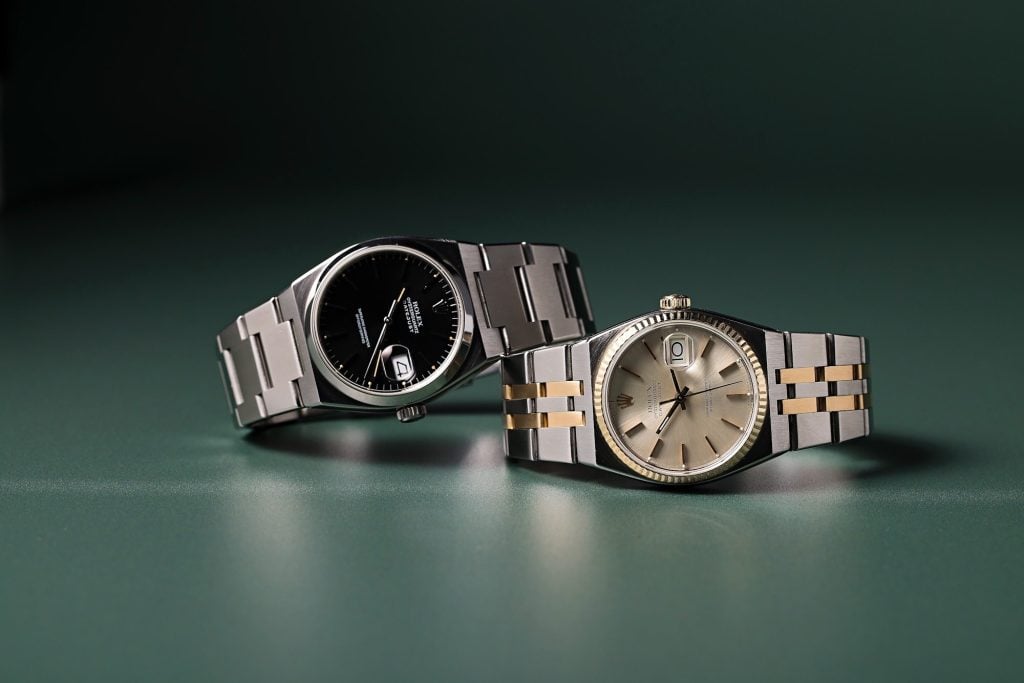
Rolex watches do not use batteries, with one historical exception. Every Rolex in the current catalog is a mechanical watch powered by a self-winding Perpetual movement that stores energy in a mainspring rather than drawing it from a cell. The only battery-powered Rolex watches are the quartz references produced between 1970 and 2001, led by the Oysterquartz Datejust and the Oysterquartz Day-Date.
For most owners the practical answer is simpler still. Any Rolex manufactured within the last twenty years is a mechanical watch, and no battery will ever need replacing in it. Rolex addresses the question in its own customer FAQ, and the brand has not produced a quartz movement since the Oysterquartz production ended in 2001 (but sold up until 2003).
How Rolex Watches Work Without a Battery
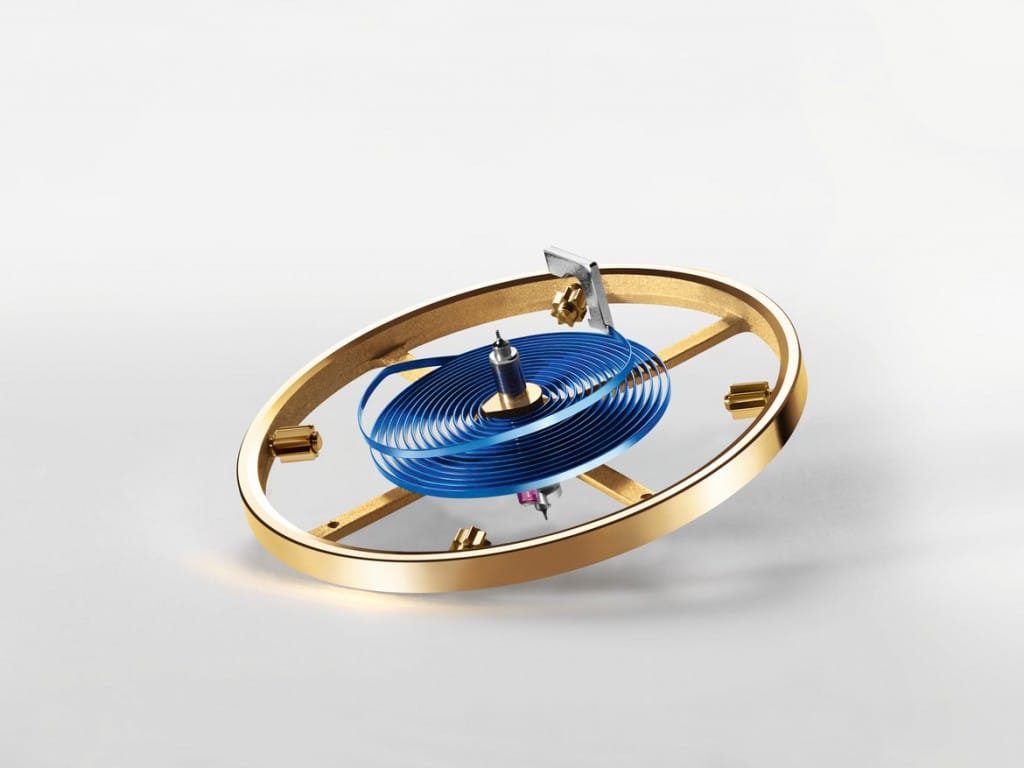
A Rolex works without a battery by capturing the motion of the wearer’s wrist and storing it as mechanical tension in a coiled mainspring. That stored tension is released through a train of gears at a rate controlled by the escapement, which is what turns raw energy into accurate timekeeping. The system is entirely mechanical, and the wearer is the power source.
The Perpetual Rotor and the Mainspring
The Perpetual rotor is a semicircular weighted disc that pivots freely inside the case and winds the mainspring as the wearer moves. Rolex has used a version of this architecture in nearly every watch it has built since the 1930s. The sequence runs in four steps.
- Wrist motion turns the rotor, which spins on a central pivot in both directions.
- The rotor’s rotation is transmitted through a reduction gear to wind the mainspring inside the barrel.
- The mainspring releases that energy gradually through the gear train to the hands.
- The escapement regulates the release into even increments, which is what keeps the watch accurate rather than simply running.
Rolex invented and patented the self-winding Perpetual rotor mechanism in 1931, five years after introducing the waterproof Oyster case in 1926. A watch left unworn will eventually stop, and that is normal behavior rather than a fault. Winding the crown restores the mainspring, and every Rolex Perpetual movement can also be wound by hand.
Rolex Power Reserve by Caliber Generation
Power reserve is the length of time a fully wound Rolex keeps accurate time after it comes off the wrist. The figure varies by movement generation rather than by model family.
| Caliber | Found In | Power Reserve |
| 3135 | Earlier Submariner and Datejust references | Approximately 48 hours |
| 3235 | Current Datejust and Submariner Date | Approximately 70 hours |
| 3285 | Current GMT-Master II | Approximately 70 hours |
| 4131 | Current Cosmograph Daytona | Approximately 72 hours |
The caliber generation, not the model name, sets the figure, which is why two Datejust references from different eras can differ by more than a full day of reserve.
Inside a Modern Rolex Caliber
An Oysterquartz Datejust ref. 17013 and a current Datejust running caliber 3235 differ visibly at the seconds hand. The 3235 oscillates at 28,800 vibrations per hour, so its seconds hand advances in eight small steps every second and reads as a continuous sweep, while the quartz caliber 5035 in the Oysterquartz moves the hand in a single full jump once per second. The difference is a direct consequence of the movement architecture, not a styling decision.
The caliber 3235 is a self-winding mechanical movement built around the Chronergy escapement, a Rolex patented escapement geometry introduced in 2015 that improves the efficiency of energy transfer from the mainspring. It also carries a paramagnetic blue Parachrom hairspring and Paraflex shock absorbers. Movements of this generation are certified as Superlative Chronometers, a Rolex specification of minus 2 to plus 2 seconds per day measured after the movement is cased, tested on top of the chronometric certification the movement receives before casing.
The Rolex Oysterquartz: The One Rolex Line Built Around a Battery
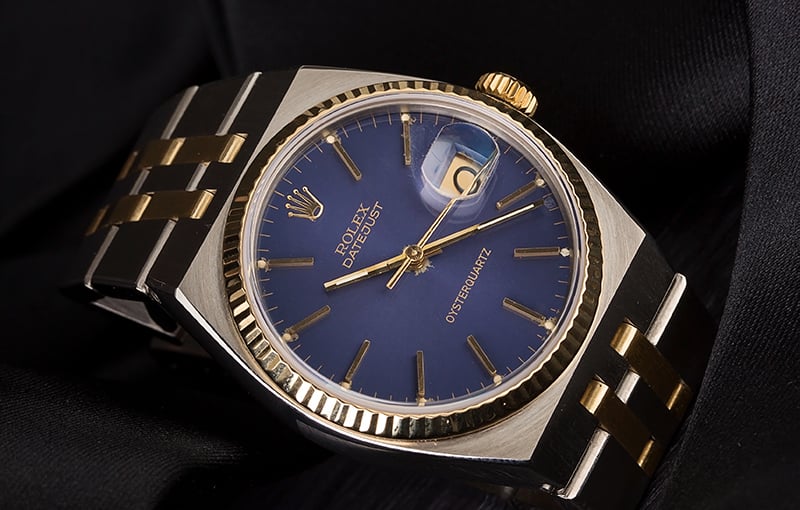
The Rolex Oysterquartz is a battery-powered quartz watch line that Rolex produced from 1977 until 2001 in the Rolex Datejust and Rolex Day-Date configurations. It runs on a cell rather than a mainspring, which means it needs a battery replacement at intervals rather than winding. Its seconds hand advances in a single jump once per second, and its case is noticeably more angular than a standard Datejust, with flat brushed surfaces and a bracelet integrated into the case rather than fitted to it.
Rolex developed two calibers for the line in-house, the 5035 for the Oysterquartz Datejust and the 5055 for the Oysterquartz Day-Date. Both are thermocompensated quartz calibers, meaning they correct for the effect of temperature change on the oscillator, and both were more accurate than any mechanical Rolex caliber of the period. The five references below are the core of the line.
| Reference | Model and Metal | Caliber |
| 17000 | Oysterquartz Datejust, stainless steel | 5035 |
| 17013 | Oysterquartz Datejust, steel and yellow gold | 5035 |
| 17014 | Oysterquartz Datejust, steel with white gold bezel | 5035 |
| 19018 | Oysterquartz Day-Date, 18k yellow gold | 5055 |
| 19019 | Oysterquartz Day-Date, 18k white gold | 5055 |
The steel 17000, the two-tone 17013 and the yellow gold 19018 are the references that most often reach the pre-owned market, while the 17014 and the 19019 surface far less frequently.
Rolex built the Oysterquartz in small numbers relative to its mechanical output, and the line is collectible today for exactly the reason it was once overlooked. Quartz movements arrived in force in the 1970s, and the Swiss industry responded to that pressure in different ways. Rolex answered by engineering a quartz caliber to its own standards and housing it in its own case language, which is the only time the brand paired its case styling with a battery-driven, high-precision quartz movement. Rolex ended production of the line in 2001. Remaining stock continued to sell through dealers into 2003, and the brand never published a final production date.
“For years the Oysterquartz was treated as the odd Rolex nobody wanted. Collectors now look at it as the only battery-powered watch Rolex ever engineered itself, and interest in the line reflects that shift.”
Carol Altieri, COO of Bob’s Watches
Rolex’s First Battery-Powered Watch Was Not the Oysterquartz

Rolex released its first battery-powered watch in 1970, seven years before the Oysterquartz. The reference 5100 was a numbered series of 1,000 pieces powered by the Beta 21, a quartz caliber developed by the Centre Electronique Horloger, a research consortium formed in 1962 by Rolex and twenty other Swiss manufacturers. Rolex later left the consortium and spent roughly five years developing the in-house calibers 5035 and 5055 that would power the Oysterquartz.
The 5100 launched in June 1970 and the entire series sold through by 1972. The Beta 21 module was too large for any existing Oyster case, so Rolex built a new one around it, angular in profile with an integrated bracelet, and fitted it with a sapphire crystal, the first Rolex to use one.
The widely repeated claim that the Oysterquartz was the only battery-powered Rolex is inaccurate. Rolex produced two distinct quartz chapters, the 5100 of 1970 with a consortium movement and the Oysterquartz from 1977 with movements of its own design.
How to Tell Whether a Rolex Is Mechanical or Battery Powered

A Rolex can be identified as mechanical or battery-powered in seconds, without opening the case. Five checks settle it.
- Watch the seconds hand. A continuous sweep indicates a mechanical Perpetual movement. A single jump each second indicates quartz.
- Check the case profile. Oysterquartz cases are markedly more angular than a standard Datejust and use a bracelet integrated into the case.
- Read the dial text. Oysterquartz models carry the word Oysterquartz on the dial.
- Check the reference number engraved between the lugs against the Oysterquartz references 17000, 17013, 17014, 19018 and 19019.
- Listen in a quiet room. A mechanical Rolex produces a rapid, fine sound from the escapement rather than one audible tick per second.
These checks also matter when buying. A watch marked Rolex whose seconds hand jumps once per second, in a case that is not one of the Oysterquartz references, warrants authentication by a specialist before money changes hands. A jumping seconds hand on its own does not prove a counterfeit, since it is exactly what an Oysterquartz should do, so the case, dial and reference all need to agree. Buyers can also verify a Rolex serial number and production year to confirm that the movement type and the era of the watch line up.
What Happens When a Rolex Stops Running

A Rolex that stops running has almost always run out of stored energy rather than failed. The mainspring has unwound because the watch sat unworn, and the fix takes less than a minute. Four steps cover nearly every case.
- Wind the crown approximately 25 turns clockwise to restore tension in the mainspring, then set the time and date.
- Wear the watch regularly, or keep it on a watch winder, if it sits in a rotation rather than serving as a daily watch.
- Have the watch serviced if it stops while worn daily or runs outside its accuracy specification. Rolex recommends servicing approximately every 10 years, depending on how the watch is used.
- Take an Oysterquartz to a watchmaker experienced with calibers 5035 and 5055 for a battery replacement, since parts for these movements are no longer produced and a general jeweler may not have handled one.
A mechanical Rolex remains serviceable for decades because its components can be cleaned, lubricated and replaced, which is the real answer to how long one of these watches lasts.
Oysterquartz Values in the Pre-Owned Market
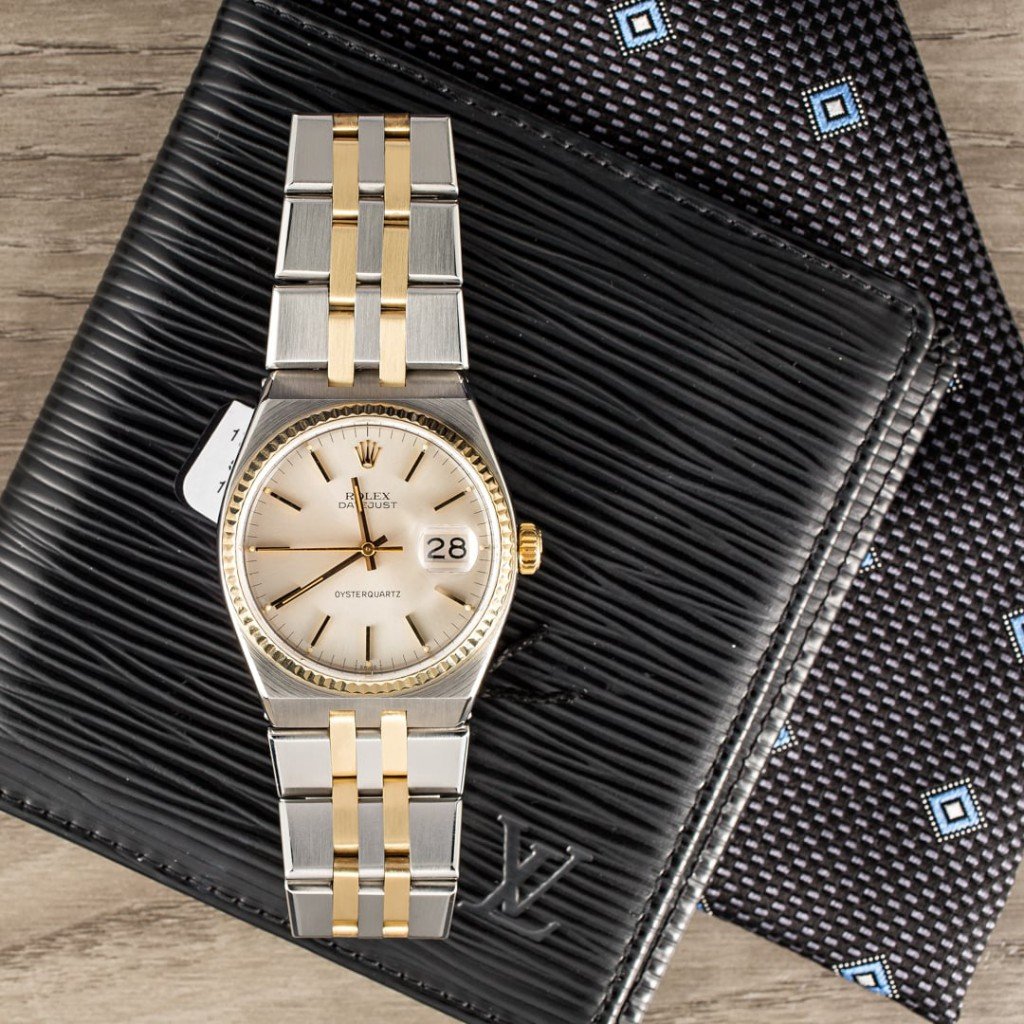
Oysterquartz values on the pre-owned market divide along metal rather than model. Steel and two-tone Oysterquartz Datejust references sold at Bob’s Watches between July 2025 and July 2026 averaged approximately $6,500 to $6,600, across a range of roughly $5,600 to $10,100 depending on condition, dial originality and bracelet condition. Yellow gold Oysterquartz Day-Date references averaged approximately $17,700 across a range of roughly $14,500 to $22,100.
| Reference | Configuration | Average Sold Price |
| 17000 | Oysterquartz Datejust, stainless steel | Approximately $6,500 |
| 17013 | Oysterquartz Datejust, steel and yellow gold | Approximately $6,600 |
| 19018 | Oysterquartz Day-Date, 18k yellow gold | Approximately $17,700 |
Sold prices at Bob’s Watches, July 2025 through July 2026. These are secondary market figures rather than retail.
The comparison that matters most to a buyer is against the mechanical equivalent. Oysterquartz Datejust references have generally traded below a comparable mechanical Datejust 36, which averaged closer to $9,000 over the same twelve months. Collectible has not meant expensive for this line, and that gap is part of why interest in the references has grown. Steel and two-tone examples sold most recently have landed toward the lower end of the year’s range, so the direction is worth watching rather than treating as settled.
Certain references can hold value better than others, and outcomes depend on condition, originality, service history, and whether the box and papers are present. No model guarantees a profit. Owners weighing whether to keep or move one can sell your Rolex watch through a specialist who prices from sold data rather than asking prices.
Rolex Movements at a Glance: What Every Owner Should Know

No Rolex in current production contains a battery. The mainspring inside a Perpetual movement is wound by wrist motion, holds roughly 48 to 72 hours of reserve depending on the caliber, and can be wound by hand at any time. Ownership means winding and periodic servicing, never a battery swap. The brand’s quartz chapter was real but brief, running from the reference 5100 in 1970 through the Oysterquartz until production ended in 2001, and those watches are now collected as historical pieces rather than bought as daily timekeepers.
Bob’s Watches handles both sides of that history, from current generation mechanical references to the Oysterquartz Datejust and Rolex Day-Date models that still turn up with their original bracelets. Every watch is authenticated before it is listed, and pricing comes from sold market data rather than asking prices. Certain references are generally considered strong performers on the pre-owned market, and outcomes depend on condition, originality, and whether the box and papers are present. No model guarantees a profit.
Frequently Asked Questions
The post Do Rolex Watches Have Batteries? appeared first on Bob's Watches.