Bob's Watches Bob's Watches
The best Swiss watch brands are Rolex, Patek Philippe, Audemars Piguet, OMEGA, and Vacheron Constantin, the five names that anchor the top of the market. Below them sit Cartier, Jaeger-LeCoultre, IWC, Breitling, Tudor, Oris, and Tissot, brands that cover every level of Swiss luxury watches from entry-level mechanical to grand complication.
Key Takeaways
- Rolex, Patek Philippe, Audemars Piguet, OMEGA, and Vacheron Constantin lead the Swiss market on craftsmanship, recognition, and pre-owned demand.
- The Holy Trinity of Swiss watchmaking refers to Patek Philippe, Audemars Piguet, and Vacheron Constantin.
- Pre-owned prices at Bob’s Watches over the past 12 months ranged from a median of $1,195 for Tissot to $26,040 for Audemars Piguet.
- Tissot, Longines, Oris, and Tudor deliver Swiss mechanical watchmaking at the most accessible price points.
- Swiss Made is a designation governed by Swiss ordinance, not a marketing phrase.
Switzerland builds watches at every level, from a mechanical diver that costs less than a laptop to a minute repeater that occupies a single watchmaker for the better part of a year. The brands that follow are organized by tier, starting with the three houses that define high watchmaking and ending with the names that make Swiss mechanical watchmaking attainable. Pre-owned figures throughout come from watches sold through Bob’s Watches over about a one year period.
What Are the Best Swiss Watch Brands?

The best Swiss watch brands are Rolex, Patek Philippe, Audemars Piguet, OMEGA, and Vacheron Constantin. These five luxury watch brands lead on horological credentials, global recognition, and sustained demand on the pre-owned market. Cartier, Jaeger-LeCoultre, IWC, Breitling, Tudor, Oris, and Tissot round out the field, cove]
| Brand | Tier | Best Known For |
| Patek Philippe | Holy Trinity | Grand complications, Nautilus, Calatrava |
| Audemars Piguet | Holy Trinity | Royal Oak, luxury steel sports watches |
| Vacheron Constantin | Holy Trinity | Continuous production since 1755, Overseas |
| Rolex | Industry giant | Submariner, Datejust, Daytona |
| OMEGA | Industry giant | Speedmaster, Seamaster, Co-Axial movements |
| Cartier | Industry giant | Tank, Santos, shaped cases |
| Jaeger-LeCoultre | High horology | Reverso, in-house caliber development |
| IWC Schaffhausen | Specialist | Big Pilot, Portugieser, Ingenieur |
| Breitling | Specialist | Navitimer, Superocean, chronograph heritage |
| Panerai | Specialist | Luminor, Radiomir, Submersible |
| Richard Mille | Ultra-luxury | Tonneau case, advanced case materials |
| Tudor | Accessible luxury | Black Bay, Pelagos |
| Oris | Accessible independent | Aquis, Divers Sixty-Five, Calibre 400 |
| Tissot | Entry-level | PRX, Powermatic 80 movements |
Buyer demand tracks that hierarchy closely. Rolex is the most purchased Swiss brand at Bob’s Watches, followed by OMEGA, Breitling, Tudor, and Cartier, and the Rolex Submariner is the single most purchased model across all Swiss brands over the past 12 months. Within OMEGA the Seamaster leads the Speedmaster, and within Tudor the Black Bay leads the Pelagos.
The Holy Trinity: Patek Philippe, Audemars Piguet, and Vacheron Constantin

The Holy Trinity of Swiss watchmaking is Patek Philippe, Audemars Piguet, and Vacheron Constantin, three manufactures recognized for the highest standards of hand finishing and complication. The grouping is a century old and reflects capability rather than price. Each of the three builds movements start to finish, decorates components on surfaces a wearer will never see, and maintains the technical depth to produce perpetual calendars, minute repeaters, and split seconds chronographs in house.
What separates the Trinity from the rest of the industry is the ratio of hand work to machine work. Bevelled edges, interior angles that no machine can cut, and bridges finished one at a time all cost hours that never appear on a specification sheet.
Patek Philippe

Patek Philippe is a Geneva manufacture founded in 1839 as Patek, Czapek & Cie by Antoni Patek and Franciszek Czapek. Adrien Philippe, inventor of the keyless winding crown, joined the business in 1845, and the firm took the name Patek Philippe & Cie in 1851. The Stern family purchased the company in 1932 and still runs it today, a continuity that shapes everything from production volume to the brand’s refusal to chase trends.
The catalog spans the dress watch tradition and the sport luxury category the brand helped create. The Calatrava, introduced in 1932, remains the reference point for a round dress watch, while the Nautilus of 1976 and the Aquanaut of 1997 carry the integrated bracelet designs that drive current collector demand. Patek Philippe also holds the record for the most expensive watch sold at auction, with a Grandmaster Chime Ref. 6300A-010 reaching $31 million in 2019. On the pre-owned market, Patek Philippe references sold through Bob’s Watches carry a median price of $25,035, with Calatrava models clustering around $22,070.
Audemars Piguet

Audemars Piguet is a manufacture based in Le Brassus in the Vallée de Joux, where Jules Louis Audemars and Edward Auguste Piguet began collaborating in 1875 and registered the firm as Audemars Piguet & Cie in 1881. The company spent its early decades building complicated movements for other houses, including some of the most respected names in Geneva, before turning to watches sold under its own name.
The brand’s defining moment came in 1972 with the Royal Oak, a stainless steel sports watch designed by Gérald Genta with an octagonal bezel, exposed screws, and an integrated bracelet. It carried the price of a gold watch in a steel case and created the luxury sports watch category that dominates the market today. The Royal Oak Offshore followed in 1993 with larger proportions and a more aggressive presentation, and Code 11.59 arrived in 2019 as the brand’s contemporary dress collection. The Royal Oak carries the highest median sold price of any model in our 12 month data at $36,875.
Vacheron Constantin

Vacheron Constantin was founded in Geneva in 1755 by Jean-Marc Vacheron and is the oldest watch manufacture in continuous production. The François Constantin partnership of 1819 gave the house its full name and its motto, a commitment to doing better whenever better is possible. The brand marks its 270th anniversary in this period, a span no competitor can claim without a gap in the record.
Vacheron Constantin holds the Hallmark of Geneva on much of its output, a certification tied to both movement quality and the city where the work is performed. The collections cover the full range of high watchmaking: the Patrimony and Traditionnelle for classical dress watches, the Overseas for travel and sport, and Métiers d’Art for enamel, engraving, and gem setting. Volume is small enough that the brand rarely appears on the secondary market in quantity, and Bob’s Watches does not have sufficient sold data to publish a representative price range.
The Industry Giants: Rolex, OMEGA, and Cartier

Rolex, OMEGA, and Cartier are the three Swiss brands with the broadest global recognition and the deepest reach into the wider luxury market. Each built its position on a different foundation. Rolex industrialized precision and durability, OMEGA tied itself to exploration and record keeping, and Cartier came to watchmaking from jewelry and brought a design vocabulary the industry still borrows from.
Scale separates these three from the Trinity. Where a Holy Trinity house measures annual output in the thousands, these brands supply the world, which is why they dominate the secondary market.
Rolex

Rolex is a Geneva manufacture founded in London in 1905 by Hans Wilsdorf, who registered the Rolex trademark in 1908 and moved the business to Switzerland in 1919. The Oyster case of 1926 gave the world its first commercially successful waterproof wristwatch, and the Perpetual rotor of 1931 introduced the self-winding system that still bears the name. The Datejust of 1945 added the automatically changing date display that became a signature across the catalog.
The professional Rolex models are the reason the brand dominates buyer demand. The Submariner defined the modern dive watch, the GMT-Master II tracks a second time zone on a rotating bezel, and the Cosmograph Daytona remains the benchmark chronograph. Rolex holds [VERIFY: Rolex chronometric awards count] awards for chronometric precision and serves as the official timekeeper of Wimbledon, alongside [VERIFY: Rolex Academy Awards timekeeping relationship]. Pre-owned Rolex models sold through Bob’s Watches carry a median price of $12,495, with most references falling between $6,070 and $26,995.
OMEGA

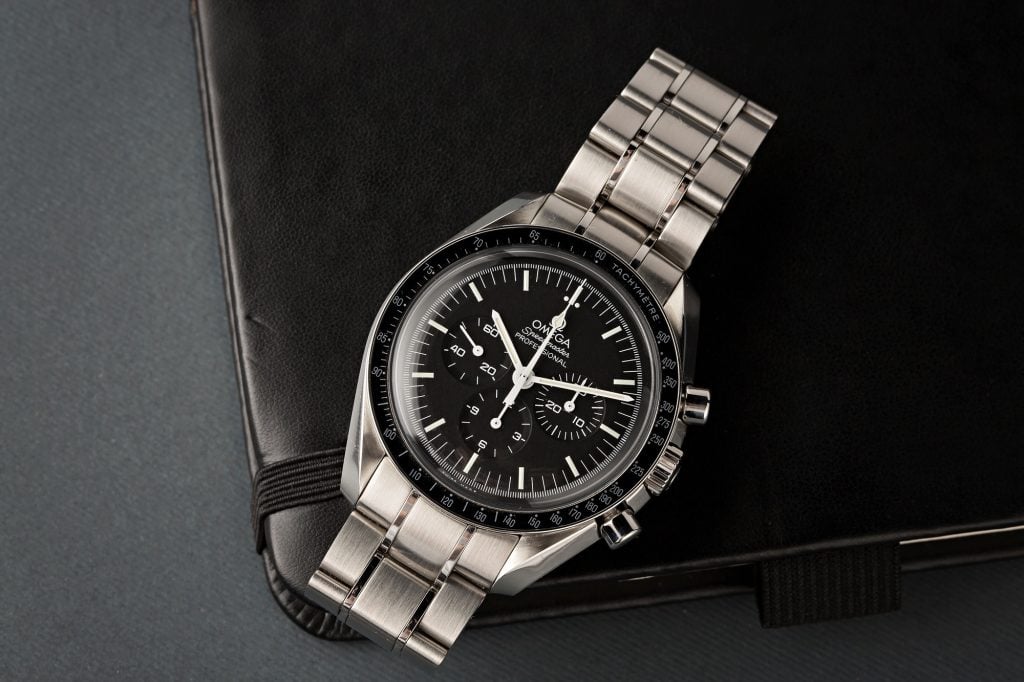
OMEGA is a Biel manufacture founded in 1848 by Louis Brandt, who traded as Louis Brandt et Frère until the company adopted the name of its 1894 caliber and became OMEGA in 1903. The brand has served as official timekeeper of the Olympic Games since 1932 and was selected by NASA for crewed spaceflight after a testing program no competing chronograph survived.
The Speedmaster Professional became the first watch worn on the lunar surface in 1969 and remains largely faithful to that specification, while the Seamaster covers everything from a 300 meter dive watch to a dress model. The current OMEGA Speedmaster models run Co-Axial calibers certified to the Master Chronometer standard. In our sold data, the Seamaster outsells the Speedmaster, though the Speedmaster carries the higher median price at $6,895 against $4,995.
Cartier

Cartier is a maison founded in Paris in 1847 by Louis-François Cartier, with watch production based in Switzerland. The house entered watchmaking from jewelry and brought a designer’s approach to case shape at a time when the industry defaulted to round. The Santos, created in 1904 for the Brazilian aviator Alberto Santos-Dumont so he could read the time without releasing the controls of his aircraft, is among the earliest purpose built men’s wristwatches.
The Tank arrived in 1917 with a rectangular case whose brancards were inspired by the treads of a military tank viewed from above, and it has never left the catalog. The Ballon Bleu, Panthère, and Tank Française carry the same design logic into contemporary collections. Cartier sits mid range on the secondary market with a median sold price of $5,032, and the Tank Must is the most accessible entry into the collection in our data at a median of $4,070.
Several other Swiss names belong in any serious discussion of the category:
- Jaeger-LeCoultre built its reputation supplying movements to other top houses and produces the Reverso, a rectangular watch with a case that flips in its carrier, introduced in 1931 for polo players.
- IWC Schaffhausen works from the German speaking side of Switzerland and defines the luxury pilot’s watch through the Big Pilot, alongside the Portugieser and the revived Ingenieur.
- Breitling has built chronographs since 1884 and anchors its range on the Navitimer with its circular slide rule bezel, the Superocean diver, and the Chronomat.
- Panerai supplied the Royal Italian Navy with luminous dive instruments and carries that military design into the Luminor, Radiomir, and Submersible collections.
- Richard Mille applies motorsport engineering to watchmaking, using titanium, carbon composites, and sapphire in a tonneau case that is instantly identifiable.
What Separates the Best Swiss Watch Brands

Movement manufacturing, chronometric certification, and finishing standards separate the best Swiss watch brands from the rest of the industry. A brand that designs and produces its own calibers controls its own quality, its own service network, and its own timeline. A brand that buys movements from a supplier competes on design and price instead.
“Every watch that comes through our door gets opened, and the movement tells you more about a brand than the dial does. Consistent finishing on components no owner will ever see is the clearest signal that a manufacture is not cutting corners.”
Carol Altieri, COO of Bob’s Watches
| Brand | Signature Caliber | Notable Specification |
| Rolex | Calibre 3235 | Chronergy escapement, approx. 70 hour power reserve |
| OMEGA | Co-Axial Master Chronometer 8800 | METAS certified, resists 15,000 gauss |
| Oris | Calibre 400 | Approx. 120 hour power reserve |
| Tissot | Powermatic 80 | Approx. 80 hour power reserve |
| Tudor | MT5602 | COSC certified, produced with Kenissi |
What “Swiss Made” Actually Means
Swiss Made is a protected designation governed by Swiss ordinance, not a marketing phrase a brand can apply at will. To print those words on a dial, a manufacturer must meet a defined set of conditions covering where the value in the watch is created and where the final work is performed.
The requirements cover four areas:
- A defined share of the manufacturing cost must be generated in Switzerland.
- The technical development of the watch must take place in Switzerland.
- The movement must itself qualify as Swiss under the same cost and assembly rules.
- The watch must be cased up and given its final inspection in Switzerland.
A Swiss Made dial does not mean every component originates in Switzerland. Cases, dials, hands, and bracelets are routinely produced elsewhere, which is the source of the recurring confusion in online horology communities about which brands are genuinely Swiss.
Swiss Watch Heritage: The Dates That Built the Industry

Swiss watch heritage rests on a set of specific innovations that changed what a wristwatch could do. Rolex introduced the Oyster case in 1926, the first commercially successful waterproof wristwatch case and the innovation that established the brand’s reputation for durability. Vacheron Constantin has operated continuously since 1755, making it the oldest watch manufacture in uninterrupted production.
Those two dates bracket the industry. One marks the beginning of organized Swiss watchmaking, the other the moment the wristwatch became a tool rather than an ornament.
| Brand | Founded | Defining Milestone |
| Vacheron Constantin | 1755 | Continuous production since founding |
| Breguet | 1775 | Tourbillon patented in 1801 |
| Jaeger-LeCoultre | 1833 | Reverso introduced in 1931 |
| Patek Philippe | 1839 | Named Patek Philippe & Cie in 1851 |
| OMEGA | 1848 | OMEGA name adopted in 1903 |
| Audemars Piguet | 1875 | Royal Oak introduced in 1972 |
| Rolex | 1905 | Oyster case introduced in 1926 |
| Tudor | 1926 | Trademark registered by Hans Wilsdorf |
Hans Wilsdorf registered the Tudor name in 1926 and established Montres TUDOR S.A. as a separate company in 1946, creating a brand that could offer Rolex case and bracelet construction at a lower price by using supplied movements.
Best Entry-Level Swiss Watch Brands

The best entry-level Swiss watch brands are Tissot, Longines, Oris, Hamilton, and Tudor. Each delivers a Swiss mechanical movement, real production standards, and a catalog with genuine history behind it, at prices that sit far below the Holy Trinity and the industry giants. Buying pre-owned lowers those entry points further.
- Tissot has operated since 1853 and sits within the Swatch Group, offering the PRX, the Seastar diver, and the Heritage line, most running the Powermatic 80 automatic. Median pre-owned price: $1,195.
- Longines was founded in 1832 in Saint-Imier and covers the Spirit pilot’s range, the Legend Diver, and the DolceVita, with a deep archive of designs to reissue. Median pre-owned price: $1,250.
- Oris has been independent since 1904 and builds the Aquis diver, the Divers Sixty-Five, and the Big Crown, including models running the in-house Calibre 400. Median pre-owned price: $1,829.
- Hamilton produces Swiss made watches with American military heritage, anchored by the Khaki Field, a design descended from the watches it supplied to US forces.
- Tudor offers Rolex adjacent construction with in-house Kenissi movements across the Black Bay, Pelagos, and Ranger. Median pre-owned price: $3,770, with the Black Bay at $3,595.
What Watch Is the “Poor Man’s Rolex”?
The “poor man’s Rolex” is a phrase most often applied to Tudor, the brand Hans Wilsdorf created to deliver Rolex case and bracelet construction at a lower price. The label stuck through the decades when Tudor used supplied ETA movements in cases stamped by Rolex, and it has also been applied to homage brands that copy the proportions of a Submariner or Datejust without the underlying engineering.
The term no longer describes the brand accurately. Tudor now produces its own COSC certified movements through Kenissi, holds its own design language in the Black Bay and Pelagos, and competes on merit rather than resemblance. The price gap remains real: the Tudor Black Bay carries a median sold price of $3,595 against $14,495 for the Rolex Submariner, which is a large part of why Tudor works as a Rolex alternative for buyers who want the construction without the queue.
Swiss Watch Prices: Current Retail vs. Pre-Owned Market

Swiss watch prices operate in two separate markets that should never be quoted as one number. Current retail is the price an authorized dealer charges for a catalog model, set by the brand and confirmed on the brand’s own website. Pre-owned is the secondary market, where price is set by condition, completeness, reference, and demand rather than by the manufacturer.
The pre-owned figures below reflect watches sold through Bob’s Watches between July 2025 and June 2026. Median is the midpoint sold price. The range covers the middle 80 percent of sales, excluding the highest and lowest tenth.
| Brand | Median Sold Price | Typical Range |
| Audemars Piguet | $26,040 | $12,945 to $65,000 |
| Patek Philippe | $25,035 | $11,035 to $53,495 |
| Rolex | $12,495 | $6,070 to $26,995 |
| IWC | $6,932 | $4,562 to $13,332 |
| Panerai | $5,895 | $4,080 to $8,995 |
| OMEGA | $5,170 | $2,895 to $8,825 |
| Cartier | $5,032 | $2,995 to $12,345 |
| Breitling | $4,295 | $2,870 to $7,266 |
| Tudor | $3,770 | $2,595 to $5,395 |
| Oris | $1,829 | $1,295 to $2,695 |
| Longines | $1,250 | $978 to $1,928 |
| Tissot | $1,195 | $845 to $1,395 |
Vacheron Constantin and Jaeger-LeCoultre are covered earlier in this article but appear too rarely in our sold data to publish a representative range. At model level, the spread within a single brand is often wider than the gap between brands.
| Model | Median Sold Price | Typical Range |
| Audemars Piguet Royal Oak | $36,875 | $17,498 to $68,532 |
| Rolex Daytona | $30,595 | $20,070 to $49,992 |
| Patek Philippe Calatrava | $22,070 | $11,315 to $34,414 |
| Rolex GMT-Master II | $18,595 | $13,892 to $25,495 |
| Rolex Submariner | $14,495 | $10,795 to $21,638 |
| Rolex Datejust 36 | $7,507 | $5,995 to $13,995 |
| OMEGA Speedmaster | $6,895 | $3,295 to $11,756 |
| OMEGA Seamaster | $4,995 | $3,235 to $8,040 |
| Cartier Tank Must | $4,070 | $2,635 to $4,995 |
| Tudor Black Bay | $3,595 | $2,876 to $4,795 |
| Oris Divers Sixty-Five | $1,495 | $1,295 to $2,555 |
Comparing the second half of 2025 with the first half of 2026, median sold prices moved upward across most of the field. Rolex rose 8.6 percent, from $11,970 to $12,995. Tudor rose 7.6 percent, Cartier 6.1 percent, Audemars Piguet 4.4 percent, OMEGA 4.2 percent, and Breitling 4.1 percent. At model level the OMEGA Speedmaster gained 11.1 percent, the Rolex Datejust 36 and the Tudor Black Bay both gained 8.2 percent, and the Rolex GMT-Master II gained 4.4 percent. These figures track the median price of watches sold, which reflects both market movement and shifts in which references sold in each period. Buyers comparing individual models can review pre-owned Rolex prices by model for reference level detail.
Certain references from these brands are generally considered strong on value retention and can hold their value well over time. Performance ties to real factors: production scarcity, condition, whether the original box and papers are present, documented provenance, and steady demand for that specific reference. No watch guarantees a profit, and results vary widely between references within the same collection.
Choosing Among the Top Swiss Watch Brands
Choosing among the top Swiss watch brands comes down to what a buyer actually wants from the watch. Complication, hand finishing, and the deepest horological credentials point toward Patek Philippe, Audemars Piguet, and Vacheron Constantin. Everyday durability, service availability, and the strongest secondary market point toward Rolex and OMEGA. Design and shaped cases point toward Cartier and Jaeger-LeCoultre. A first Swiss mechanical watch at a sensible price points toward Tissot, Longines, Oris, and Tudor, all of which deliver genuine Swiss watchmaking without the wait.
Retail waiting lists at authorized dealers can run for years on the most requested references, which is why the pre-owned market has become the practical route to most of these brands. Bob’s Watches inspects and authenticates every watch it sells, and the pricing throughout this article reflects real transactions rather than asking prices, which gives buyers a grounded sense of what these watches actually trade for. Whichever tier a buyer starts in, the condition of the individual watch and the completeness of its documentation matter more than the name on the dial.
Frequently Asked Questions
The post Best Swiss Watch Brands: The Definitive Guide for 2026 Brands appeared first on Bob's Watches.