Bob's Watches Bob's Watches
The best field watch for most people is the Tudor Ranger. It defines the category with genuine military heritage, a clean and legible dial, and a power reserve of 70 hours. In this guide, we rank the 15 best field watches of 2026 across every budget, from entry level quartz to a Rolex, and walk you through exactly how to choose the right one.
Key Takeaways
- Best overall field watch: Tudor Ranger, the consensus pick among experts and collectors for its heritage, legibility, and value.
- Best budget field watch: Timex Expedition Scout, around $100, a reliable quartz watch with a backlit dial.
- Best automatic field watch on a budget: Seiko 5 Sports Field 36mm, around $295, with a proven Seiko automatic movement.
- Best luxury field watch: Rolex Explorer ref. 124270, around $9,295 pre-owned, the most refined expression of the field watch formula.
Our team spends every day handling, photographing, and evaluating watches at every price point, and the recommendations below draw on that experience along with input from watch experts and online communities. Below you will find the full rankings, a side by side comparison, and everything you need to choose the right field watch for you.
Best Field Watches at a Glance
Here is how all 15 picks compare on price, size, movement, and water resistance.
| Watch | Best For | Price (approx.) | Case Size | Movement | Water Resistance |
|---|---|---|---|---|---|
| Tudor Ranger | Best Overall | $3,700 | 39mm | Automatic (COSC) | 100m |
| Timex Expedition Scout | Best Budget Field Watch | $100 | 40mm | Quartz | 50m |
| Seiko 5 Sports Field 36mm | Best Affordable Automatic | $295 | 36.4mm | Automatic | 100m |
| Citizen Garrison Eco-Drive | Best Solar Field Watch | $300 | 37mm | Solar quartz | 100m |
| Bertucci A-2T Super Classic | Best Field Watch Under $250 | $200 | 40mm | Quartz | 100m |
| Vaer C4 Tactical Field Solar | Best Tactical Field Watch | $500 | 41.5mm | Solar quartz | 200m |
| OMEGA Railmaster | Best Anti-Magnetic Field Watch | Mid-$5,000s pre-owned | 38–40mm | Automatic (Master Chronometer) | 150m |
| Seiko Prospex Alpinist SPB507 | Best Automatic Under $1,000 | $900 | 39.5mm | Automatic | 200m |
| Nodus Sector Field II Titanium | Best Microbrand Field Watch | $500 | 38mm | Automatic | 100m |
| Oris Big Crown Pointer Date Bronze | Best Bronze Field Watch | $2,800 | 40mm | Automatic | 50m |
| CWC G10 | Best for Small Wrists | $350 | 36.5mm | Quartz | 50m |
| Rolex Explorer 124270 | Best Premium Field Watch | $9,300 | 36mm | Automatic | 100m |
| Casio G-Shock DW5600 | Toughest Digital Alternative | $70 | 43mm | Digital quartz | 200m |
What Is a Field Watch?

A field watch is a rugged, highly legible, time focused wristwatch descended from the military watches of World War I and World War II. It was built so a soldier could read the time instantly in any light, in any weather, on any terrain. Today, those same qualities make it one of the most practical watch styles you can own.
Most field watches share the same core traits:
- A high contrast dial, usually black or white, with bold Arabic numerals
- An inner 24 hour track for reading military time
- Luminous hands and hour markers for visibility at night
- A modest case size, typically 36mm to 42mm
- A tough strap, most often nylon, canvas, or leather
- Water resistance between 50 and 200 meters
The design has endured for more than a century because it works everywhere. A field watch looks correct on a hiking trail, at the office, and with a blazer on the weekend, which is why so many collectors keep at least one in the rotation.
The 15 Best Field Watches of 2026, Ranked
The picks below are organized by category, from around $100 to nearly $8,000, so you can jump straight to the label that matches your budget and needs. We selected them based on specifications, build quality, brand heritage, value, and the consistent consensus of experts and online communities.
Best Overall Field Watch: Tudor Ranger

The Tudor Ranger is the best field watch overall because it delivers a certified chronometer movement built in house, genuine exploration heritage, and Rolex family build quality at a price no rival can match. The Ranger name dates to 1967, when Tudor built rugged expedition watches under the same crown as its sibling brand Rolex. The current 39mm model keeps the matte black dial, painted numerals, and burgundy accented seconds hand of the vintage pieces, with no date window to interrupt the symmetry.
The MT5402 movement inside is COSC certified with a power reserve of 70 hours, and owners routinely report accuracy well inside the official rating. A domed sapphire crystal and 100 meters of water resistance make it a genuine daily tool rather than a display piece. The honest drawbacks are minor: the lume is adequate rather than exceptional, and the fabric strap option lacks tool free adjustment. On the secondary market, clean examples trade below retail, which makes a pre-owned Ranger one of the strongest buys in luxury sport watches.
Pros
- In house COSC certified movement with a 70 hour power reserve
- Heritage design executed with modern build quality
- Versatile 39mm case that suits most wrists
- Strong value pre-owned
Cons
- No date, if you want one
- Lume is adequate rather than exceptional
- Priced well above tool oriented field watches
Best Budget Field Watch: Timex Expedition Scout
The Timex Expedition Scout is the best field watch under $100, and it is not a close race. Timex built its reputation on watches that take abuse and keep running, and the Expedition Scout carries that tradition with a light 40mm case, a clean dial with a full 24 hour track, and a quartz movement that stays accurate within seconds per month.
Its standout feature is Indiglo, an electroluminescent backlight that illuminates the entire dial at the press of the crown. That makes it more readable at 2 a.m. than watches costing twenty times as much. The tradeoffs are what you would expect at this price: a mineral crystal that can scratch, a ticking that is audible in a quiet room, and a battery that needs replacing every few years. As a first watch, a travel watch, or a beater you never worry about, it is the standard.
Pros
- Costs about as much as a strap for other watches on this list
- Indiglo backlight gives it excellent nighttime legibility
- Light and comfortable for all day wear
- Easy strap swaps with standard 20mm lugs
Cons
- Mineral crystal scratches with hard use
- Loud tick
- Brass case with plating rather than solid stainless steel
Best Affordable Automatic Field Watch: Seiko 5 Sports Field 36mm

The Seiko 5 Sports Field 36mm, often called the Midfield, is the best automatic field watch under $300 and one of the most recommended watches in online watch communities. It revives the spirit of Seiko’s discontinued SNK series, a long time favorite among collectors, with an upgraded case and 100 meters of water resistance. The bead blasted finish gives it a purposeful, matte military look.
The 4R36 automatic movement hacks and hand winds, features that matter for setting the time precisely, and it has a track record measured in millions of watches. Accuracy is rated at roughly minus 35 to plus 45 seconds per day, and most examples perform far better than that in daily wear. The Hardlex crystal is a step below sapphire, and the 36mm sizing runs small for those used to larger watches, but at this price nothing else offers a mechanical field watch this complete.
Pros
- Proven Seiko automatic with hacking and hand winding
- 100m water resistance
- Multiple dial colors and strap options
- Compact size true to vintage military watches
Cons
- Hardlex crystal instead of sapphire
- Modest accuracy specification compared to quartz
- Too small for those who prefer a 40mm and up presence
Best Solar Field Watch: Citizen Garrison Eco-Drive

The Citizen Garrison is the best field watch for anyone who wants to set it once and forget it. Its Eco-Drive movement charges from any light source, indoor or outdoor, and stores enough energy to run for months in complete darkness. There is no battery to replace and no winding to remember, which makes it a strong travel companion.
The 37mm stainless steel case keeps things compact and comfortable, and the dial follows the classic formula with crisp white numerals on black and a red seconds hand for a touch of color. A day and date display adds everyday practicality that purists may find untraditional but most owners appreciate. The mineral crystal and stiff factory strap are the weak points, and both are common at this price.
Pros
- Eco-Drive solar power means no battery changes
- 100m water resistance with a screw case back
- Day and date display
- Compact 37mm size suits most wrists
Cons
- Mineral crystal
- Factory strap takes time to break in
- Dial layout departs slightly from the traditional field watch look
Best Field Watch Under $250: Bertucci A-2T Super Classic
The Bertucci A-2T Super Classic is the most durable field watch you can buy for around $200. The case is solid titanium, which makes it lighter than steel and highly resistant to corrosion, and the lugs are a single piece with the case, so there are no spring bars to fail. Gear reviewers who wear watches hard consistently report years of heavy outdoor use with little visible wear.
The crown sits at 4 o’clock, where it stays out of the way when your wrist bends, a small detail that makes a noticeable difference during activity. The dial is simple and high contrast, and the lume holds up through the night. This is not a watch for dressing up. The nylon strap and utilitarian styling read as pure tool, which is exactly the point.
Pros
- Titanium case at a very accessible price
- Fixed lug bars eliminate a common failure point
- 4 o’clock crown improves comfort
- Strong lume that lasts until morning
Cons
- Styling is strictly utilitarian
- One piece straps only, due to the fixed bars
- Mineral crystal
Best Tactical Field Watch: Vaer C4 Tactical Field Solar
The Vaer C4 Tactical Field Solar is the best tactical field watch under $1,000, and it is assembled in the United States. The specifications punch well above the price: a sapphire crystal, 200 meters of water resistance, a black DLC coated steel case, and a solar movement rated to run six months on six hours of light while keeping time within about 20 seconds per month.
A rotating bezel separates the C4 from most field watches and adds genuine utility, letting you track elapsed time or a second time zone. Vaer also ships every watch with two quick change straps, so it is ready for both fieldwork and daily wear out of the box. At 41.5mm it wears larger than the vintage inspired picks on this list, which is the one thing to consider if your wrist is on the smaller side.
Pros
- Sapphire crystal and 200m water resistance at $500
- Solar movement with excellent accuracy
- Rotating bezel adds real function
- Includes two straps
Cons
- Larger than a traditional field watch
- Quartz feel will not satisfy mechanical purists
Best Anti-Magnetic Field Watch: OMEGA Railmaster
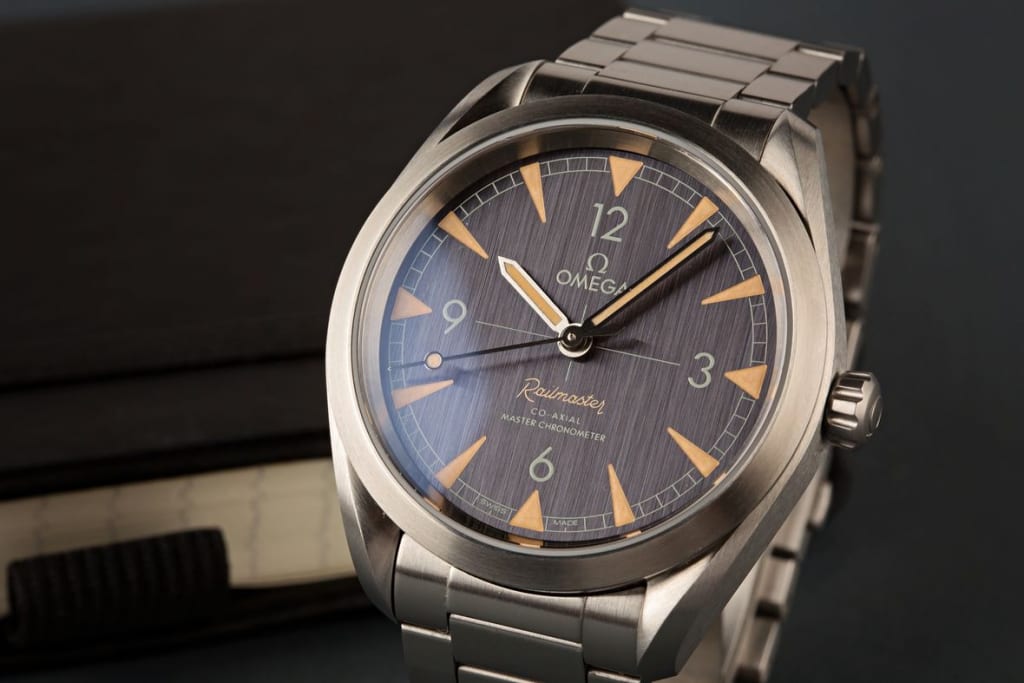
The OMEGA Railmaster solves a problem most field watches ignore entirely: magnetism. Launched in 1957 as part of the same “Professional” trio that gave the world the Seamaster and Speedmaster, the original Railmaster wrapped its movement in a soft iron inner shell so engineers and technicians could work around electrified equipment without their watch drifting. The modern version goes much further. Its Master Chronometer movement shrugs off magnetic fields up to 15,000 gauss, strong enough to sit directly on a speaker magnet or MRI-adjacent equipment without missing a beat, while most field watches lose accuracy from a phone case magnet.
The design stays true to the tool-watch brief: a stainless steel case around 38 to 40mm, vertically brushed dial, high-contrast markers, and no date window or bezel gimmicks to clutter the view. With 150 meters of water resistance, it more than doubles the rating of most field watches, and every movement is independently certified by METAS for accuracy after magnetic exposure, a testing standard stricter than COSC alone. The trade-off is cost: pre-owned examples typically land in the mid-$5,000 range. For that money you get the most technically overbuilt watch in this guide wearing the most understated clothes.
Pros
- Resists magnetic fields up to 15,000 gauss, unmatched in this category
- Master Chronometer certification exceeds standard chronometer testing
- 150m water resistance leads the field watch class
- Clean, no-date dial with genuine 1957 heritage
Cons
- Priced well above traditional field watches
- No tritium tubes; lume requires light to charge
- Understated looks may underwhelm given the price
Best Automatic Field Watch Under $1,000: Seiko Prospex Alpinist SPB507

The Seiko Prospex Alpinist SPB507 is the best automatic field watch under $1,000 for buyers who want one watch that does everything. Updated for 2026, it carries the 6R55 movement with a power reserve of 72 hours, enough to set it down Friday evening and pick it up running Monday morning. The green dial, gold accents, and cathedral hands trace back to Seiko’s original 1959 Alpinist, built for Japanese mountain climbers.
A second crown at 4 o’clock operates an internal compass bezel, a functional nod to its mountaineering roots, and the 200 meter water resistance outclasses nearly every watch in this guide. The Alpinist is dressier than a standard field watch, which is either its greatest strength or its one flaw depending on your taste. It moves from trail to dinner table without missing a step.
Pros
- 72 hour power reserve
- 200m water resistance and sapphire crystal
- Internal compass bezel
- Polished finishing that dresses up easily
Cons
- Busier dial than a traditional field watch
- Thicker than most picks at 13.2mm
- The 2026 update raised the price
Best Microbrand Field Watch: Nodus Sector Field II Titanium
The Nodus Sector Field II Titanium is the best field watch from an independent microbrand, designed and assembled in Los Angeles. Nodus chose grade 2 titanium for the case because its naturally matte surface avoids glare, a practical decision that also keeps the watch remarkably light on the wrist. The specifications, including a sapphire crystal and 100 meters of water resistance, compete directly with watches from far larger companies.
Where the Sector Field II separates itself is character. The gradient dials, offered in blue, gray, and green, bring color to a category dominated by black and khaki, while the 24 hour inner track keeps the military DNA intact. The Seiko NH38 movement is a proven engine, though its finishing is basic, and microbrand ownership means factory service goes through a small company rather than a global network. For enthusiasts, that independence is part of the appeal.
Pros
- Grade 2 titanium case with a glare free matte finish
- Assembled and regulated in the United States
- Distinctive gradient dial options
- Strong specifications for $500
Cons
- Basic movement finishing
- Small company service network
- Limited production runs sell out
Best Bronze Field Watch: Oris Big Crown Pointer Date Bronze

The Oris Big Crown Pointer Date Bronze is the best bronze field watch, and few rivals can match its lineage. Oris has built this design continuously since 1938, making it the oldest model in the company’s catalog. The details that defined the original are all still here: an exaggerated crown sized for a pilot’s gloved fingers, a coin-edge bezel, and the trademark crescent-tipped hand that circles the outer dial to indicate the date. Power comes from the automatic Oris 754, built on the widely used Sellita SW200-1 base, which means any competent watchmaker can service it without hunting for parts.
Bronze is the reason to choose this watch. The metal darkens and shifts in tone as it reacts with air and skin, so no two examples age the same way. This Oris Big Crown commits fully to the material, offering versions where the bezel, crown, and even the linked bracelet are bronze alongside the case, while a steel back plate keeps the reactive alloy away from your wrist. At 40mm across with a domed sapphire crystal, it works as both a tool and a conversation piece. Buyers should know the patina is not optional; if you want a case that always looks factory fresh, choose steel.
Pros
- Heritage design in continuous production since 1938
- Full bronze construction available, down to the bracelet
- Distinctive pointer date complication you won’t see elsewhere at this price
- Steel case back prevents green marks on your skin
Cons
- Patina is inevitable and not for everyone
- 50m water resistance trails dedicated tool watches
- Power reserve of 38 hours trails competitors
Best Field Watch for Small Wrists: CWC G10
The CWC G10 is the best field watch for small wrists, and it carries real service history. The Cabot Watch Company supplied this exact design to British forces for decades, with issued examples on soldiers’ wrists as recently as 2008. The 36.5mm case with its satin, glare free finish sits flat and light, which is exactly what a watch built for daily military use should do.
Two details reveal its purpose. The spring bars are fixed, so the strap can never detach from a broken bar, and the crystal is acrylic, which can scratch but will not shatter. Scratches polish out in minutes with a cloth and compound. A Swiss quartz movement with a multi year battery keeps maintenance close to zero. It is not flashy, and that restraint is why collectors of military watches respect it.
Pros
- Genuine issued military design with decades of service
- Slim, light, and ideal for wrists under 6.75 inches
- Fixed bars mean the strap cannot fall off
- Shatter resistant acrylic crystal polishes clean
Cons
- Acrylic scratches more easily than sapphire
- Fixed bars limit you to one piece straps
- 50m water resistance
Best Luxury Field Watch Under $5,000: Tudor Ranger
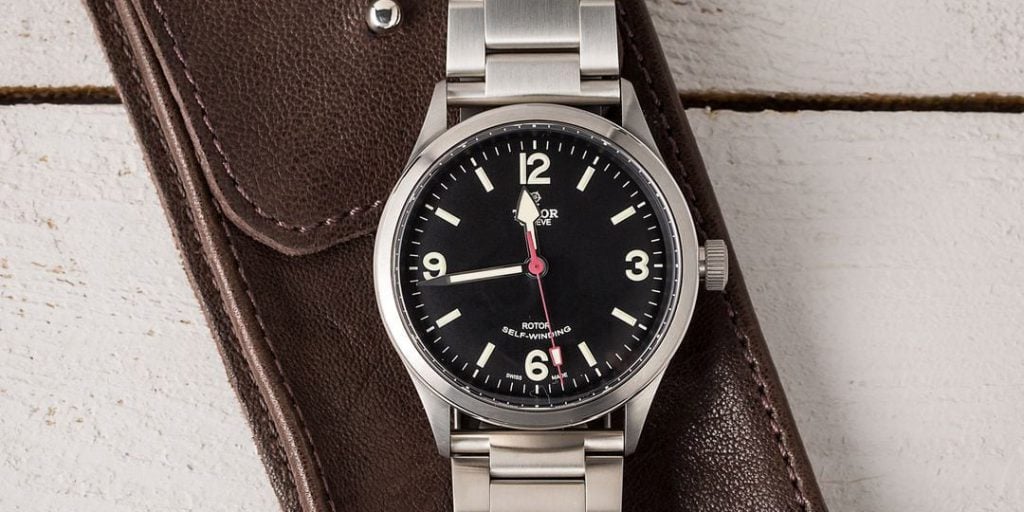
The Tudor Ranger is the best luxury field watch under $5,000 and the natural step up for anyone who loves the style but wants a movement built in house. Tudor’s MT5402 is a certified chronometer with a power reserve of 70 hours and a reputation for running well inside its official accuracy rating. The Ranger name dates to 1967, when Tudor built rugged exploration watches under the same crown as its sibling brand Rolex.
The current 39mm model, introduced in 2022, keeps the matte black dial, painted numerals, and burgundy accented seconds hand of the vintage pieces while adding a domed sapphire crystal and 100 meters of water resistance. There is no date window to interrupt the dial, a purist choice. Owners sometimes wish for more lume and a quick adjust clasp on the fabric strap option, which i’ve pointed out in our Tudor Ranger review as minor points on a watch this complete. On the secondary market, clean examples trade below retail, which makes a pre-owned Ranger one of the strongest values in luxury watches.
Pros
- In house COSC certified movement with a 70 hour reserve
- Heritage design executed with modern build quality
- Versatile 39mm sizing
- Strong value pre-owned
Cons
- No date, if you want one
- Lume is adequate rather than exceptional
- Bracelet clasp lacks tool free adjustment
Best Premium Field Watch: Rolex Explorer 124270
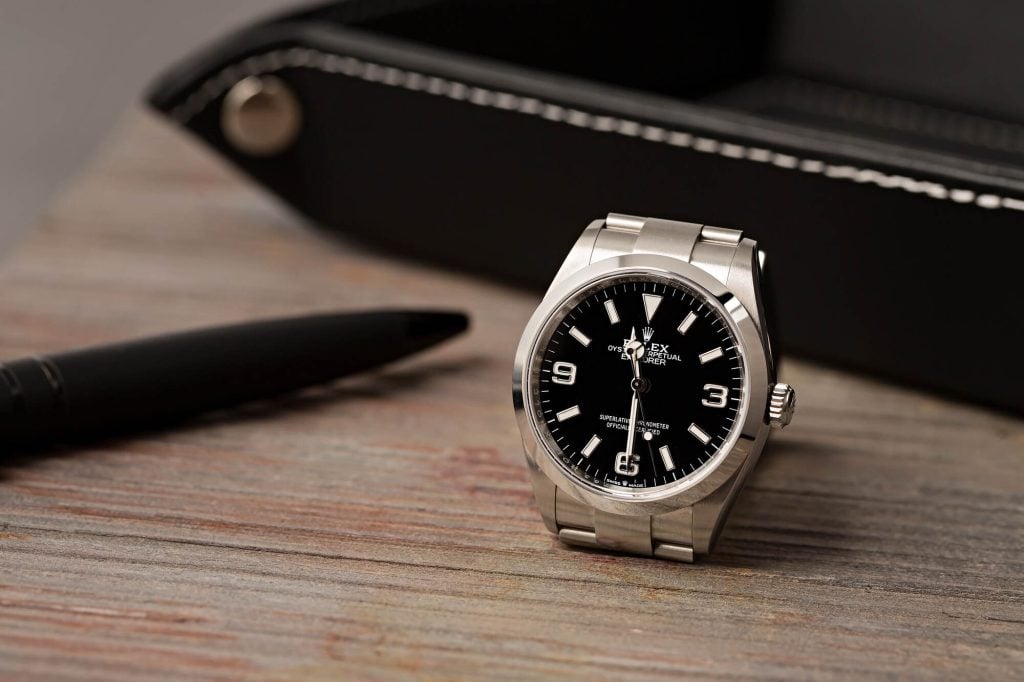
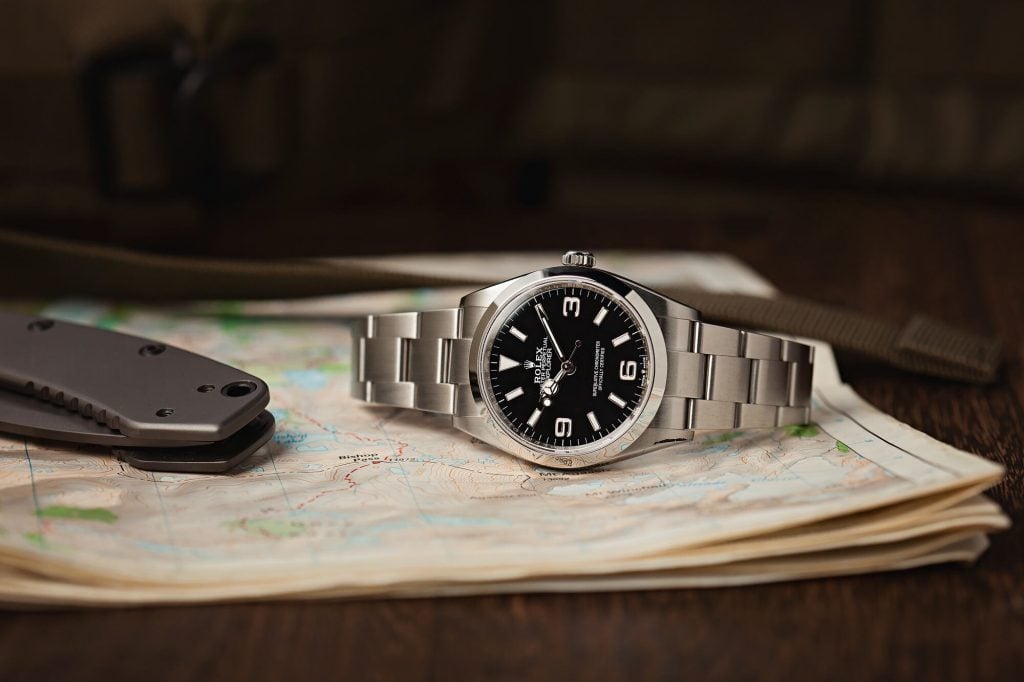
The Rolex Explorer is the finest field watch made, full stop. Rolex launched it in 1953, the same year Sir Edmund Hillary and Tenzing Norgay reached the summit of Everest on an expedition equipped with Rolex Oyster Perpetual watches, and the Explorer has carried that mountaineering identity ever since. The black dial with 3, 6, and 9 numerals is among the most recognizable designs in watchmaking.
The current 36mm reference 124270 runs the Caliber 3230, certified by Rolex as a Superlative Chronometer accurate to within plus or minus 2 seconds per day, roughly triple the COSC standard. Chromalight lume glows blue for hours, the Oystersteel case shrugs off corrosion, and the bracelet includes the Easylink extension for quick fit adjustments. Retail availability is limited, with waitlists common at authorized dealers, which is why many buyers turn to the pre-owned market, where Explorers are available immediately and hold their value as well as almost any watch in the world.
Pros
- Superlative Chronometer accuracy of plus or minus 2 seconds per day
- Legendary durability proven on expeditions for 70 years
- Exceptional resale value
- Timeless 36mm design that fits any setting
Cons
- Difficult to buy at retail
- Priced far beyond its function as a tool
- Too valuable for many owners to actually wear in the field
Toughest Digital Alternative: Casio G-Shock DW5600
The Casio G-Shock DW5600 is not a field watch in the traditional sense, but it is the watch most commonly seen on the wrists of actual service members today. Its shock resistant construction survives drops, impacts, and vibration that would destroy a mechanical watch, and the 200 meter water resistance covers anything short of professional diving.
The square case design has barely changed since the 1980s because it does not need to. You get an alarm, stopwatch, backlight, and a battery that lasts years, all for around $70. It lacks the analog charm and heritage that define the category, which is why it sits here as an honorable mention rather than in the rankings. As a pure instrument, nothing on this list survives more abuse.
Pros
- Nearly indestructible shock resistant build
- 200m water resistance
- Alarm, stopwatch, and backlight included
- Widely worn by military personnel worldwide
Cons
- Digital display lacks field watch character
- Plastic case and strap
- Sits tall on the wrist
How to Choose the Best Field Watch: Buyer’s Guide
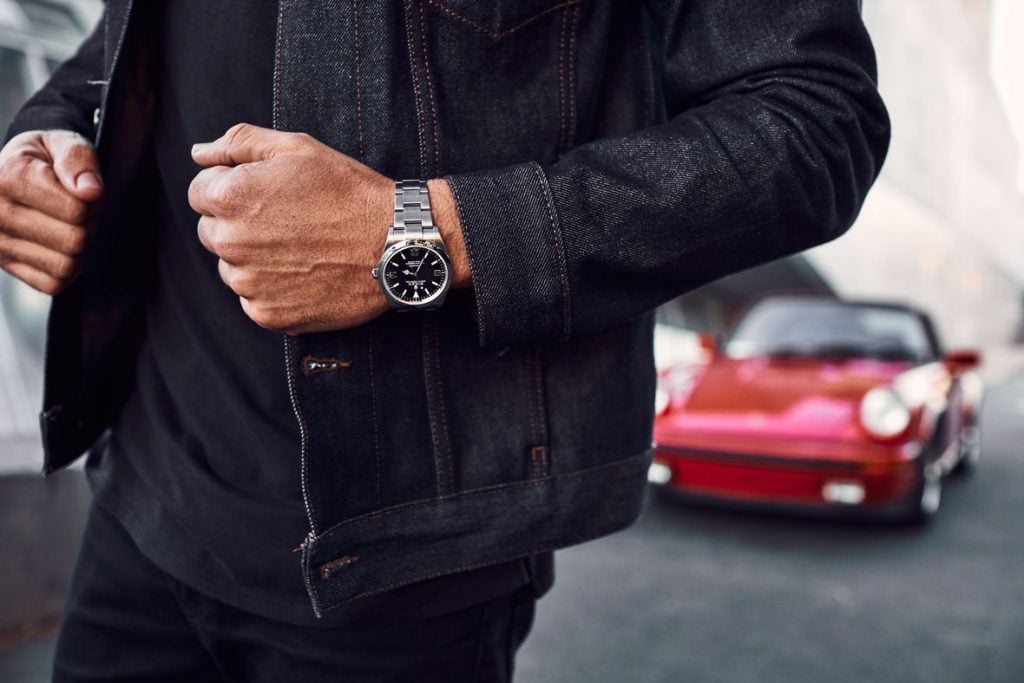
Five factors determine which field watch is right for you: movement type, case size, durability features, strap, and budget. Work through each one below and you will know exactly what to buy by the end of this section.
Movement: Quartz vs. Automatic vs. Solar
Quartz is the most accurate and affordable option, automatic offers mechanical craftsmanship without batteries, and solar combines quartz accuracy with power that never runs out. There is no wrong answer, only a question of what you value.
| Movement Type | Pros | Cons | Typical Price | Best For |
| Quartz | Accurate to seconds per month, affordable, low maintenance | Battery changes every few years, less collectible | $50 to $500 | First watches, travel, hard daily use |
| Automatic | No battery, powered by wrist motion, traditional craftsmanship | Less accurate, needs service every 5 to 10 years, costs more | $250 to $10,000+ | Enthusiasts and collectors |
| Solar | Charges from any light, runs for months on a full charge, quartz accuracy | Capacitor eventually needs replacement, limited to quartz feel | $150 to $600 | Set it and forget it owners, travelers |
Case Size and Wearability
For most wrists, the ideal field watch case size is 36mm to 40mm. The style was born on watches even smaller than that, so field watches look correct at sizes that would feel undersized in a dive watch. If your wrist measures under 6.75 inches, favor the lower end of that range.
Lug to lug distance, the measurement from the tip of the top lugs to the tip of the bottom ones, matters more than diameter. A watch whose lug to lug span exceeds the width of your wrist will overhang and wear poorly no matter what the dial size says. Thickness counts too. Field watches under 12mm slide beneath a shirt cuff, which is part of what makes them such capable everyday watches.
Water Resistance, Crystal, and Lume
These three specifications determine how much real world abuse a field watch can absorb. Here is the short version of what to look for:
- Water resistance: 100 meters is the practical benchmark. It covers swimming, rain, and accidental submersion. 50 meters handles weather but not the pool, and 30 meters means splashes only.
- Sapphire crystal: the most scratch resistant option and worth prioritizing above $500.
- Mineral crystal: common under $500, more scratch prone.
- Acrylic crystal: scratches easily but resists shattering, and scratches polish out by hand.
- Super-LumiNova and similar paints: charge in light and glow for hours, with brightness fading through the night.
- Tritium tubes: glow continuously for 10 to 20 years without charging, found on Marathon and other military suppliers.
Straps: NATO, Leather, and Bracelets
The strap changes a field watch more than any other single element, and most models make swapping easy with standard lug widths. A quick tip when buying: look for drilled lugs or quick release spring bars, which let you change straps in seconds without tools.
- NATO and nylon: the traditional choice, secure even if a spring bar fails, and comfortable when wet
- Leather: dresses the watch up for the office, best kept away from water
- Steel bracelets: the most durable and versatile, though they add weight and cost
How Much Should You Spend on a Field Watch?
A fully capable field watch costs between $100 and $15,000, and spending more buys refinement rather than function. A lower priced quartz Timex will keep better time than a $7,950 Rolex Explorer, because quartz technology is simply more accurate than any mechanical movement. A Rolex Explorer, however, will retain value and likely appreciate. What higher budgets buy is craftsmanship, materials, heritage, and pride of ownership.
| Budget | What You Get |
| Under $100 | Reliable quartz watches with mineral crystals, like the Timex Expedition Scout |
| $100 to $500 | Sapphire crystals, titanium cases, solar movements, and entry automatics like the Seiko 5 Sports Field |
| $500 to $1,200 | Swiss automatic movements, 150m and up water resistance, refined finishing, and true military suppliers |
| $1,200 and up | Certified chronometers, movements built in house, precious case materials, and names like Tudor and Rolex |
A Brief History of Field Watches: From the Trenches to Today
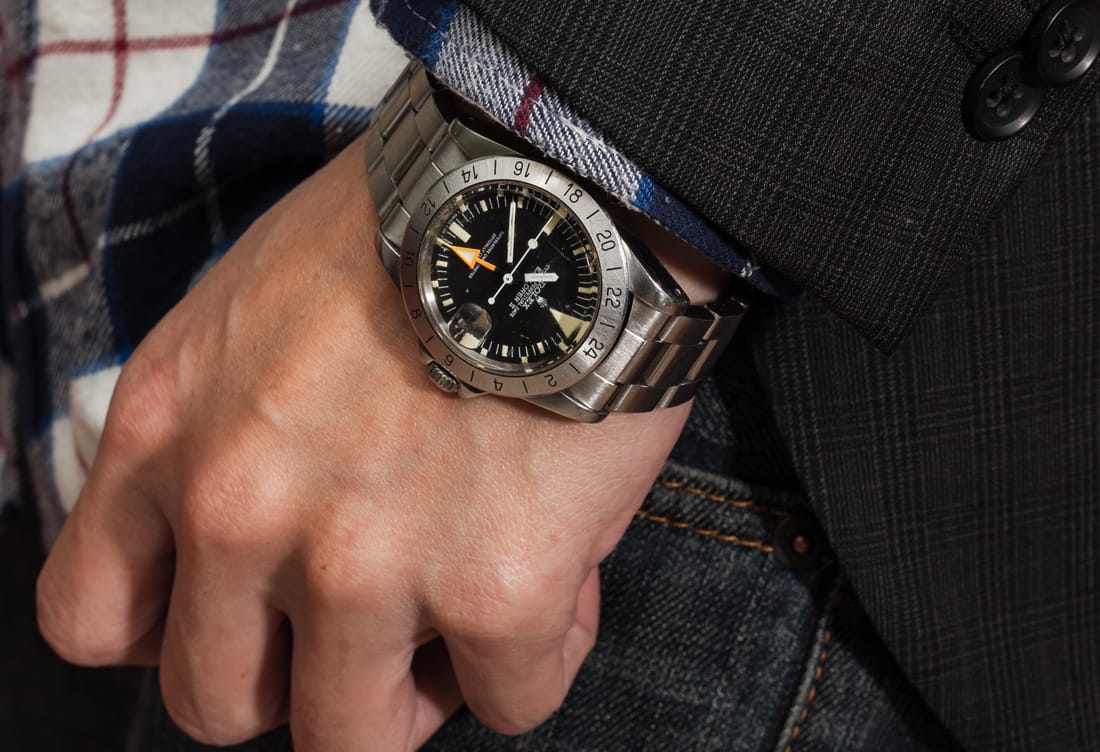
Field watches began in the trenches of World War I, when soldiers discovered that pulling a pocket watch out under fire was impractical. Officers began strapping small watches to their wrists, and manufacturers responded with purpose built trench watches featuring luminous dials and protective covers. The wristwatch, previously considered jewelry for women, became standard military equipment almost overnight.
World War II defined the category as we know it. The British Ministry of Defence commissioned twelve Swiss companies, later nicknamed the Dirty Dozen, to build watches to a single specification: black dial, luminous markers, railroad minute track, and a rugged waterproofed case. On the American side, Hamilton halted all civilian production and delivered more than one million timepieces to the war effort.
The Vietnam era brought disposable field watches built to United States military specifications by Hamilton, Benrus, and others, watches so simple and effective that brands still reissue them today. When soldiers came home, they kept wearing their watches, and civilians followed. The modern field watch, from a low priced Timex to a Rolex Explorer luxury watch, still follows the same brief written for soldiers a century ago: legible, tough, and dependable.
Field Watch vs. Pilot Watch vs. Dive Watch: What’s the Difference?
A field watch is built for legibility and durability on land, a pilot watch is built for reading time quickly in a cockpit, and a dive watch is built to survive deep water with a timing bezel for tracking air supply. The three styles share military roots but evolved to solve different problems.
| Style | Origin | Key Features | Typical Size | Best For |
| Field watch | Army, WWI and WWII | High contrast dial, 24 hour track, rugged strap, compact case | 36mm to 42mm | Everyday wear, travel, outdoors |
| Pilot watch | Aviation, early 1900s | Oversized numerals, large crown, sometimes a chronograph or slide rule | 40mm to 46mm | Bold styling, aviation heritage fans |
| Dive watch | Naval and sport diving, 1950s | Rotating timing bezel, 200m and up water resistance, screwed crown | 40mm to 44mm | Swimming, water sports, one watch collections |
Field and pilot watches overlap the most, since early aviator watches used the same legible dials as ground troops’ watches. If you find yourself drawn to both, several picks in this guide, like the Hamilton Khaki Field and the Vaer C4, borrow from each style.
How We Chose These Field Watches

We evaluated each watch against five criteria and weighted them equally: legibility, durability, movement quality, wearability, and value at its price point. Every specification listed in this guide, from case dimensions to water resistance ratings, was verified against manufacturer documentation rather than pulled from memory or secondhand listings.
Our team handles and photographs thousands of watches a year, which gives us a practical sense of how cases wear, how dials read in poor light, and which movements hold up over time. We also weighed the long term consensus of watch experts and online communities, where models like the Hamilton Khaki Field and Seiko 5 Sports Field have earned their reputations across years of ownership reports rather than launch week reviews. When a watch has a known weakness, such as the Marathon GPM’s 30 meter water resistance, we say so directly, because a recommendation you cannot trust is worthless.
Finding the Best Field Watch: My Final Thoughts
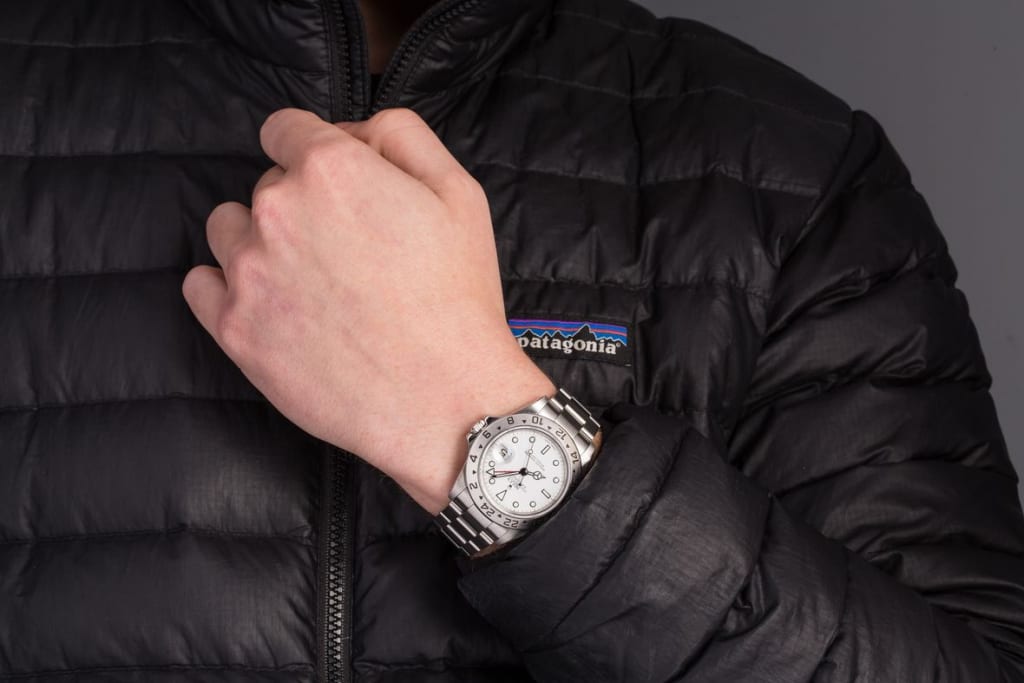
The best field watch for most people remains the Hamilton Khaki Field Mechanical, and the Timex Expedition Scout covers the same ground for a tenth of the price. Choosing the best field watch for you comes down to three decisions: pick the movement that fits your habits, pick a case size that fits your wrist, and pick the budget tier that fits your goals, whether that is a tool to wear hard or a piece to keep for decades.
Whichever direction you take, a field watch is one of the smartest purchases in watches. It is a buy it once tool that moves from the trail to the office without changing anything but the strap, and the design has stayed relevant for over a century because it was never about fashion in the first place. If the luxury end of the category appeals to you, explore our pre-owned Rolex Explorer and Tudor Ranger collections, where you can skip the waitlist and put a proven expedition watch on your wrist today.
Frequently Asked Questions
The post Best Field Watches for Everyday Wear, Travel, and Outdoor Use appeared first on Bob's Watches.