Bob's Watches Bob's Watches
The OMEGA Speedmaster ‘First OMEGA in Space’ is one of those watches that, in truth, doesn’t get the recognition it perhaps deserves. It’s based on the CK2998 that Wally Schirra wore into space on 3rd October 1962 and is a 39.7mm hand-wound chronograph with a very different look from the classic Moonwatch. In my view, that’s absolutely a good thing.
There are two modern versions to mention: the original 2012 reissue (powered by the Caliber 1861 and now available only pre-owned) and the 2024 relaunch, which features the Master Chronometer Caliber 3861.
I’ll say the quiet part first. In my opinion, the FOIS is the best-looking OMEGA Speedmaster the company currently makes, and I don’t think it’s close. I know there will be a fair number of Moonwatch fans who will absolutely disagree, and that’s perfectly fine. The 2024 model shares its movement with the current Moonwatch, but it has its own distinct character. So which FOIS would I actually buy? Is the newer one worth the premium over the original? Let’s get into it.
First OMEGA in Space Specifications
| Spec | 2024 First OMEGA in Space |
| References | 310.30.40.50.06.001 (bracelet), 310.32.40.50.06.001 (black leather), 310.32.40.50.06.002 (brown leather) |
| Case diameter | 39.7mm |
| Thickness | 13.4mm |
| Lug-to-lug | 48mm |
| Lug width | 19mm |
| Case | Polished and brushed stainless steel, symmetrical, straight lugs, no crown guards |
| Crystal | Domed sapphire in a Hesalite-style profile, OMEGA logo at center, anti-reflective coating inside |
| Dial | Sun-brushed grey-blue, stepped, recessed sub-dials, applied vintage-style OMEGA logo |
| Hands | Polished Alpha hour and minute hands, white chronograph seconds hand |
| Lume | Vintage-tone Super-LumiNova on hands and hour markers |
| Bezel | Black anodized aluminum tachymeter with the Dot Over Ninety |
| Movement | Calibre 3861, hand-wound, Co-Axial escapement, Master Chronometer (METAS) |
| Power reserve | 50 hours |
| Frequency | 21,600 vph (3 Hz) |
| Magnetic resistance | 15,000 gauss |
| Water resistance | 50m / 165 ft |
| Caseback | Solid steel, Seahorse medallion, engraved THE FIRST OMEGA IN SPACE and OCTOBER 3, 1962; not numbered |
| Bracelet or strap | Flat-link steel bracelet with comfort-release adjustment (approx. 133g); black or brown leather on a pin buckle (approx. 79g) |
| Current retail | $8,900 on bracelet, $8,500 on leather (OMEGA US, as of November 2026) |
Retail figures are from OMEGA’s official First OMEGA in Space page. The rest is from OMEGA’s published spec sheet and their October 2024 launch coverage.
Who wore the first OMEGA in space, and when?

Wally Schirra wore the first OMEGA in space on 3rd October 1962 on the Sigma 7 (Mercury-Atlas 8) flight of the Mercury program. The watch on his wrist was a Speedmaster CK2998, which he’d bought for himself. NASA didn’t qualify the Speedmaster for flight until 1965, so Schirra was wearing it three years before it became flight equipment.
That’s the one thing that makes me prefer this watch to the OMEGA Moonwatch. The Moonwatch story is a government test program to pick a winner. The FOIS story is a pilot choosing a chronograph the way you or I would, with our own money, and then taking it round the world six times on a flight that lasted just over nine hours. (Schirra, for the record, is the only astronaut to have flown Mercury, Gemini and Apollo. He had a real feel for missions too.)
The CK2998 was the second-generation Speedmaster, launched in 1959. It featured a symmetrical case, straight lugs, no crown guards, slim Alpha hands instead of the Broad Arrows from the 1957 model, and the first black tach on a Speedmaster. It housed Caliber 321. It’s a pre-Moon watch in collector’s terms, as it predates both the NASA testing and the caseback text with the Moon landing.
Shop This Article


2012 FOIS vs. 2024 FOIS: What Actually Changed
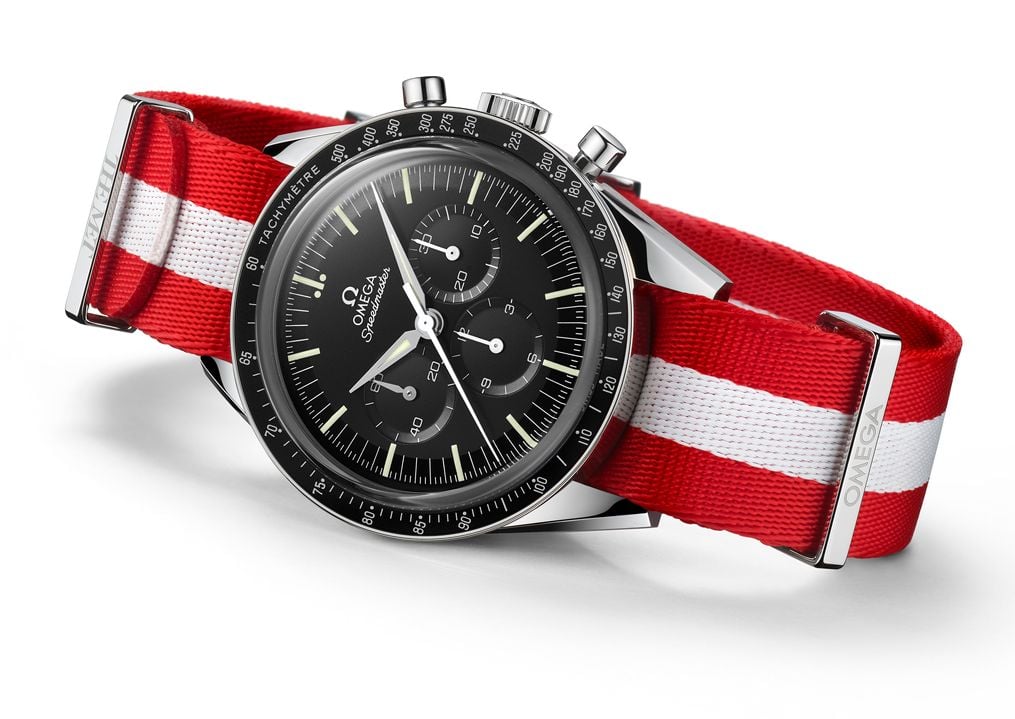
The 2024 FOIS is the better watch, and I’d actually pay the extra for it over the 2012, even though the 2012 is the cheaper way to get into the same case. They’re both 39.7mm in diameter, have 19mm lugs, sapphire crystal, and a Seahorse caseback. That’s about where the similarity ends.
Some background. OMEGA introduced the original FOIS (ref. 311.32.40.30.01.001) at Baselworld 2012 to mark the 50th anniversary of Schirra’s flight. It was an individually numbered edition, not a fixed-run limited edition with an edition number on the caseback. It was available only on a leather strap. Production effectively ceased around the end of 2020. The relaunch came on October 3rd 2024 (the 62nd anniversary of the flight) as a regular collection watch without numbering.
| Feature | 2012 FOIS (311.32.40.30.01.001) | 2024 FOIS (310.30.40.50.06.001) |
| Movement | Caliber 1861, hand-wound, 48-hour reserve | Caliber 3861, Co-Axial Master Chronometer, 50-hour reserve |
| Thickness | 14.0mm | 13.4mm |
| Dial | Matte black | Sun-brushed grey-blue, stepped, recessed sub-dials |
| Lume | White | Vintage-tone Super-LumiNova |
| Crystal | Tall, flat-topped sapphire | Domed sapphire shaped like Hesalite, logo at center |
| Bracelet or strap | Leather strap only, 19mm | Flat-link steel bracelet, or black or brown leather |
| Caseback | Numbered edition | Not numbered |
| Status | Discontinued, pre-owned only | Current production |
| Launch retail | $5,300 | $7,500 on leather, $7,900 on bracelet (October 2024) |
The real difference is in the movement. The 1861 is a very good movement, a Lemania-derived movement that flew on Apollo, but it lacks the modern anti-magnetic properties or the Master Chronometer certification of the 3861. The 3861 is METAS-certified, immune to 15,000 gauss, and features a silicon hairspring and a Co-Axial escapement. It also has the stop-seconds function on the FOIS. Smae winding procedure, same cam-actuated pusher, just a lot more modern underneath. If you’ve ever had a hand-wound Speedmaster get magnetized by a laptop lid, you’ll know which column you’re after.
The dial is where the argument lies. The 2012 is matte black with white lume, and it’s a classic Professional that’s just shrunk in the wash. The 2024 dial is CVD grey-blue, looks black in pretty much all light, and only shows its color at a certain angle. It has sunken sub-dials and a stepped edge that the 2012 absolutely doesn’t have. I’m not a fan of fake patina in general. I’ve come to accept it here, as it’s very restrained, and the watch is quite clearly playing the 1962 card. If you can’t get past it, then nothing I say is going to help, and the 2012 is right there.
The bracelet is the real winner, and a significant one. The 2012 came out on leather with no factory bracelet option, so if you wanted steel, you had to go to a third party. The 2024 bracelet is a proper flat link with brushed centers, polished outer links, and a clasp with a comfort-release adjustment. The 2024 case has a much softer bevel on the lugs, a larger crown and pushers (again, much closer to the CK2998), and the crystal dome finally has the Hesalite profile with sapphire-level scratch resistance.
So, which one? The original 2012 First OMEGA in Space is clearly the one to go for if you’re after a black dial, white lume, and a numbered caseback (that’s its only real selling point in my book). The 2024 FOIS, on the flat-link bracelet or a leather strap, is the one I’d choose in most cases (the 3861 and the bracelet being the strongest cases). For a pre-owned one, always check the original sale date and the paperwork to see if any OMEGA warranty remains.
FOIS vs. Moonwatch: Same Movement, Different Watch

The 2024 FOIS and the Speedmaster Moonwatch Professional run the same Caliber 3861 and share the same 50m water resistance. Everything you see and touch is different: a 39.7mm symmetrical case against a 42mm asymmetrical one, straight lugs against twisted lugs with crown guards, a grey-blue dial with Alpha hands against a black step dial with white batons.
| Feature | 2024 FOIS | Moonwatch 3861 (310.30.42.50.01.001) |
| Case diameter | 39.7mm | 42mm |
| Lug-to-lug | 48mm | 47.5mm |
| Thickness | 13.4mm | 13.2mm with Hesalite |
| Lug width | 19mm | 20mm |
| Case shape | Symmetrical, straight lugs, no crown guards | Asymmetrical, twisted lugs, crown guards |
| Crystal | Domed sapphire | Hesalite (sapphire on ref. 310.30.42.50.01.002) |
| Dial and hands | Grey-blue, Alpha hands, vintage-tone lume | Black step dial, white baton hands, white lume |
| Movement | Calibre 3861 | Calibre 3861 |
| Caseback | Seahorse, THE FIRST OMEGA IN SPACE | Seahorse, THE FIRST WATCH WORN ON THE MOON |
| Current retail on bracelet | $8,900 | $7,800 |
The number that surprises people is lug-to-lug. The FOIS gives up 2.3mm of diameter to the Moonwatch and claws back only half a millimeter in length, because straight lugs run out flat instead of curving down the way twisted lugs do. So the FOIS covers nearly the same stretch of wrist, top to bottom, while the dial itself looks a size smaller. If you tried a Moonwatch and found it long, the FOIS may not fix that, given its similar lug-to-lug length. If you found it wide, it will. (This is the single most useful thing I can tell you about the watch, and almost nobody mentions it.)
Two smaller things. The 19mm lug width narrows your strap choices compared with 20mm, though OMEGA’s own bracelet and both leather options cover the obvious bases. And there’s no Hesalite FOIS. It’s sapphire only, domed to look the part, which I think is the right call for a watch most owners will wear more than they’ll fuss over.
Then there’s the story each caseback tells. The Moonwatch is the NASA-qualified lineage, the one that went to the lunar surface. The FOIS is the watch from before any of that, when the Speedmaster was a racing chronograph that one astronaut happened to trust. My advice runs against my own taste: if you own neither, I’d still send most first-timers to the Moonwatch, because it’s the one everybody recognizes and it’s cheaper at retail. If you already own a Moonwatch, the FOIS is the rare second Speedmaster that doesn’t feel like buying the same watch twice.
First OMEGA in Space Price: Current Retail vs. Pre-Pwned
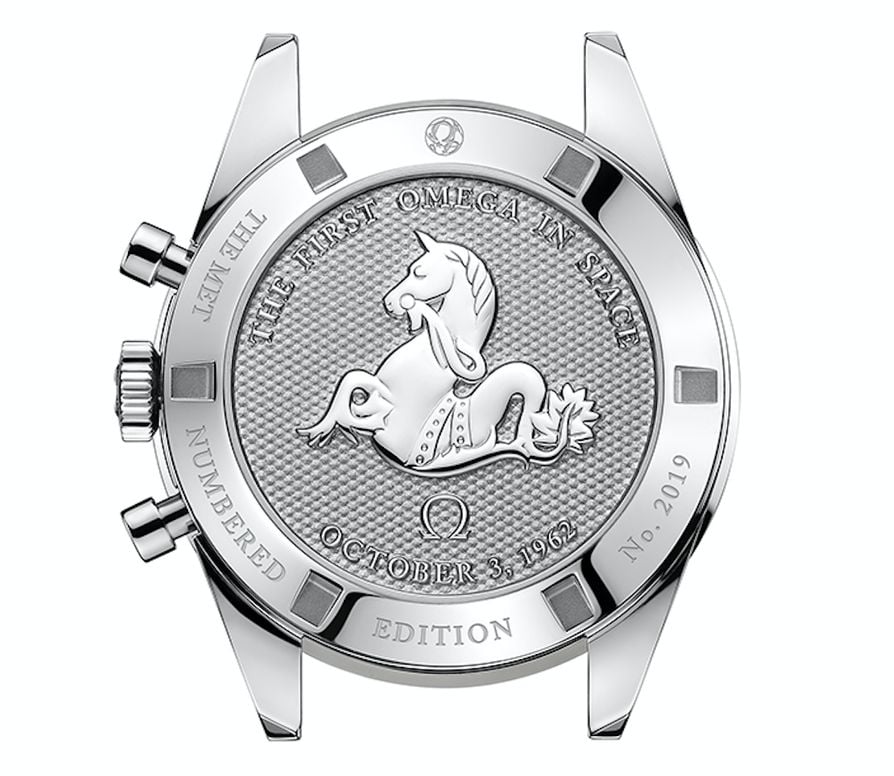
At current retail, the FOIS costs more than a Hesalite Moonwatch and a touch less than a sapphire one. Pre-owned is where it gets interesting, and the table shows what each sold for at Bob’s Watches this year.
| Model | Current retail (OMEGA US, Nov 2026) | Bob’s pre-owned range (Jan to Nov 2026) |
| 2024 FOIS, flat-link bracelet | $8,900 | $7,495 to $7,695 |
| 2024 FOIS, leather strap | $8,500 | $7,895 to $8,295 |
| 2012 FOIS, leather strap | Discontinued | $5,695 to $5,995 |
| Moonwatch 3861, Hesalite, bracelet | $7,800 | $5,595 to $6,995 |
| Moonwatch 3861, sapphire, bracelet | $9,000 | $6,595 to $7,695 |
Pre-owned figures are based on completed Bob’s Watches transactions from January 1 through November 18, 2026. Each is an individual watch with its own production year, condition, and accessories, so read the ranges as our observed selling prices, not a guaranteed resale value or a quote.
Three things I take from that table. In our sample, the 2024 FOIS sold closer to its retail price than the Hesalite Moonwatch did. That looks encouraging, though a handful of sales cannot tell us how overall demand has changed since launch. Our leather-strap examples happened to bring more than the bracelet ones, which runs against the usual Speedmaster pattern. I’d check the condition, production year, accessories, and sample size before reading too much into it. And our 2012 FOIS examples sold above the model’s old retail price of about $5,300. That’s an interesting comparison for a stainless steel OMEGA watch, though not proof that an original owner made a profit after inflation and selling costs.
On value more broadly: the FOIS is generally considered a strong holder among stainless steel Speedmasters, and certain references, the discontinued 2012 in particular, may appreciate as complete sets get harder to find. None of that is a promise. Condition, box and papers, service history, and plain demand decide what any single watch brings, and no model guarantees a profit.
“The First OMEGA in Space is a great example of how two generations of the same watch can appeal to very different collectors. The discontinued 2012 model offers an attractive entry point into the Speedmaster’s early history, while the 2024 edition combines that heritage with modern watchmaking technology. From a pre-owned buying perspective, we always encourage customers to look beyond price and consider condition, originality, service history, and completeness. Those details can make a meaningful difference in both the ownership experience and long-term value.”
Carol Altieri, COO, Bob’s Watches
Which One Should You Buy?

Buy the 2024 FOIS if you want the CK2998 look with a current movement and potentially remaining manufacturer warranty coverage, and you can live with sapphire and vintage-tone lume. To my eye, it’s OMEGA’s most convincing modern tribute to the Schirra watch, and the factory bracelet alone fixes the biggest complaint about the first one. This is the one I’d buy.
Buy the 2012 FOIS if the black dial and white lume matter more to you than the 3861, or if the pre-owned gap between the two is the difference between buying now and waiting another year. You give up the 3861’s anti-magnetic performance, the stop-seconds feature, the factory bracelet option, and the prospect of remaining original manufacturer warranty coverage. You get a numbered caseback and a watch OMEGA no longer makes, and I understand the appeal of both.
Buy the Moonwatch if you want the NASA story, the Hesalite option, 20mm lugs, and a lower retail price. It’s wider but a touch shorter lug-to-lug than the FOIS, and it’s the one most people picture when they hear the word Speedmaster.
Here’s the thing about the FOIS, though. For 60-odd years, the Speedmaster’s reputation has rested on a test NASA ran in 1965. The watch Schirra wore passed a different test three years earlier: a pilot with his own money chose it. That’s a quieter credential, and it’s the one this watch wears on its caseback. If that’s the story you’d rather tell, you already know which Speedmaster to buy. Both generations, and the rest of the family, are in our pre-owned Omega Speedmaster collection.
Frequently Asked Questions
The post OMEGA Speedmaster First OMEGA in Space: 2024 vs. 2012 vs. Moonwatch appeared first on Bob's Watches.