Bob's Watches Bob's Watches
The history of Vacheron Constantin begins in 1755, making it the world’s oldest watch manufacturer in continuous operation, with an unbroken record of production that now stretches across more than 270 years. A member of watchmaking’s “Holy Trinity” alongside Patek Philippe and Audemars Piguet, the Maison is celebrated for its technical innovation and for hand finishing so exacting that many of its movements carry the Geneva Seal. In that time it has survived a revolution, a depression, and the quartz crisis, all while producing some of the most complicated watches ever made, a story that runs from a 24 year old Geneva watchmaker named Jean-Marc Vacheron through the partnership that gave the brand its name to the record setting complications it builds today.
Key Takeaways
- Vacheron Constantin was founded in 1755 by Jean-Marc Vacheron in Geneva, a full 150 years before Rolex was established in 1905.
- François Constantin joined the company in 1819, giving the brand its name and its famous motto: “Do better if possible, and that is always possible.”
- Technical director Georges-Auguste Leschot introduced the pantograph in 1839, a machine that standardized watch parts and changed the industry.
- Vacheron Constantin is a member of the “Holy Trinity” of watchmaking, alongside Patek Philippe and Audemars Piguet.
- The brand created the two most complicated watches in the world: the Reference 57260 with 57 complications in 2015, and the Les Cabinotiers Berkley Grand Complication with 63 complications in 2024.
- The Richemont Group has owned Vacheron Constantin since 1996.
From a small attic workshop during the Age of Enlightenment to a modern manufacture shaped like its own Maltese Cross emblem, Vacheron Constantin has earned its position at the top of fine watchmaking one generation at a time. Here is how it happened.
Vacheron Constantin History at a Glance: Key Dates and Milestones
The timeline below covers the most important moments in Vacheron Constantin’s history, from its founding in 1755 to the present day.
| Year | Milestone |
| 1755 | Jean-Marc Vacheron founds his workshop in Geneva and signs his first apprentice |
| 1770 | The company produces its first complicated watch |
| 1779 | First guilloché dials appear on Vacheron watches |
| 1785 | Abraham Vacheron, son of the founder, takes over the business |
| 1810 | Jacques-Barthélémi Vacheron leads the firm and expands exports to France and Italy |
| 1819 | François Constantin becomes a partner and writes the company motto |
| 1839 | Georges-Auguste Leschot joins and develops the pantograph |
| 1844 | The pantograph earns the Prix de la Rive from the Arts Society of Geneva |
| 1880 | The Maltese Cross is registered as the official trademark |
| 1887 | A Vacheron & Constantin watch is placed inside Fabergé’s Third Imperial Egg |
| 1906 | The first boutique opens on the Quai de l’Île in Geneva |
| 1921 | The American driving watch debuts with its angled dial |
| 1929 | A grand complication pocket watch is delivered to King Fuad I of Egypt |
| 1955 | Calibre 1003 becomes the thinnest manually wound movement at 1.64mm |
| 1977 | The 222 launches to celebrate the brand’s 222nd anniversary |
| 1996 | Richemont acquires the company and the Overseas collection debuts |
| 2015 | Reference 57260 sets a record with 57 complications |
| 2024 | The Les Cabinotiers Berkley Grand Complication raises the record to 63 complications |
Who Founded Vacheron Constantin?

Vacheron Constantin was founded by Jean-Marc Vacheron, a Geneva watchmaker who was just 24 years old when he set up his own workshop in 1755. The founding document still exists. It is an apprenticeship contract signed that year, in which Vacheron agreed to train a young apprentice in the craft. That contract marks the official starting point of a company that has never stopped producing watches since.
The son of a weaver, Jean-Marc Vacheron built his reputation in a city that was becoming the center of European watchmaking. Geneva’s craftsmen, known as cabinotiers, worked in bright attic workshops and served a clientele shaped by the ideas of the Enlightenment, the world of Rousseau and Voltaire. Vacheron produced a small number of watches under his own name, and his earliest known piece, a pocket watch from around 1755, remains in the brand’s heritage collection today. In 1770 the workshop produced its first complicated watch, an early sign of the technical ambition that would come to define the company.
Abraham Vacheron and the Expansion of Complications (1785)
Leadership passed to the founder’s son, Abraham Vacheron, in 1785. Building on the firm’s first complication of 1770, the workshop under his direction deepened its work on complicated pocket watches and took its place among the early specialists in the field. These pieces laid the groundwork for the technical reputation the company still holds.
Abraham also steered the firm through one of the most difficult periods in its history. France annexed Geneva in 1798 during the aftermath of the French Revolution, and the city remained under French control until 1813. Demand for luxury goods collapsed, and many workshops closed. The Vacheron family kept the business running through the entire period, preserving the unbroken record of production that sets the company apart to this day.
The Constantin Era: A Partnership That Named the Maison

The third generation brought the company onto the world stage. Jacques-Barthélémi Vacheron, grandson of the founder, took charge in 1810 and began exporting watches to France and Italy. His watches grew more ambitious as well, with musical repeaters and calendar complications joining the catalog. His most important decision, though, had nothing to do with movements or markets. It was a hire.
In 1819, businessman François Constantin joined the firm as a partner, and the company became Vacheron & Constantin. Constantin was a gifted salesman who spent much of his life on the road, opening markets across Europe and beyond. In a letter to Vacheron dated July 5, 1819, he wrote the phrase that became the company’s motto and remains so today:
“Do better if possible, and that is always possible.”
Constantin’s travels paid off in a big way across the Atlantic. The company began selling watches in the United States in 1832, making it one of the first Swiss watch brands to establish a presence in the American market. Wealthy landowners and industrialists joined a client list that already included European aristocracy, and the brand’s international reputation was set.
Georges-Auguste Leschot and the Pantograph (1839)
In 1839, Vacheron & Constantin hired Georges-Auguste Leschot as its technical director, and his impact reached far beyond a single company. Leschot developed the pantograph, a machine tool that could reproduce movement components with identical dimensions every time. Before his invention, every watch movement was a unique, handmade object. After it, watchmaking entered the era of the standardized calibre.
The pantograph changed the industry in three key ways:
- Interchangeable parts: Components could be swapped between movements of the same calibre, which made servicing and repair far more practical.
- Standardized calibres: Movements could be produced in series with consistent quality, the model the entire watch industry follows today.
- Precision at scale: The company could grow its output without lowering the hand finishing standards its clients expected.
The Arts Society of Geneva recognized the achievement in 1844, awarding Leschot the Prix de la Rive for the discovery of the greatest value to Genevan industry.
The Maltese Cross, Royal Patrons, and a Golden Age

François Constantin died in 1854, and Jacques-Barthélémi Vacheron followed in 1863. The founders’ work was complete, though, and the second half of the 19th century became a golden age for the Maison. Successive heirs guided the company as its watches collected prizes in observatory chronometer trials, the competitions that tested the finest movements of the era for accuracy.
In 1880, the company registered the Maltese Cross as its official trademark. The emblem was not chosen for military or religious reasons. Its shape resembles a small component fitted to the barrel cover in certain precision movements, a part that helped regulate the force of the mainspring. The symbol has appeared on every Vacheron Constantin watch since, and it stands for the technical precision the company built its name on. Other highlights from the period include:
- The Fabergé Third Imperial Egg (1887): A Vacheron & Constantin lady’s watch was set inside one of Fabergé’s imperial Easter eggs made for the Russian court.
- Gold medal at the Swiss National Exhibition (1887): The same year, the company restructured as a shareholder company and earned top honors for its work.
- The first boutique (1906): The Maison opened its first store on the Quai de l’Île in Geneva, a location it still occupies.
- The Packard repeater (1918): American automobile pioneer James Ward Packard purchased a quarter repeating pocket watch with a 20k gold case decorated with guilloché and engraving done by hand.
The luxury watches of this era showcased everything Geneva could offer. Enameled cases carried miniature paintings, including a famous pocket watch from around 1824 decorated with a map of Italy. Guilloché dials, elaborate bracelet watches for women, and heavily complicated movements rounded out a catalog built for royalty and the world’s wealthiest collectors.
Wristwatches, World Wars, and the Great Depression
The 20th century pushed watches from the pocket to the wrist, and Vacheron & Constantin adapted with style. In 1921, the company released a driving watch with a dial rotated at an angle, which let a driver read the time without taking a hand off the wheel. The design was decades ahead of its time, and the company revived it in 2008 as the Historiques American 1921, one of its most recognizable modern models.
Royal commissions continued through the era. In 1929, the Swiss colony in Egypt presented King Fuad I with a Vacheron & Constantin grand complication pocket watch featuring a chronograph, perpetual calendar, and minute repeater. A similar commission followed in 1935 for his son, the future King Farouk. The Great Depression hit shortly after, and while the company survived, it did not escape unharmed. Charles Constantin, a descendant of François, became the last member of either founding family to lead the firm. In 1940, businessman Georges Ketterer acquired control, opening a chapter that would carry the brand through the middle of the century.
Thin Records, the Quartz Crisis, and the 222

The decades after World War II tested every Swiss watchmaker, and Vacheron Constantin answered with some of its most creative work. The company set records for thinness, redesigned its identity, and eventually delivered its answer to the biggest trend in luxury watchmaking. This period shaped much of the brand’s modern catalog.
The 1940s and 1950s produced dress watches that collectors still chase today. Cases with teardrop lugs, a style known as Cornes de Vache, gave the watches an elegant profile that few rivals matched. In 1955, the company introduced the calibre 1003, the thinnest manually wound movement in the world at just 1.64mm. In 1970, under Jacques Ketterer, the company simplified its name to Vacheron Constantin, dropping the ampersand, and moved the Maltese Cross onto the dial. Creativity carried it through the early quartz years, including an asymmetrical model with an oval movement that earned the Diplôme du Prestige de la France in 1972.
The 222: Vacheron Constantin’s Answer to the Luxury Sports Watch (1977)
The 222 launched in 1977 to mark the company’s 222nd anniversary, and it remains one of the most important watches the Maison has ever produced. The luxury sports watch category was taking shape around it. Audemars Piguet had stunned the industry with the Royal Oak in 1972, and Patek Philippe followed with the Nautilus in 1976. Vacheron Constantin took its time, and the wait produced something distinct.
Designed by Jörg Hysek, who was only 23 years old at the time, the 222 paired an integrated bracelet with hexagonal links and a bezel with a notched, gear tooth edge. A small Maltese Cross sat at the lower corner of the case. The watch kept the company relevant through the worst of the quartz crisis, and its influence did not end there. It served as the direct ancestor of the Overseas collection, and the company brought it back in 2022 as the Historiques 222, a faithful tribute in yellow gold that became one of the most talked about releases of the year.
From Family Firm to Richemont: The Modern Era

Ownership changed twice in the modern era, and each transition strengthened the company. When Jacques Ketterer died in 1987 with no heir prepared to take over, Sheikh Ahmed Zaki Yamani, the former oil minister of Saudi Arabia, became the majority owner. The brand kept innovating under his watch. In 1992, it released the calibre 1755, the thinnest minute repeater movement in the world at 3.28mm, and its Métiers d’Art projects continued, including the 1994 Tribute to Mercator with retrograde displays shaped like a navigator’s dividers.
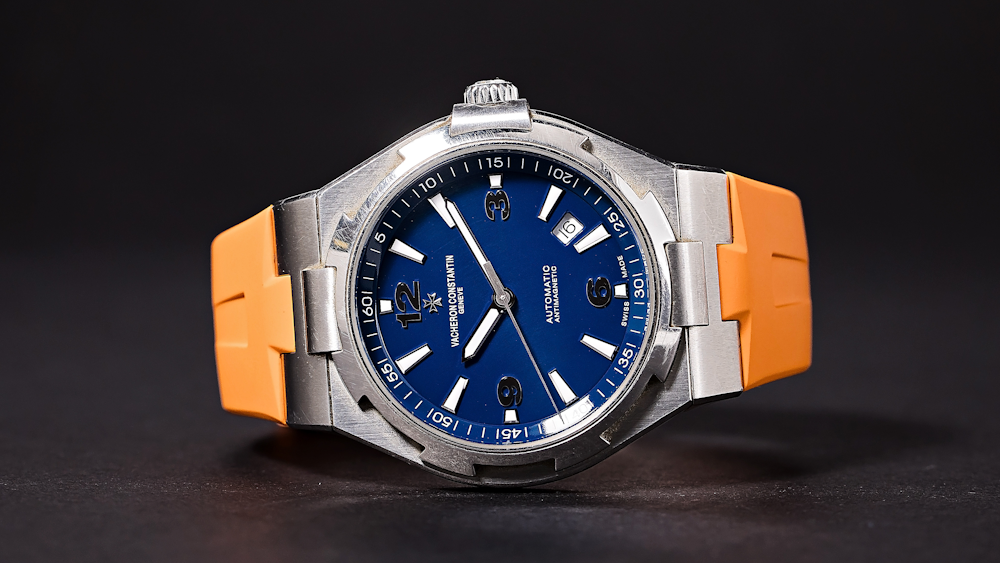
In 1996, the Richemont Group acquired Vacheron Constantin outright, placing it alongside Cartier, Jaeger-LeCoultre, IWC, and A. Lange & Söhne. The results came quickly. The Vacheron Constantin Overseas collection launched that same year, translating the spirit of the 222 into a bolder sports watch. The Patrimony collection arrived in 2004, drawing on the clean dress watch designs of the 1950s. That same year, the company opened its manufacture in Plan-les-Ouates outside Geneva, a building designed to resemble a sliced Maltese Cross.
Record Setting Complications: Reference 57260 and the Berkley Grand Complication
Vacheron Constantin currently holds the record for the most complicated watch ever made, and it broke its own previous record to do it. Both pieces came from Les Cabinotiers, the department that builds unique commissioned watches for individual clients, continuing a tradition that dates back to the royal orders of earlier centuries.
| Watch | Year | Complications |
| Reference 57260 | 2015 | 57 |
| Les Cabinotiers Berkley Grand Complication | 2024 | 63 |
The Reference 57260, a pocket watch completed in 2015 after eight years of work by three watchmakers, packed 57 complications into a single case. In 2024, the Berkley Grand Complication surpassed it with 63, including the first Chinese perpetual calendar ever built into a watch. Together, they prove the company’s inventive streak is as strong as it was in 1755.
What Makes Vacheron Constantin Special? The Holy Trinity and 270 Years of Continuity
Vacheron Constantin’s reputation rests on a combination of history, craft, and technical achievement that few brands can match. Several factors set the Maison apart:
- The oldest continuous manufacture in the world: Watch production has never stopped since 1755. Blancpain’s founding date of 1735 is older on paper, but its production history includes interruptions, which is why experts credit Vacheron Constantin with the longest unbroken record.
- Holy Trinity membership: Along with Patek Philippe and Audemars Piguet, Vacheron Constantin forms the group collectors call the Holy Trinity, the three houses regarded as the summit of traditional Swiss watchmaking.
- The Geneva Seal: Many of its movements carry the Poinçon de Genève, an independent certification with strict standards for finishing and craftsmanship.
- Métiers d’Art craftsmanship: The company maintains workshops for enameling, engraving, guilloché, and gem setting, arts it has practiced since the 18th century.
- Record setting complications: From early pocket watch complications to the 63 complication Berkley, the Maison has pushed technical limits for more than two centuries.
- A historic clientele: Kings, tsars, industrialists, and heads of state have worn its watches, from King Fuad I of Egypt to James Ward Packard.
What ties those points together is a level of hand finishing that machines alone cannot deliver. It is the part of a Vacheron Constantin that a spec sheet never captures, and the part our specialists point to first when a client asks what the money buys.
“While modern machinery cuts the raw components of a Vacheron Constantin movement to micrometer perfection, the touch of a master artisan who polishes microscopic bevels, engraves, and finishes every hidden bridge by hand transforms cold metal into wearable art.”
– Paul Altieri, Founder and CEO of Bob’s Watches
Each point on this list connects back to the company motto. Doing better when possible, over 270 years, is what separates a great watchmaker from a legendary one.
The Oldest Watch Manufacturer in the World: Why Vacheron Constantin’s Story Still Matters

The history of Vacheron Constantin reads like a history of watchmaking itself. A single workshop opened during the Enlightenment grew into a family dynasty, took on a partner whose name and motto still define it, industrialized precision without sacrificing artistry, and outlasted a revolution, a depression, and the quartz crisis. Few companies in any industry can claim 270 years of uninterrupted work, and none in watchmaking can.
That continuity is more than a talking point. It shapes what the company makes today. The Vacheron Constantin Historiques collection revives designs from its own archive, Les Cabinotiers builds one of a kind commissions the way the original cabinotiers did, and pieces like the Berkley Grand Complication carry the record setting spirit forward. For collectors, owning a Vacheron Constantin means owning a piece of the longest running story in watchmaking, one that is still being written. That heritage also holds its value on the secondary market, which is why owners looking to sell a Vacheron Constantin tend to find steady collector demand for the brand.
Frequently Asked Questions
The post Vacheron Constantin History: The World’s Oldest Watchmaker appeared first on Bob's Watches.