Bob's Watches Bob's Watches
After decades of steel sport watch domination in the watch market, Cartier has proven to be the prime beneficiary of the relatively recent pivot to classic, design-driven dress watches.
Among factors that are driving the Paris house’s current surge in popularity is its rapid adoption by younger generations, including Gen Z. Cartier has cultivated a fashion-conscious, heavily female social media following that has been especially responsive to smaller cases, leather straps, and the house’s iconic shaped watches.
The maison’s historic legacy in shaped watches broke the conventional round rules, from the rectilinear Deco lines of the Cartier Tank in all its iterations to the surrealistic amorphous Crash, which shattered the auction ceiling this spring with back-to-back record-breaking sales crossing the $2 million threshold. Rather than construct a case to fit around a selected movement, Cartier, for more than a century, starts with the design of the case first.
Regarded for harmonious case geometry and dial symmetry, the elegant Cartier aesthetic is not only timely but timeless, drawing a diverse audience ranging from fashionistas and trend-driven enthusiasts to hardcore collectors, who have come to recognize the veritable haute horlogerie of the limited Cartier Privé collection.
Approachable Pricing and Resale Resilience

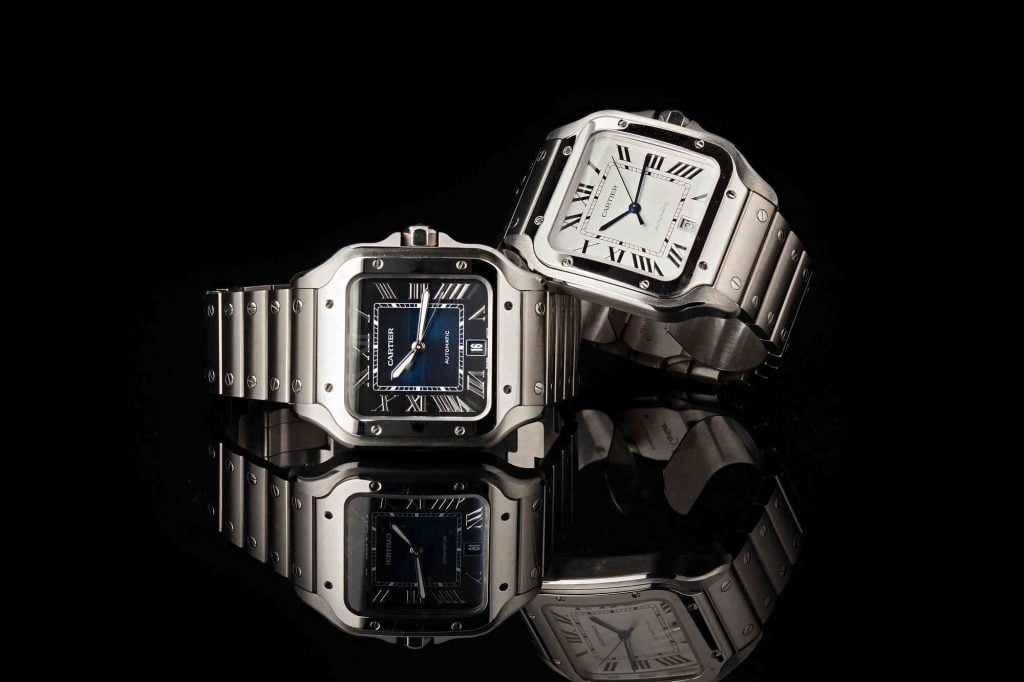
As supply constraints for popular models have plagued the broader Swiss industry, Cartier has benefitted from its strategy to maintain steady, controlled production numbers and carefully managed, relatively approachable pricing, even for newcomers to the watch market. An entry level Tank Must in stainless steel with a high-autonomy quartz movement starts at $3,750, while an entry level quartz Santos Dumont in steel goes for $4,050.
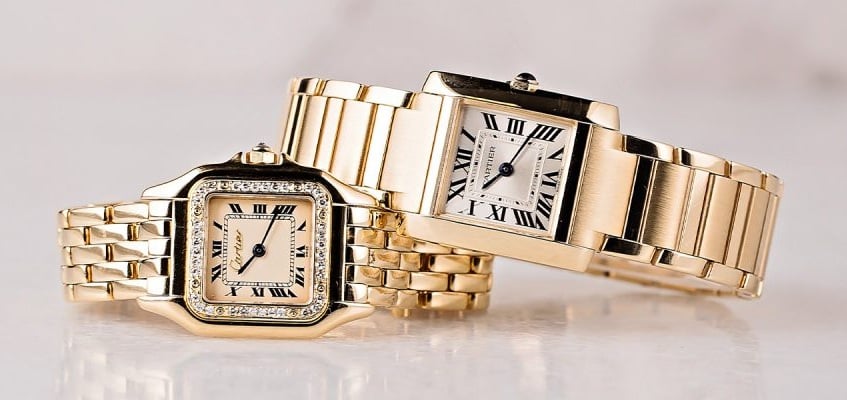
Naturally, retail scarcity of the most coveted models has caused a ripple effect in the secondary and vintage markets, where pre-owned Cartiers have proven remarkably resilient and have often appreciated in value. Popular models with deep historical roots – such as the Must de Cartier Tank, the two-tone Panthère, and the Santos Galbée – have seen resale values surge.
According to Bob’s Watches proprietary data, Cartier’s AOV has increased 36.5% over the last three years (from $4,800 in 2023 to $6,553 in 2026). Additionally, sales volume grew by 75% when comparing 2025 to 2024, with similar results expected in 2026.
By The Numbers
According to the Ninth Annual “Swiss Watcher” Report published in February by Morgan Stanley Research in collaboration with the Swiss luxury consulting firm LuxeConsult (headed by industry expert Oliver R. Müller), Cartier experienced a remarkable sales increase of an estimated CHF3.488 billion (approximately $4.37 billion) in 2025, expanding its total global retail market share for Swiss watches to 8.7%.
It’s important to note that this sales jump of more than 10% year-over-year was achieved while the Swiss watch industry at large significantly contracted with major cuts in overall unit export volumes and double-digit declines in mid-tier legacy brands such as Longines, Hamilton, Panerai, and Zenith, some of which contracted by 15% or more. In this dismal sales environment, Cartier actually managed to expand its global retail market share in Swiss watches to 8.7% by value, up .7% year over year and up 3% since 2019.
Such stellar results solidified Cartier’s ranking as the second largest Swiss brand in terms of retail sales after Rolex, which maintained its dominant first-place position with an incredible 32.9% global market share, an increase of 1% year over year. The report also projected that Rolex surpassed CHF11 billion (approximately $13.79 billion) in estimated wholesale sales for the first time in its history.
Pop Culture Pops
In a 1973 interview, famed pop artist and legendary watch collector Andy Warhol said: “I don’t wear a Tank watch to tell the time. In fact, I never wind it. I wear a Tank because it’s the watch to wear.” Warhol wore an 18-karat yellow gold Cartier Tank Louis, which he valued as a luxurious design object (and status symbol), much like a piece of jewelry, rather than a mechanical instrument.
Originally designed in 1917, taking inspiration from the overhead silhouette of a World War I Renault FT-17 military tank used on the Western Front, Cartier’s Tank wristwatch made its commercial launch in 1919 with a mere six pieces, which quickly sold out.
Today, the Tank is one of the most iconic watches in an industry rich with icons. As the Tank evolved into different interpretations over the decades, the contemporary version of the original goes by Tank Normale. For more than a century, Tanks of various styles have made their way on to the wrists of A-list celebrities, royalty, and artists, like Warhol.
And it’s not just Tanks that have made their mark in the cultural zeitgeist. Far bigger than Warhol, pop titan Taylor Swift and beau Travis Kelce announced their engagement last year with a viral Instagram photo of Swift wearing her neo-vintage yellow gold Cartier Santos Demoiselle with a diamond-set bezel, placing Cartier at the center of a pop cultural milestone moment and reaching a vast young audience, fueling demand for classic Cartiers.
A Legacy in Shaped Watches
In the early 1900s after he issued a royal warrant to the maison, King Edward VII of England famously hailed Cartier as “The jeweler of kings and the king of jewelers.” Cartier’s primary image as a jeweler is underscored by the domination of jewelry sales, which are estimated by equity analysts at about 65% of total sales.
In the late 20th century, connoisseur collectors snubbed the brand for using quartz and simple ETA supplied movements in what were marketed as luxury watches. When mechanical watchmaking experienced a revival in the late 1980s and ’90s following the decimation of the quartz crisis in the 1970s, elite collectors became obsessed with in-house-made, or manufacture, movements, which at the time, only a handful of brands were capable of producing.
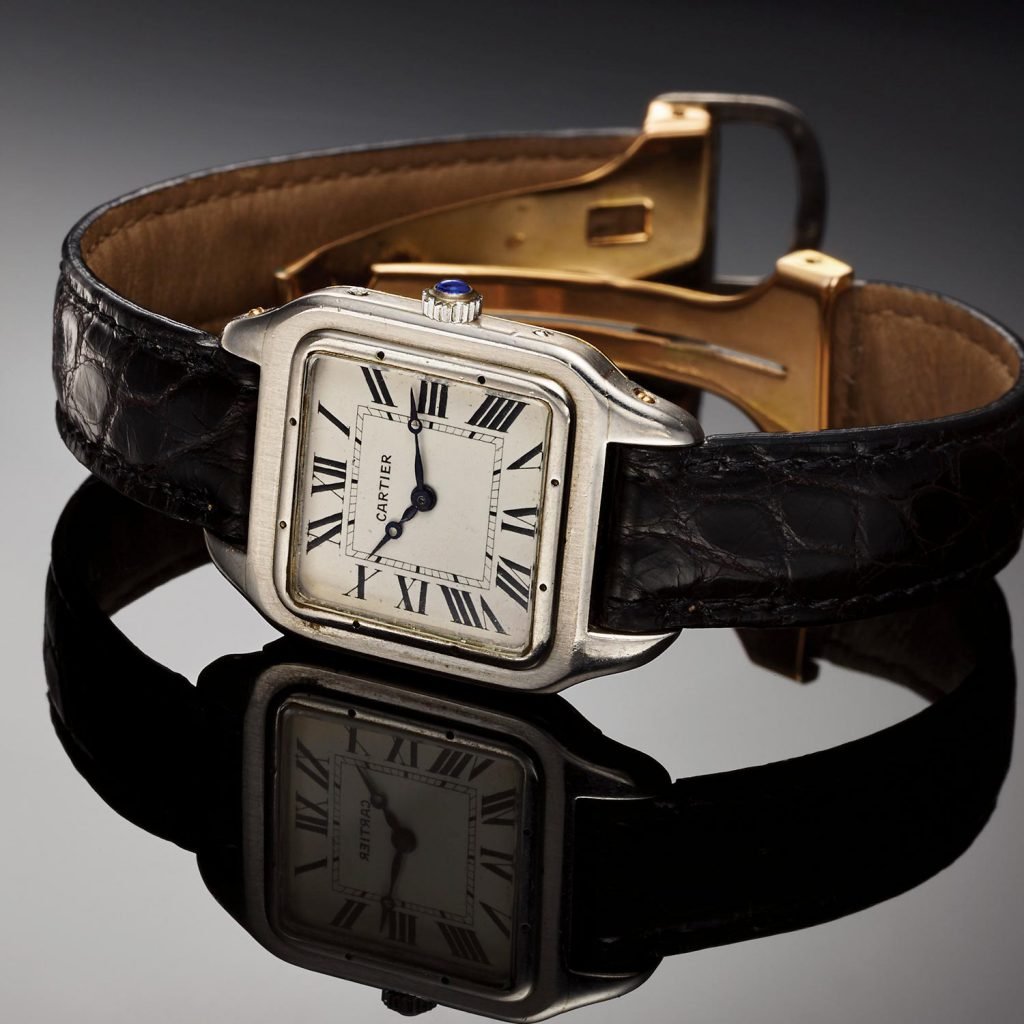
In 1998, Cartier launched a fine watchmaking initiative named Collection Privée Cartier Paris (CPCP) to overcome this reputational obstacle. CPCP revived historically significant archival designs, such as Tank Cintrée, Tortue, Tonneau, Cloche, Santos-Dumont, and Tank à Guichets, tapping into the illustrious heritage of it venerable shaped cases.
Cartier then matched them with complicated elite third-party Swiss movements from exceptional manufacturers, including Richemont sister brands Piaget and Jaeger-LeCoultre (which Richemont acquired in 2000), as well as some prominent movement specialists. Sapphire case backs revealed the finely finished movements, which drew praise even among skeptics.
As it evolved, the CPCP line expanded into ultra-complex tourbillons, perpetual calendars, and massive futuristic Cartier ID concept pieces that failed to catch fire among Cartier devotees. Consequently, CPCP was phased out in 2008 in a decision that predated the Great Recession. However, according to Sotheby’s, “For many collectors, Collection Privée Cartier Paris marked the beginning of modern Cartier scholarship and serious collector-driven demand.”
Privé Revival

In 2015, Cartier sought to re-tap that coveted collector market with the soft launch of the updated Cartier Privé line, which kicked off with a platinum skeletonized Crash, limited to only 67 pieces in a nod to the year 1967, when Crash emerged from Cartier London.
Two years later, Cartier Privé carried on the tradition of annual revivals of historic models, although highlighting only one archival shaped watch in precious metals per year in limited numbers, driving demand among the exploding contemporary collector base.
One important distinction between the original CPCP collection and the modern Cartier Privé pieces is that they are now powered by in-house-manufactured mechanical Cartier movements produced at the Manufacture de Haute Horlogerie Cartier in La Chaux-de-Fonds, located in the Canton of Neuchâtel.
Breaking the one-per-year mold for its 10th edition this year, Cartier Privé launched six new editions in two trios of seminal shapes.
In platinum with burgundy accents, the manually wound Cartier Privé – Les Opus (also referred to as the Trio Exceptionnel) includes a Tortue Chronographe Monopoussoir (limited to 200 pieces) powered by the shaped in-house 1928 MC monopusher chronograph movement launched in the 2024 Tortue; a Crash Squellete (limited to 150 pieces) powered by the new shaped manufacture 1967 MC caliber; and a Tank Normale (limited to 200 pieces) fitted with the elegant seven-row link bracelet introduced on the Privé Tank Normale in 2023.
Dubbed La Collection, the second trio, which is not limited, sticks to 18-karat yellow gold with manually-wound movements. It comprises a Tank Normale, a Cloche de Cartier, and a Tank Cintrée. Similarly, all three share a connecting aesthetic thread with golden dials, blued steel pomme hands and dark gray straps. Underscoring the importance of these shaped watches in the Privé collection, each solid gold case back is engraved with a stylized silhouette of the watch.
The Privé revival has served as an additional catalyst for Cartier among high-end purist collectors, producing a halo effect that is driving demand in both modern and vintage catalogs.
The post Why Cartier Watches Are Exploding in Popularity appeared first on Bob's Watches.